My name is Daniel. I’m fifty-four years old, and if you had told me ten years ago that the little girl who once begged me to braid her hair for school would one day stand at her own wedding and pretend I didn’t exist, I would have laughed. But that’s the funny thing about family. The people you give the most to often think they’re entitled to even more. And sometimes, they only remember your value when the credit card declines.

I met Grace when she was just nine, a shy, bright-eyed girl trying to navigate the messy aftermath of her parents’ divorce. Her mother, Olivia, and I were both survivors of our own marital shipwrecks, and we found a quiet harbor in each other. Grace’s biological father, Jeremy, was a ghost in her life—a man who would materialize twice a year with a guilt-laced check and a quick trip for ice cream before vanishing again for another six months.
I never tried to replace him. I simply showed up. I was there for the school plays, sitting in the front row with a trembling camcorder. I was there for the scraped knees, the late-night algebra homework, and the tearful drama of her first middle-school heartbreak. I showed up even when it was inconvenient, especially when it was inconvenient. Over time, the name she called me shifted. One day, after her eighth-grade graduation, she looked up at me, her face beaming, and said, “Thanks, Dad.” I’ll admit, I teared up. Olivia squeezed my hand, a silent acknowledgment of a bond that had grown organically, nurtured by consistency and care.
I paid for her braces. I helped her buy her first car—a safe, used Honda that I spent a month saving for. When she got into her dream college, I drove the U-Haul eight hours across three states and spent two sleepless nights assembling IKEA furniture in her dorm room. For a decade, I was there. Not because I had to be, but because I loved her as my own.
The shift began when she turned twenty. It was subtle at first. The “thank yous” became scarcer, the phone calls more transactional. Then, during her senior year of college, Jeremy reappeared, not as a fleeting visitor, but as a full-blown social media campaign. He’d apparently turned over a new leaf and reinvented himself. He began posting old photos of him and Grace, carefully cropping Olivia and me out of the frame, with gushing captions like, “So proud of my little girl!”
Grace drank it up like a woman dying of thirst. I didn’t blame her. Every child wants to be wanted by the parent who left. Still, I couldn’t shake the feeling of being pushed aside, of being the loyal substitute teacher who is dismissed the moment the permanent one decides to return.
Then came the engagement. She was thrilled, and I was genuinely happy for her. I remember her waving her hand, the new diamond catching the light, and I pulled her into a hug. “We’re so proud of you,” I said.
Grace smiled, but the warmth didn’t quite reach her eyes. “Thanks,” she replied. “I’m just so glad I’ll have both my parents there to walk me down the aisle.”
I blinked. Olivia glanced at me, a flicker of panic in her eyes, and cleared her throat. “You mean…” she began, but Grace cut her off, her voice bright and brittle.
“Of course, I mean Dad,” she said, and the way she said it made it clear she meant Jeremy. Not me. Not the man who taught her how to ride a bike or held her hand in the emergency room when she had appendicitis. I brushed it off. I told myself it was a sentimental moment, a young woman trying to build a bridge to a broken part of her past. I could respect that. I could step aside.
But the slights kept piling up. She started referring to Jeremy exclusively as “Dad” and to me as “Daniel” in public. She removed my last name from her social media bios, reverting to her birth surname. When I gently offered to help with wedding costs, she smiled, nodded, and then asked if I could front the $12,000 deposit for the venue. There was no mention of reimbursement, just a casual, entitled assumption that I would handle it.
I did. Not for her, but for Olivia, who I knew couldn’t bear to see her daughter’s dream day crumble. I felt myself becoming less of a father figure and more of an ATM with legs. Olivia saw it too and tried to intervene, but Grace would shut her down, accusing her of trying to “guilt trip” her for wanting her “real dad” in her life. That word, real, stung more than I ever let on.
A week before the wedding, I came home early and overheard them in the kitchen.
“He’s paid for almost everything, Grace,” Olivia said, her voice low but firm. “You can’t just pretend he doesn’t exist. He’s been more of a father to you than Jeremy ever was.”
Grace scoffed, the sound sharp and dismissive. “That was his choice. No one forced him to.”
“You used to call him Dad,” Olivia pressed.
“That was before I had a real one again,” she snapped.
I backed out of the house before they could see me. I didn’t say a word. I just got in my car and drove until the gas light came on.
The day of the wedding arrived, and I put on my best suit. I tied my tie three times before the knot was straight. I showed up early, helped the caterers, and fixed a problem with the sound system. Grace, in her cloud of white taffeta, barely acknowledged my existence. Jeremy arrived late, smelling of expensive cologne, and she squealed, running to hug him like a soldier returning from war. I stood back and watched, an extra in a movie I had fully funded.
During the ceremony, I sat next to Olivia, her hand cold in mine. When the officiant asked who gave this woman, Grace looped her arm through Jeremy’s and beamed. No mention of me. Not even a glance in our direction. At the reception, the father-daughter dance was, of course, with Jeremy. Her toast was a gushing tribute to her mother, her new in-laws, and “my incredible dad, Jeremy, who came back into my life at just the right moment.”
She never said my name. Not once.
I didn’t make a scene. I smiled. I shook hands. I toasted the happy couple. But inside, a slow, quiet fire was beginning to burn, consuming a decade’s worth of love and patience.
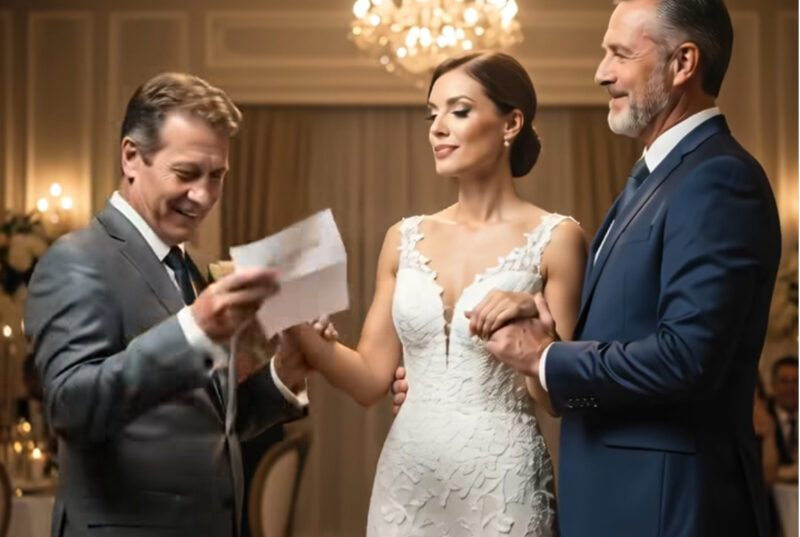
After the cake was cut, as the night was winding down, Grace finally approached me. She looked radiant and smug, holding a folded piece of paper. “The final balance,” she said cheerfully, as if we were settling a lunch tab. “Thought you’d want to take care of it before we fly out tomorrow.”
I unfolded the paper. It was a handwritten list of expenses, some of which I knew I had already paid, totaling a number that made my jaw tighten. I looked at her. She smiled, waiting for me to reach for my wallet, as I always had.
I didn’t.
I folded the paper, put it in my jacket pocket, and walked right past her, down the stairs, through the parking lot, and into the night without saying a single word.
I didn’t sleep that night. It wasn’t anger or hurt. It was something colder, quieter. A door had shut deep inside me, and I had no desire to ever open it again.
The next morning, I ignored the incessant buzzing of my phone. I sat in my home office and pulled out a binder labeled “Wedding Expenses.” Every receipt, every wire transfer, every invoice was neatly categorized. The total came to just under $38,000. I had paid for over eighty percent of the entire event. And that final “bill” she had handed me? It was a fabrication, an attempt to double-charge me, banking on the assumption that I was too sentimental or too much of a doormat to notice.
I spent that Sunday systematically dismantling my role as their benefactor. I filed disputes with every vendor I had paid directly, providing proof of payment. I froze the joint account I had set up with Olivia for wedding emergencies. Then, I sent Grace a single, simple text: I will no longer be responsible for any of your wedding costs. Any outstanding balance is between you and your biological father. Please direct all future communication through your mother.
I turned off my phone.
That night, Olivia and I had the conversation. She was heartbroken, not just by Grace’s cruelty, but by my silence. “I thought she’d come around,” she cried. “I thought once she saw everything you did for her…”
“She did see it, Olivia,” I said quietly. “She just didn’t care.”
The fallout was swift. Grace sent a long, self-pitying email, justifying her actions and calling me childish for “abandoning my responsibilities.” Then Jeremy, the man who had contributed nothing but his presence, left me a voicemail. “Man to man,” he said, his voice oozing false sincerity, “I think you overreacted. Girls and their dads, you know? She needed me, and I stepped up. Don’t punish her for choosing her real family.”
Stepped up. The audacity of it was breathtaking. I had stepped up when Grace was hospitalized at thirteen with appendicitis and Jeremy was “too busy.” I had stepped up when her financial aid fell through and she was too embarrassed to tell anyone. I had stepped up every single day for ten years.
That’s when I decided I wasn’t just going to walk away. I called my accountant and began dissolving the joint account. I updated my will, removing Grace as a beneficiary. I wrote a final, gentle letter to Olivia, explaining that I couldn’t keep pouring myself into a family that saw my love as a transaction. I left the letter on the counter and moved into a condo across town I had quietly purchased months earlier as a contingency plan. I suppose some part of me had known this day was coming.
A month passed in silence. Then, one afternoon, Olivia sent a text. She’s here. She wants to talk. Please, Daniel. She’s crying.
I drove to the house, my heart a cold, heavy stone. Grace was sitting on the living room couch, her eyes red and swollen. She stood when she saw me. “Daniel,” she began, but I raised a hand, silencing her.
“When you were thirteen,” I said, my voice even, “you begged me to come to your school’s father-daughter breakfast because Jeremy hadn’t texted in six months. I took the morning off work. You held my arm and told everyone I was your dad.”
She flinched. “I remember that,” she whispered.
“I remember everything, Grace. Because I was there for everything. You made me pay for a seat at a table I was never really invited to. You erased ten years of my life, and still expected me to pay for the napkins.”
“I didn’t mean for it to be like this,” she murmured. “I just got caught up in the idea of finally having my real dad around.”
Olivia stepped out of the hallway, her own eyes red. “Mom, tell him,” Grace pleaded, but Olivia just shook her head. “No, Grace. Not this time.”
For the first time, Grace seemed to realize she wouldn’t be rescued by sentiment or guilt. “I didn’t expect you to just disappear,” she said, her voice cracking.
“I didn’t disappear,” I replied. “I just stopped showing up for people who treat me like a utility. You made a choice at your wedding. I’m making one now.”
“What do I have to do to fix this?” she finally asked, the question a raw, trembling whisper.
I paused at the door, not looking back. “You start by not asking me to tell you,” I said, and walked out.
The next morning, the silence was absolute. No calls, no texts. Three days passed. Then, on the fourth day, my assistant buzzed me at my office. Grace was in the lobby. No appointment. I hesitated, then told her to send her in.
She walked in, stripped of her usual arrogance. In her hands was a thin folder. She sat across from me and slid it across the desk. Inside was a neatly typed document titled “Wedding Expense Reconciliation Report.”
“I went through everything,” she said quietly. “Every vendor, every transfer. I made a list of what you paid and what I owe you. I added interest. I broke it into a repayment plan.”
I looked at the document. The numbers were accurate. The plan was meticulous.
“I remembered the time you drove six hours back from a business trip to help me proofread a college essay,” she said, her voice shaking. “I remembered the birthday when Jeremy was a no-show, and you found that rare book series I wanted. I remembered all of it. And I realized… I didn’t just erase you from the wedding. I erased you from my own story. You were never a placeholder, Daniel. You were the only one who stayed.”
I didn’t speak. My throat was too tight.
“I’m not asking you to forgive me,” she said, meeting my eyes. “But I wanted you to know that I see it now. All of it. And I’m going to make it right. Not with words. With time.”
That was six months ago. She’s made every payment. She calls once a week, just to talk. Last week, she told me she was pregnant and asked, her voice trembling, if I would consider being a part of her child’s life. I told her I’d think about it. And then I smiled.
We’re not fixed. There are still scars. But scars mean something has healed. I didn’t walk out to make them feel guilty. I walked out to remind myself that I mattered. And now, finally, they know it too.