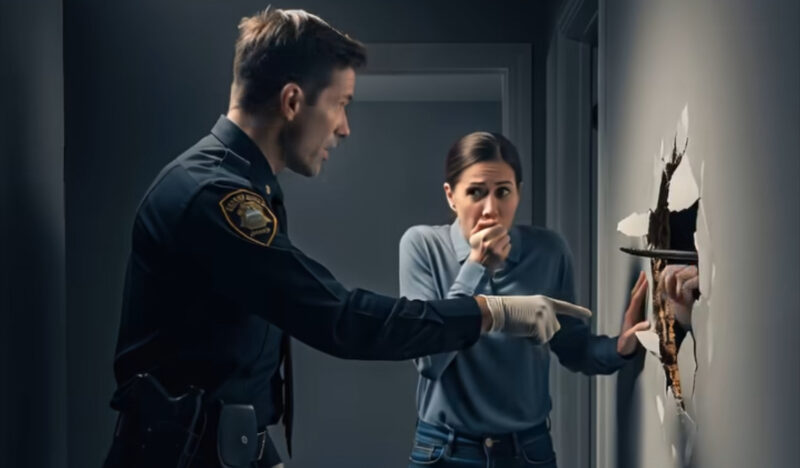
The police officer’s question hung in the air, a grotesque counterpoint to the scent of fresh paint and new beginnings. “Are you aware there’s a body decomposing in your walls?”
I froze, the keys to my new life feeling heavy and useless in my hand. “What? Don’t for a second think I had anything to do with this. I’m the one who called you about the smell.” I crossed my arms, a pathetic shield against the absurdity of the situation.
The officer’s face remained a neutral mask, but his partner was already walking toward their patrol car. “Due to the nature of your relationship to the victim, we’re going to have to bring you in for questioning.”
“Relationship to the victim? Who is the victim?” My voice cracked, a fragile sound in the heavy afternoon air.
“We’re not at liberty to say at this time. Please come with us.”
I had bought this house just three weeks ago. A little two-bedroom ranch in a quiet neighborhood, it was supposed to be a fresh start after my divorce, a place to rebuild. The smell had started a few days after I moved in—at first, a faint, cloying sweetness I dismissed as a dead mouse. But it grew, becoming a pervasive, rotting presence that was impossible to ignore.
They didn’t handcuff me, but the click of the patrol car’s locks felt like a final, damning judgment. Through the window, I watched as my new home, my sanctuary, was wrapped in the garish yellow of crime scene tape. Officers in white hazmat suits carried equipment inside, transforming my dream into a nightmare. My mind raced. The previous owner was an elderly woman who died in a nursing home. Had someone broken in while the house sat empty? But why did they think I had a relationship with whoever, or whatever, was in my walls?
At the station, they put me in a small, gray interrogation room with a metal table and a one-way mirror. For hours, I sat in silence, my panicked thoughts my only company. Finally, two detectives entered. The older one, Harper, had tired, knowing eyes. The younger one, Maguire, clutched a file folder like it held the secrets of the universe.
“I want to be clear,” I said before they could speak, my voice trembling. “I just bought this house. Whatever is in those walls has nothing to do with me.”
Harper nodded, unconvinced. “Let’s start with your family.”
“My family? I’m divorced, no kids. My parents live in Florida.”
“What about siblings?” Maguire asked, his pen poised over a notepad.
A knot of ice formed in my stomach. “I had a brother. He… he went missing fifteen years ago.”
The detectives exchanged a look that made my blood run cold. Harper opened the file and slid a photograph across the table. It was a forensic photo of something wrapped in plastic, nestled within a wall cavity. The shape was unmistakably human.
“Your brother, Tommy, was seventeen when he disappeared, correct?” Harper’s voice was gentle but firm.
“Yes. We filed a missing person report, but the police never found anything.” My hands were shaking now.
They asked more questions about Tommy—what he was wearing, if we had fought. I answered honestly, explaining that he had been a troubled kid, caught up in drugs and a bad crowd. We had all assumed he’d simply run away.
After an hour, Harper finally got to the point. “The thing is,” he said, his eyes never leaving mine, “we found some interesting evidence in those walls along with the body. DNA evidence—hair, blood—that helps us identify not just the victim, but potentially the person who put them there.” He paused, letting the weight of his words settle. He pushed a second photo across the table. A gold class ring, caked in dirt and decay. Tommy’s ring. The one he never took off.
“We’re rushing the full DNA panel,” Harper said, his voice dropping lower, “but the initial field tests are… concerning.”
“Concerning how?” I managed to whisper.
He leaned forward, his gaze pinning me to my chair. “Ma’am, why is it that we found your son’s DNA in your walls?”
The words hit me like a physical blow. “I… I don’t have a son.” The detectives exchanged another look. “I’ve never had kids,” I repeated, my voice cracking.
Harper studied my face, his fingers drumming a slow, deliberate rhythm on the table. “The field test shows first-degree relative DNA. That means parent, child, or sibling.”
My hands were shaking so violently I had to press them flat against the cold metal. “I want a lawyer,” I said, the words coming out louder than I intended. “I want a lawyer right now.”
They left me alone in that gray room, my pale, strange reflection staring back at me from the mirror. Could Tommy have had a child no one knew about? It was possible. Or maybe the test was wrong, a tactic to scare me into a false confession.
Harper returned alone, placing my phone and wallet on the table. “You’re free to go, for now,” he said, handing me his card. “Don’t leave town.”
I practically ran from the station. In my car, I called my mom, my hands trembling. “Mom, it’s me. They found something in my house. They think… they think it might be Tommy.” The line went to voicemail. I sat there, trying to breathe, then scrolled through my contacts and called my ex-husband. We hadn’t spoken in six months, but I didn’t know who else to turn to.
He answered, his voice a mixture of confusion and concern. “You need a lawyer,” he said after I’d stumbled through the story. “Immediately. I know someone. Georgia. She’s good. I’ll text you her number.”
I spent the rest of the day in my small, box-filled apartment, digging through old yearbooks and photo albums, searching for a clue, for anything that could explain how my brother ended up sealed inside a wall.
The next morning, I was in the office of Georgia Ayres, a formidable woman with sharp eyes and a sharper mind. She listened to my story, taking meticulous notes.
“First rule,” she said, her gaze steady, “you do not talk to the police again without me present. Second, document everything.” She tapped her pen on the desk. “Now, about this DNA. Police often use misleading language to get a reaction. ‘First-degree relative’ could easily mean your brother. Let’s wait for the actual lab results before we panic.”
Just then, my phone buzzed. A text from Detective Harper. They were executing a search warrant at my house. Georgia was on the phone instantly, her voice crisp and authoritative, demanding compliance with the warrant’s scope and copies of every report.
“They’re going to tear that house apart,” she said after hanging up. “But the good news is, you just bought it. It’s hard to argue you hid a body there fifteen years ago when you didn’t own the property. But we need to figure out the connection. Why that house? Why now?”
The search warrant returns came back with a chilling revelation. Old renovation permits from fifteen years ago showed that work had been done on my house by a specific construction company. The same company my father had worked for. I remembered him doing side jobs on weekends for extra cash, right around the time Tommy disappeared.
I called my parents. My mother was immediately defensive, her voice strained. My father, when I mentioned the house, became enraged. “Let the past stay buried,” he snarled before hanging up. I wrote down his exact words, just as Georgia had instructed.
The pieces began to click into place, forming a horrifying, unbelievable picture. A few days later, I found my old diary from when I was seventeen. Page after page detailed the violent, escalating fights between my father and Tommy. Tommy, caught in the grips of addiction, had been stealing from him. One entry, from the night Tommy vanished, mentioned my father coming home late, his clothes covered in dirt and what I had thought at the time was white paint. I had forgotten that detail completely. The diary went straight to Georgia.
I couldn’t wait any longer. Ignoring Georgia’s advice, I drove twelve hours to my parents’ condo in Florida. The tension in their small, sterile home was suffocating. My father sat in his recliner, stonewalling. My mother nervously tried to change the subject. I kept pushing, asking about the house, the side jobs, the night Tommy disappeared.
Finally, my father stood up and went to the garage. I followed him. There, hanging on a hook, was his old tool belt, a faded company tag still attached, matching the one on the permit records. I pointed at it, my voice shaking. “Explain this, Dad.”
He wouldn’t look at me, his hands trembling as he fiddled with a wrench. It was then that my phone lit up with a text from Georgia. “URGENT. Leave now. Do not get any more statements without recording.”
I was about to leave when my father finally broke. He turned to me, his face a mask of cold, hard resolve. “I did what I had to do to protect this family,” he said, the words hanging in the air like poison. My mother, who had followed us into the garage, started sobbing, begging me to let it go. I grabbed my bag and walked out, my father’s words echoing in my ears.
I drove to a dingy motel, my body shaking. He had all but confessed. That night, a memory, long buried, surfaced with brutal clarity. A fight, just before Tommy disappeared. I had been in my room, listening through the wall as Tommy screamed at my father, threatening to tell everyone “the truth” about what he’d been doing. My father had grabbed him, shoved him against the wall. The sound of the impact had made me flinch. I had blocked it out, for fifteen years.
The final, official DNA results came back three days later. A perfect match. To my father. Not Tommy, not an imaginary son. My father. He was arrested at his condo the next morning. The charges were abuse of a corpse and tampering with evidence. They couldn’t prove murder; after fifteen years, the cause of death was impossible to determine.
My mother called me, sobbing, not with grief for her lost son, but with fury at me for “turning against the family.” An hour later, her story changed. In a flat, empty voice, she told me the truth.
Tommy had overdosed that night. My father, a man obsessed with appearances, had found him. Instead of calling 911, he panicked. Panicked about the scandal, the shame, the judgment of the neighbors. He told my mother it was “too late anyway.” The elderly owner of the house he was working on was out of town for the week. He had the keys. He wrapped my brother’s body in plastic sheeting, drove it ten miles across town, opened up the wall he was supposed to be repairing, and sealed my brother inside. He came home hours later, covered in drywall dust, and they had kept that monstrous secret for fifteen years.
Every Christmas candle we lit for Tommy, every birthday we marked in his absence, they knew. They knew he was ten miles away, entombed in a wall. My father had treated his own son like construction waste.
The legal battles that followed were long and arduous. My father, facing irrefutable evidence, pleaded guilty. He was sentenced to three years in prison. My mother, in a final, heartbreaking act of denial, stood by him, selling their condo to move into a small apartment near the prison. Our relationship, like the rest of my childhood, became a lie, a fragile construction of safe, meaningless topics like the weather.
I kept the house. The thought of selling it, of passing on its haunted history, felt wrong. I hired a compassionate, discreet contractor who tore out the damaged walls and rebuilt the space. I painted the room a soft, peaceful blue. I saw a therapist who helped me navigate the complex grief of losing my brother all over again, and of losing the parents I thought I knew.
It’s been a year. The house, once a source of such horror , has become a place of quiet healing. It’s no longer a crime scene; it’s my home. I still have the police reports, the legal documents, the diary filled with a teenage girl’s fears. They are a reminder of the truth, a truth that cost my family everything. But in the quiet moments, when the sun streams through the window of the room where my brother once lay, I feel a strange sense of peace. The house that held my family’s darkest secret is now the place where I am finally, painstakingly, learning to be free.