The Day I Stopped Begging to See My Grandchildren
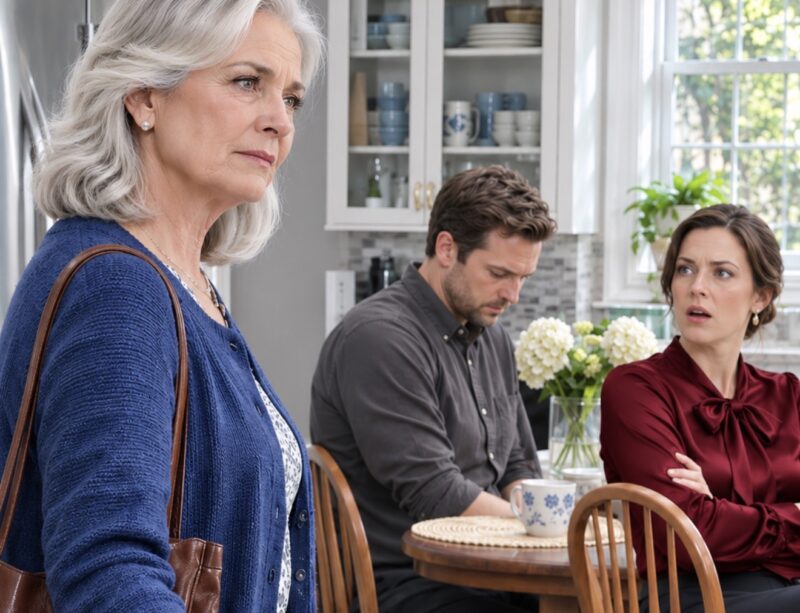
“We’re going no-contact,” Vanessa said, folding her arms as if she had rehearsed the moment in front of a mirror. “No phone calls, no visits, and you won’t see the children anymore.”
I was still holding a container of chicken soup. I had made it that morning because seven-year-old Sophie had been home sick, and I thought a warm meal might help. My son, Daniel, sat beside his wife at the kitchen table. He looked down at his hands.
Vanessa watched me closely, waiting for me to plead. For years, I would have. I would have apologized before I understood what I’d done. I would have promised to change, even when the only thing she wanted changed was my willingness to disagree.
Instead, I set the soup on the counter.
“All right,” I said.
Her expression shifted. “What?”
“I heard you. I’ll respect your decision.”
“You’re not going to fight for the kids?”
I looked at Daniel. His eyes stayed on the table.
For six years, I had helped them whenever they asked. I picked up Sophie from school when Vanessa’s schedule changed, brought groceries when their budget was tight, and watched the children when a meeting ran late or an appointment took longer than expected. When Daniel’s car needed repairs, I paid the bill. When Sophie started dance lessons, I covered the registration fee.
I didn’t keep a list. I didn’t expect a thank-you every time. They were my family, and I loved them.
But somewhere along the way, help had become an obligation. Whenever Vanessa and I disagreed, the conversation ended with the same warning: “If you don’t like it, you won’t see the children.”
At first, I told myself she was angry and didn’t mean it. Then it happened again. And again. Eventually I began measuring every sentence before I spoke, afraid a small difference of opinion could cost me the only thing I couldn’t replace: time with Sophie and her little brother, Ethan.
“Vanessa,” I said, keeping my voice low, “you can decide who visits your home. But I’m not going to beg you to let me love your children.”
Her cheeks reddened. Daniel finally looked up.
“Mom, please don’t make this worse.”
I turned toward him. “I’m not. Your wife asked me to stop contacting your family. I’m agreeing.”
Vanessa rose from the table. “And don’t think you can buy your way back with gifts.”
“I won’t.”
“No birthday presents. No little packages. Nothing.”
“Understood.”
She looked almost offended that I wasn’t arguing. “So you really don’t care about Sophie and Ethan?”
The words landed where she meant them to. I felt my throat tighten, but I didn’t let the hurt make my decision for me.
“I love them more than I can explain,” I said. “That’s why I won’t turn them into weapons in an argument.”
I picked up my purse and walked to the door. Vanessa followed me down the hall.
“You’ll come crawling back,” she called.
I stepped onto the porch without turning around.
At home, I put the unused soup in the refrigerator and sat at the kitchen table. The quiet felt unfamiliar. I kept checking my phone, half expecting Daniel to write that Vanessa had changed her mind, or that he was sorry he hadn’t spoken up.
Instead, the phone rang seventeen times.
I didn’t answer. At 9:42 p.m., a message appeared from Daniel: “Mom, Vanessa wants to know why you haven’t responded about picking up the kids tomorrow.”
I read it twice. Then I typed, “Because you told me we’re no-contact.”
Three minutes later, he replied: “Mom, this is serious. Vanessa has an important appointment tomorrow. We need you.”
I stared at the message. For the first time in years, they were discovering that my help wasn’t something they could demand whenever it suited them.
Daniel called again. I watched his name flash across the screen, then answered.
“Mom,” he said, and the strain in his voice made my heart sink. “Sophie heard us. She thinks you’re never coming back.”
For a moment, I couldn’t speak. I pictured Sophie curled on the couch with her blanket, her cheeks warm from the fever, listening from the hallway while her mother told me I would never see her again.
“Is she still sick?” I asked.
“Not as much. She’s awake, though. She heard Vanessa say you wouldn’t be coming around anymore.” Daniel exhaled. “She asked if you were mad at her.”
“I’m not mad at Sophie.”
“I know. I tried to explain that.”
“What did you tell her?”
“That grown-ups were having a disagreement.”
I closed my eyes. “Then tell her the truth she needs to hear: I love her. I love Ethan. None of this is their fault.”
He went quiet. In the background, I heard a cupboard close and Vanessa’s voice, too low to make out.
“Why didn’t you say anything at the house?” I asked.
“Because every time I get between you two, it turns into a bigger fight.”
“Staying silent didn’t keep the peace, Daniel. It only left me alone in the room.”
He let out a tired breath. “I know.”
That admission surprised me more than the angry messages had.
“Vanessa’s appointment is at ten,” he said. “She needs me to take her, and I have a meeting I can’t move. We thought you could pick up the kids, but…” He trailed off.
“But you told me not to contact your family.”
“I didn’t say that. Vanessa did.”
“You sat beside her and said nothing.”
“I know, Mom.”
The old reflex rose in me: offer to pick up the children, smooth things over, make sure nobody had to feel the consequences of a hard conversation. I could be at their house in twenty minutes. I could collect Sophie’s medicine, make lunch, keep Ethan busy, and come home with the empty containers they’d return weeks later.
But if I did that without addressing what had happened, the message would be clear. Vanessa could shut me out whenever I disagreed with her, then call me back whenever she needed help.
“I’m sorry,” Daniel said. “I should have spoken up.”
“I’m glad you see that now. But I can’t pretend yesterday didn’t happen.”
“I understand.”
“Do you?” I asked. “Because this isn’t only about tomorrow’s pickup. It’s about being told my place in the children’s lives disappears whenever I don’t do what Vanessa wants.”
 “I know she’s said that before.”
“And you’ve let it happen.”
His silence answered me.
“I’m not going to show up without your permission,” I said. “You’re their parents. You decide who sees them. But I won’t be available as a babysitter while being told I’m not family.”
“I don’t want you to feel that way.”
“I’ve felt that way for a long time.”
He started to answer, then stopped. I heard a small voice close to the phone. Sophie.
“Daddy, is Grandma still there?”
My eyes stung. Daniel must have covered the receiver, because his next words came muffled. Then the phone shifted.
“Grandma?” Sophie said.
“Hi, sweetheart.”
“Are you mad at me?”
“Never. I love you so much.”
“Mom said you’re not coming anymore.”
“I’m giving your mom and dad the space they asked for. That’s something grown-ups have to work out. You didn’t do anything wrong.”
“Can I still call you?”
There was a pause. I didn’t want to promise something her parents had forbidden, and I didn’t want her to think I was turning away from her.
“That’s something you need to ask your mom and dad,” I said gently. “But I want you to know I’m thinking about you.”
I heard her sniffle. “I miss you.”
“I miss you too.”
Daniel came back on the line. “That’s what I mean. This is hurting her.”
“It’s hurting me too,” I said. “But the answer isn’t for me to ignore the boundary your mother set. The answer is for you and Vanessa to decide what you really want.”
“I’ll talk to her.”
“Then call me when you’re ready to talk about more than tomorrow’s schedule.”
I ended the call with my hands shaking. I wanted to pick up the children. I wanted to be the grandmother who arrived with soup, spare mittens, and a solution. But love didn’t mean pretending that my feelings didn’t matter.
The next day, I kept my phone nearby and tried to get through my usual errands. I checked it between stops, though I told myself I wouldn’t. No message came from Daniel.
At lunchtime, I took the container of soup from the refrigerator and poured a bowl for myself. It tasted exactly the same as it had the night before, yet I could barely swallow it.
That afternoon, an envelope appeared in my mailbox. Inside was a drawing Sophie had made at school weeks earlier: three people holding hands beneath a crooked yellow sun. She had written “Grandma, Sophie, Ethan” in careful letters along the bottom. I sat at the table with the picture in my hands, fighting the urge to drive to their house.
Then Daniel called.
“She’s okay,” he said before I could ask. “Vanessa got through her appointment. I’m calling because I need to tell you what’s really going on.”
I sat down. “Go ahead.”
“Vanessa has been overwhelmed. She says she feels like you step in before she can make a decision as a mother.”
I thought of the times I’d offered advice about a fever, a school problem, or what the children should wear. “I may have given advice when she didn’t ask for it.”
“She says you make her feel judged.”
“That wasn’t what I wanted. But I can listen to how it felt to her.”
“And she says when you help us, she feels like she owes you.”
I looked at the drawing. “I never wanted her to feel indebted.”
“I know. But I should have told you this sooner. I kept hoping it would sort itself out.”
“Instead, she threatened to cut me off.”
“I know.”
“Daniel, those two things can both be true. I can have overstepped, and she can have handled it unfairly.”
He didn’t answer right away. Then he said, “That’s what I’m trying to explain to her.”
“Are you?”
“Yes.”
It was the first time he sounded as if he understood that fixing things might require him to do more than hope the women in his life stopped arguing.
Part 3
Daniel called again the next morning. He asked if I would meet him and Vanessa at a café near their house, without the children.
“I’ll come,” I said. “But I’m not coming to be told that I’m the problem because I didn’t show up to babysit.”
“I understand.”
When I arrived, Vanessa was already seated with both hands wrapped around a cup of tea. She didn’t smile. Daniel stood when he saw me, then pulled out the chair across from them.
For a few seconds, no one spoke. The clatter of cups and quiet conversation around us made the silence at our table feel even heavier.
Vanessa looked down first. “I shouldn’t have said you’d never see the children again.”
I waited.
“I was angry,” she continued. “I felt like you didn’t respect the way I was raising them, and I wanted you to understand how serious it felt to me.”
“So you used the children to make sure I listened?”
Her eyes flicked up. “I didn’t think of it that way.”
“But that’s what it did.”
Daniel moved his cup slightly, then stopped. This time, he didn’t look away. “She’s right,” he said. “We can ask for space without making the kids sound like a punishment.”
Vanessa’s jaw tightened. For a moment, I thought she would argue. Then her shoulders lowered.
“I know,” she said. “I’m sorry.”
The apology was quiet, not polished. It didn’t erase what she’d said, but it was the first time she seemed willing to consider how it had landed.
“I’m sorry too,” I said. “I’ve offered advice when you didn’t ask for it. I’ve stepped in quickly because I thought I was helping. I can see how that might feel like I don’t trust you to be their mother.”
Vanessa studied my face. “Sometimes it felt like you thought I couldn’t manage.”
“I didn’t think that. But I understand that my intentions don’t change how it felt to you.”
She looked down at her tea. “I’ve had a hard time asking for help without feeling like I owe everyone something afterward.”
“I don’t want help to become a debt,” I said. “And I don’t want it to become an expectation either. If I say yes, it’s because I can and I want to. If I say no, it doesn’t mean I love the children less.”
Daniel nodded. “We need to stop assuming you’ll always be available.”
“And I need to stop trying to solve things before you ask,” I said. “If you want advice, ask me. If you want me to listen, tell me that.”
Vanessa rubbed a thumb along the edge of her cup. “I can try to do that.”
“What happens the next time we disagree?” I asked.
She took a moment. “I’ll tell you I need space. I won’t threaten to keep the kids from you.”
“And I’ll respect the space,” I said. “But we need to be clear about what it means. No calls for a while is different from ‘you’re out of our lives.’”
Daniel looked between us. “We can figure out a way to communicate that doesn’t make Sophie and Ethan feel caught in the middle.”
“Good,” I said. “They shouldn’t have to carry messages or wonder whether someone stopped loving them.”
Vanessa’s face softened at the mention of Sophie. “She asked about you all morning.”
“I miss her.”
“I know.” Vanessa looked uncomfortable, but she kept going. “I told her that you love her and that the grown-ups were working things out.”
That was what I had hoped she would say.
We agreed to start slowly. I wouldn’t come over unannounced, and Vanessa wouldn’t assume I was available for childcare unless I had agreed in advance. If either of us felt a boundary had been crossed, we would talk about the specific thing that happened instead of reaching for the biggest threat we could make.
There was no dramatic hug. No one pretended the hurt had disappeared. We left the café with an understanding that would need to be proven through ordinary choices.
Two days later, Daniel texted to ask if I would like to see the children at the park on Saturday. Vanessa added that she would come too. I read the message twice before answering yes.
On Saturday morning, I brought no presents and no food. I brought myself. Sophie ran to me the moment she spotted me, then stopped a few feet away and glanced at her mother.
Vanessa gave a small nod.
Sophie crossed the rest of the distance and wrapped her arms around my waist. Ethan followed, one hand clutching his toy truck. I knelt to hug them both, careful not to make promises I couldn’t keep.
“I missed you,” Sophie said.
“I missed you too.”
We spent the afternoon at the park. Vanessa and I talked about school, the children’s routines, and a book Sophie had started reading. Our conversation was careful, but it was real. When Ethan spilled juice on his sleeve, I reached for a napkin, then paused.
“Do you want me to help?” I asked Vanessa.
She smiled a little. “Yes, please.”
It was a small exchange. No grand declaration. No perfect resolution. Just a question, an answer, and the space for both of us to choose how to move forward.
As we were leaving, Vanessa helped Sophie into her jacket. “Would you be able to watch them next Thursday?” she asked. “I have another appointment. It’s okay if you can’t.”
I glanced at Daniel. He didn’t jump in to answer for me.
“I’ll check my schedule and let you know tonight,” I said.
Vanessa nodded. “That’s fair.”
The children ran ahead toward the car, arguing cheerfully about who would get to press the lock button. Daniel held the door while Vanessa followed them. For once, no one acted as if affection meant automatic agreement or help meant an unlimited promise.
That evening, I texted Vanessa that I could watch the children Thursday. She thanked me, then asked if I could bring the soup recipe Sophie liked. I sent it to her instead.
It was a small change, but it mattered. She could make the soup herself. I could offer help without taking over. We could care about each other without keeping score.
The next time we disagreed, Vanessa told me she needed a day before discussing it. I gave her the day. The time after that, I told her I couldn’t cover a last-minute pickup. She found another arrangement, and no one threatened to end the relationship.
Trust returned in pieces: a phone call to share a school story, a Saturday lunch, a picture from Ethan’s classroom. Daniel began speaking up instead of waiting for conflict to disappear. Vanessa and I still weren’t alike, but we stopped treating every difference as proof that one of us didn’t care.
I learned that accepting a boundary didn’t mean I had stopped loving my grandchildren. It meant I could love them without begging for a place in their lives. And when their parents opened the door again, I could walk through it with warmth—and with my own dignity intact.