My husband had nothing when we got married. I paid off his debts, financed his business, and helped turn him into a millionaire. But once he became successful, he betrayed me with his mistress and demanded a divorce. I signed the papers, walked away from any claim to his assets, and boarded a flight to Geneva, quietly protecting my own $50 million fortune. Meanwhile, he was at the hospital showing off his wealth as his mistress prepared to give birth. Then the doctor revealed something that instantly wiped the smile from his face…
Part 1 of 3
PART 1
There is a strange kind of quiet that follows when you sign a document someone else believes guarantees their victory. I experienced that silence on a cold December morning at Manhattan Family Court, where my husband of twelve years stood before me, convinced that he had finally taken everything I owned.
Outside, the sky was dark and gray, but the real trouble was standing directly in front of me. Colton Briggs, whom everyone called Colt, wore an expensive Italian suit and a luxury watch, along with the familiar cologne I had personally purchased for him.
Without showing the slightest hesitation, Colt dropped the divorce papers and an unconditional property waiver onto my lap. His expression was filled with satisfaction as he ordered me to sign away my rights.
“Sign the papers, Imogen, and move out today. My son is about to be born, and he deserves a proper home without you in it.”
Twelve years earlier, Colt had entered our marriage with almost nothing except unpaid bills and mounting debts. I had sold valuable personal belongings to help him repay what he owed, invested my own money into his business, and spent countless nights reviewing contracts to help his struggling company grow.
Over the years, I had worked tirelessly behind the scenes until Colt became the successful businessman everyone admired. Yet after achieving wealth and recognition, he had decided that I was no longer important to his future.
I didn’t cry because I had already spent too many nights grieving the marriage I once believed would last forever. Instead, I picked up the brass pen resting on the table and calmly signed my name, Imogen Shaw, across every required page.
My unexpected cooperation briefly surprised Colt, but he quickly recovered and grabbed the documents from me. He looked pleased with himself as he explained what he intended to leave behind.
“At least you’re finally being reasonable. I’ll let you keep the old condo in Queens as compensation for your years of housework. But don’t expect a penny from my company, the Hamptons estate, or my luxury cars. The law doesn’t reward someone who contributes nothing.”
Standing beside him, my mother-in-law, Loretta, clutched the expensive designer handbag I had bought her. She had once depended on my generosity, but now she seemed delighted to watch her son humiliate me.
“You should be grateful you’re getting anything at all! You deserve to leave with nothing. Getting you out of this family before my grandson arrives is the best thing that could happen to us.”
I listened without interrupting because arguing with them would have accomplished nothing. Neither Colt nor Loretta seemed to remember how much they had relied on me before their lives became comfortable, and neither understood how vulnerable their financial position actually was.
I simply smiled and offered them a quiet farewell. My calm reaction seemed to confuse them more than any angry confrontation could have.
“I sincerely hope Savannah and the baby have a day they’ll never forget. I also hope both of you receive exactly what you deserve.”
With that, I turned away and left the courthouse carrying only a small leather handbag. I made no demands for additional property, requested no alimony, and gave Colt no reason to suspect that I had already prepared my next move.
An hour later, I was sitting in the first-class lounge at JFK Airport with a boarding pass for Geneva. Snow drifted beyond the windows as I looked toward the distant Manhattan skyline, feeling strangely peaceful after ending twelve years of marriage.
At precisely 10:30 a.m., I called Ellis Hartman, the trusted attorney who had represented my family for years. He answered in his usual composed manner, although I could hear the anticipation in his voice.
“Imogen, has everything been finalized at the courthouse?”
I glanced at the glass of red wine resting beside me before giving him the confirmation he had been waiting for.
“Yes, Ellis. The divorce papers are signed. You can proceed with the next step.”
He remained silent for several seconds, understanding exactly what my instructions would set into motion. When he finally spoke, he wanted to be absolutely certain that I was prepared for the consequences.
“Are you sure about this, Imogen? Once we begin, there won’t be any way to undo it.”
I had considered that question countless times before walking into the courthouse. After everything Colt had done, I no longer had any doubts about my decision.
“I’ve been preparing for this moment long enough. Go ahead.”
“Understood, Imogen. Have a safe flight to Geneva. It’s time for you to begin a new chapter.”
After ending the call, I removed the SIM card from my phone and broke it in half. I dropped the pieces into my glass of wine, watching them sink as I silently closed the door on the marriage that had consumed twelve years of my life.
Meanwhile, across Manhattan, Colt was celebrating his supposed victory at an exclusive maternity hospital. He stood beside his pregnant mistress, Savannah, generously tipping the reception staff and proudly preparing to welcome the son he believed would complete his new family.
He had no idea that the instructions I had just given Ellis were already being carried out. More importantly, he couldn’t have imagined that a shocking discovery in the delivery room would soon destroy the confidence he had displayed at the courthouse.
PART 2
While I waited peacefully at JFK Airport for my flight to Geneva, an entirely different scene was unfolding at Prestige Grace Medical Center on Manhattan’s Upper East Side. The luxurious maternity hospital was filled with anxious activity as Colt arrived with his pregnant mistress, Savannah Reed, and his mother, Loretta.
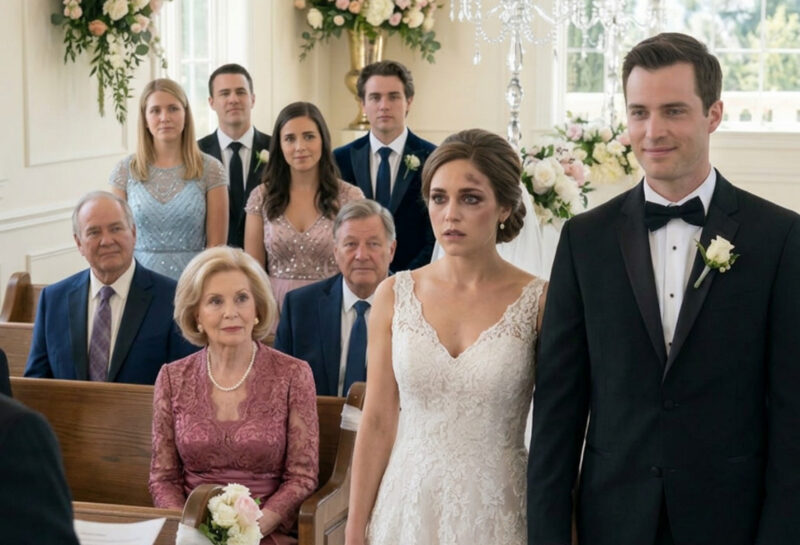 Savannah was twenty-four years old and had previously worked as Colt’s executive assistant before becoming his mistress. Now, with her due date approaching, she was preparing to deliver the baby Colt proudly believed would become his heir.
Colt carefully supported Savannah as they entered the hospital’s impressive marble lobby. She held her noticeably swollen abdomen with both hands, her face covered in expertly applied makeup despite the intense labor pains she claimed to be experiencing.
Savannah leaned heavily against Colt’s expensive suit, making certain he understood how uncomfortable she was. Even in the middle of her supposed distress, she remained focused on receiving the most luxurious treatment the hospital could provide.
“Baby, I’m in so much pain. Please make sure they give us the presidential maternity suite, okay? I don’t want an ordinary VIP room. The nurses are always making noise, and I need complete peace and quiet for our son.”
Colt immediately reassured her, gently kissing her temple as he guided her toward the reception desk. He seemed delighted by the opportunity to demonstrate just how much money he was willing to spend on Savannah and their expected child.
“Of course, sweetheart. Our son deserves the finest treatment available anywhere in New York. Don’t worry about the cost. Money means nothing to us.”
A few steps behind them, Loretta struggled to carry several expensive designer baby bags. Despite the weight of the luggage, she could barely contain her excitement because she believed her first grandson was about to be born.
Loretta had spent years dreaming of seeing the Briggs family name become even more prominent among Manhattan’s wealthy social circles. In her mind, the arrival of Colt’s son would secure the family’s future and strengthen the legacy she was so determined to protect.
Colt approached the polished marble admissions counter with the confidence of a man accustomed to getting whatever he wanted. His expensive clothing, carefully maintained appearance, and commanding manner made it obvious that he expected the hospital staff to accommodate his demands without question.
He opened his elegant leather wallet and removed a heavy black metal credit card. It was the same prestigious card he frequently displayed during business meetings, using it to impress investors and remind competitors of his supposed financial power.
Without bothering to exchange pleasantries, Colt handed the card to the young admissions clerk with a dismissive movement of his wrist. He spoke loudly and confidently, making certain that everyone nearby could hear the level of luxury he was purchasing.
“We want the Presidential Maternity Package. Charge the fifty-thousand-dollar deposit to this card, and make sure our suite has a view overlooking the park.”
Colt stood proudly at the counter, fully expecting the transaction to proceed without the slightest difficulty. With Savannah waiting beside him and Loretta smiling behind them, he believed his money could guarantee the perfect beginning for his new family.
The clerk swiped the card. The terminal beeped twice.
“I’m sorry, Mr. Briggs. This card has been declined.”
Home Stories My husband had nothing when we got married. I paid off his debts, financed his business, and helped turn him into a millionaire. But once he became successful, he betrayed me with his mistress and demanded a divorce. I signed the papers, walked away from any claim to his assets, and boarded a flight to Geneva, quietly protecting my own $50 million fortune. Meanwhile, he was at the hospital showing off his wealth as his mistress prepared to give birth. Then the doctor revealed something that instantly wiped the smile from his face…
Part 2 of 3
Colt laughed, the way a man laughs when he thinks the world has made a clerical error. “Run it again.”
She did. Declined.
“Try the other one.” He slid a platinum card across the marble. Declined. A third, a corporate card with his company’s name embossed in silver. The clerk glanced at the screen, then at the line forming behind him, and lowered her voice.
“Sir, this account has been frozen by the issuing bank.”
“That’s impossible. I own Briggs Logistics. I’ll call my CFO right now.”
His phone rang before he could dial. The screen said Unknown Caller, then Unknown Caller again, then a flood of notifications spilled down the glass: Credit line terminated. Account suspended. Notice of default.
Savannah’s moans stopped abruptly. “Colt? What’s happening?”
“Nothing. A glitch. Sit down, baby.”
But it was not a glitch. It was Ellis, doing precisely what I had asked him to do.
What Colt had never understood, because he had never read a single page of the paperwork I put in front of him, was how his company had actually been built. The seed capital for Briggs Logistics had come from my family’s holding company, Shaw Meridian Partners. Every credit line, every equipment loan, every warehouse lease was guaranteed by an entity that carried my name, or my late father’s, at the top. The agreements had been signed twelve years ago, when Colt was desperate and grateful, and he had been too proud and too busy to examine the terms.
Those terms included a clause my father insisted upon. It stated that the guarantee would remain in force for as long as I was married to Colt Briggs, and would terminate, with all outstanding facilities immediately callable, on the day I was no longer his wife.
This morning, he had made me his ex-wife with his own hands.
The property waiver I signed surrendered my rights to marital property. It did not, and could not, touch loans, guarantees, or the separate assets of Shaw Meridian. Ellis had told me this three times. I had read it myself a dozen times more.
At the hospital counter, Colt’s phone would not stop ringing.
PART 3
I learned all of this later, in pieces, from Ellis and from people who had been standing in that marble lobby.
By noon, three banks had called Colt’s loans due. By one o’clock, his corporate accounts were frozen pending review. By two, the finance director at Briggs Logistics, who had quietly been loyal to me for years, sent Ellis a complete ledger confirming that every one of Colt’s major facilities carried the Shaw Meridian guarantee.
None of it was theft. That was the part I was most careful about. I took nothing that was his. I withdrew only what had always been mine.
Back at the hospital, Colt finally found a cash deposit. Loretta emptied her purse and wrote a check against an account that was, unbeknownst to her, also linked to a loan I had once cosigned for her. The check bounced. The hospital, to its credit, did not turn a laboring woman away. A nurse quietly moved Savannah to a standard maternity room and told the family that billing would be sorted out later.
Savannah was furious. She hissed at Colt through contractions that he had promised her the presidential suite and a view of the park.
“I’ll fix it,” he kept saying. “Just give me a day.”
At 5:42 p.m., Savannah gave birth to a healthy baby boy.
Colt, who had been pacing the hallway with his phone, rushed in. He took one look at the baby in the nurse’s arms and his face softened into a kind of wonder. For a moment, he forgot the cards and the calls and the courthouse.
“My son,” he whispered. “Look at him, Mom.”
Loretta wept openly. “He has the Briggs nose.”
It was the happiest minute of their day. It was also the last.
The attending physician, Dr. Anand Mehta, stepped into the room a little after seven. He was a calm, gray-haired man with the careful posture of someone who had delivered hard news before. He carried a tablet and asked to speak with the parents privately.
“Anything you say, you can say in front of my mother,” Colt said grandly.
“Very well.” Dr. Mehta glanced at the chart. “As part of routine newborn care, we run a blood type screening on every infant. We also keep the mother’s blood type on file. And Mr. Briggs, when you were admitted to this hospital three years ago for your appendectomy, we recorded yours.”
Colt frowned. “What does that have to do with anything?”
“Mr. Briggs, you are blood type O. Ms. Reed, you are also type O.” The doctor paused. “Your son is type AB.”
Nobody spoke.
“I want to be careful,” Dr. Mehta continued, in the gentle, precise voice of someone choosing each word. “A blood type test alone cannot establish who a child’s father is. But it can rule people out. Two type O parents cannot have a type AB child. It is not possible. If you wish, we can arrange a formal paternity test, and I would recommend it. But I would be failing in my duty if I did not tell you what the screening shows.”
The smile that Colt had worn since the courthouse, the smile of a man who believed he had won everything, left his face like a light being switched off.
“There has been a mistake,” he said. “The lab mixed something up.”
“We double-checked, Mr. Briggs. Twice.”
Colt turned to Savannah. She had gone gray against the pillow, her fingers knotted in the hospital blanket. She did not look at him.
“Savannah.”
“I can explain.”
“Explain.”
“It was a long time ago. Before you and I were really together.” Her words tumbled out. “I thought it was yours. I swear, I thought it was. The timing was close. And when you started talking about an heir, I thought…” She stopped.
“You thought you’d let me think it.”
“You wanted a son so badly!”
Loretta’s voice came out cracked and thin. “You’re lying. This is a lie to take my son’s money.”
“Mom.” Colt’s voice was barely a breath. “Stop.”
For the first time in his life, I imagine, Colt Briggs looked at the woman he had thrown away a marriage for, and saw exactly who she was.
He had signed away twelve years for a baby who wasn’t his. He had humiliated the one person who had built his life, and he had done it for a story.
Home Stories My husband had nothing when we got married. I paid off his debts, financed his business, and helped turn him into a millionaire. But once he became successful, he betrayed me with his mistress and demanded a divorce. I signed the papers, walked away from any claim to his assets, and boarded a flight to Geneva, quietly protecting my own $50 million fortune. Meanwhile, he was at the hospital showing off his wealth as his mistress prepared to give birth. Then the doctor revealed something that instantly wiped the smile from his face…
Part 3 of 3
Dr. Mehta quietly excused himself.
Later that night, Savannah’s actual circumstances came out. The father was a bartender she had dated briefly the year before, someone who had left town when she told him she was pregnant. She had met Colt at a time when she was frightened and had spotted an opening. I do not hate her for being afraid. I do not forgive the lie, and I do not forgive the way she smiled when she walked past me in the Briggs office, knowing what she knew. But I understand fear. It makes people do things.
By Friday, the paternity test had confirmed what the blood type implied. By the following Wednesday, Savannah had moved out of the penthouse Colt had been leasing for her, and the lease was in default anyway.
I did not watch any of this happen.
I was in Geneva, in a small apartment with tall windows overlooking Lac Léman, with a view of the Jet d’Eau on the clear mornings and nothing at all on the foggy ones. I bought a new phone and a plain black coat. I slept for fourteen hours the first night and woke up without the knot that had lived in my chest for two years.
Ellis called on the fifth day.
“They’ve asked for a settlement conference,” he said. “Colt and his attorneys. He wants to talk.”
“What does he want?”
“What do you think? Time. Forbearance. A restructure.”
“What do you recommend?”
“That you let me handle it. And that you remember what you told me before you left.”
I stood at the window, watching a ferry cut a white line across the gray water.
“I told you I didn’t want revenge. I wanted what was mine.”
“That’s right.”
“Then give him a fair path. Not a gift. A path. Liquidate the assets the loans were secured against. Let the Hamptons estate go. Let the cars go. Let the company be sold, orderly, to a buyer who’ll keep the drivers and warehouse crews employed. If there’s anything left after the debts, it’s his.”
“There may not be much.”
“Then there won’t be. But no one on that loading dock should lose a paycheck because of Colt’s choices.”
Ellis was quiet for a moment. “You’re a better person than I’d be.”
“I’m not sure that’s true,” I said. “I’m just tired of being angry.”
The sale closed in April. A regional freight company bought Briggs Logistics at a fraction of what Colt had once imagined it was worth, and kept all four hundred employees. The Hamptons estate sold to a family from Connecticut. The cars went to auction. After the creditors were paid, Colt walked away with enough to rent a modest apartment in New Jersey and not much else.
Loretta, I heard, had moved in with her sister in Scranton. She sent me one letter, handwritten, which I read once and put in a drawer. It did not contain an apology. It contained a request for a small loan.
I did not answer it.
In May, I flew back to New York for one afternoon, to sign the last documents at Ellis’s office. I wore a cream-colored blazer and carried the same small leather handbag. I did not tell anyone I was coming.
I was crossing the lobby of his building when I heard someone say my name.
Colt stood by the elevators, thinner, in a suit that no longer fit. The expensive watch was gone. His hair needed a cut.
“Imogen.”
I stopped. I did not step toward him, and I did not step back.
“I wanted to say something,” he said. “I rehearsed it on the train. And now I can’t remember any of it.”
“Then say what you can.”
He looked at the floor. “I was an idiot. No, that’s too easy. I was cruel. I forgot who made me. I forgot you.” His voice shook. “I told myself that you’d never leave. I told myself a lot of things.”
“You did.”
“I’m not asking for anything. I know I don’t deserve to.”
“Good,” I said, not unkindly.
He nodded. For a moment I saw the young man I had met at twenty-six: broke, frightened, grateful, brave enough to ask for help. That man had been real. He had just been buried under so many years of success that he’d forgotten he’d ever needed anyone.
“I hope you’re all right, Colt,” I said. And, to my surprise, I meant it. “I hope you build something honest, this time. But you’ll have to do it yourself.”
“I will.”
“Then goodbye.”
I stepped into the elevator, and the doors closed on his face.
I did not return to the old life. I used part of my family’s capital to start a small foundation, Meridian Hands, that makes seed loans to women entrepreneurs who have been shut out of traditional credit. We operate out of a renovated office in Geneva with a satellite desk in Brooklyn. Our first borrower was a former hospital cleaner who wanted to start a medical supply company. She repaid her loan eight months early.
Ellis visits twice a year and always brings a box of the pretzels I can’t find in Switzerland. On my birthday last winter, he stood in my kitchen with a glass of wine and asked, without any preamble, whether I regretted anything.
I thought about it honestly. The courthouse. The quiet signature. The SIM card sinking in red wine.
“I regret that it took me twelve years to see it,” I said. “I don’t regret the leaving.”
The snow was falling over the lake again, the same slow gray December snow that had fallen over JFK on the morning I left. I watched it drift against the window and felt the same strange peace.
There is a quiet that follows when you sign a document someone else believes guarantees their victory. I used to think that quiet meant surrender.
I know now it can also be the sound of a door opening.
THE END.