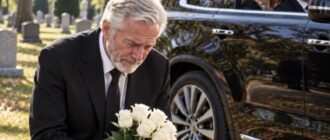
Since Martha passed, the house had become far too large. The silence in its rooms was bigger than the memories. I, Arthur Finch, at eighty-two, had spent the last two years living a quiet life, a ghost rattling around my own legacy. To my son, Robert, and his wife, Cynthia, I was just a doddering old man, a relic living off “wise investments” from years ago. They had no idea that those investments were Orion Air, an empire I had built from the ground up, one rivet and one flight path at a time.

They arrived on a Thursday morning, bearing false smiles and a gift-wrapped box of chocolates. “Surprise!” Cynthia chirped, her voice a little too bright. “We’ve booked you a luxury vacation in Florida! A permanent one. It’s time you got some rest and sunshine.”
Robert nodded in agreement, his eyes darting around the room, already mentally appraising the furniture. “We’ve already packed your bags, Dad. The plane leaves in three hours.”
I looked into their eyes and saw no love, only a cold, impatient greed. But I summoned a frail, wavering smile. “Oh, how thoughtful of you both. A vacation sounds… lovely.”
I was not fooled. Two weeks ago, I had been in the library, pretending to nap in my favorite armchair when I overheard them whispering in the kitchen. Their words were sharp as broken glass: “…facility in Florida, it’s a permanent solution…,” “…power of attorney will give us full control…,” “…he’s so out of it, he’ll never know what hit him.”
They saw me as a senile burden, an inconvenient roadblock on their path to my fortune. They didn’t see the man who had negotiated billion-dollar deals on a handshake, the man who knew the name of every employee who had been with the company for more than twenty years. They saw a fading old man, not a sleeping lion.
I did not confront them then. A general never engages on enemy territory unprepared. Instead, I had quietly gone to my study and made a single, untraceable call to a private number. “Michael,” I’d said to the current CEO of Orion Air, a man I had handpicked to be my successor. “It’s me. I’m taking a flight on Thursday… I need you to coordinate with Maria Rodriguez at the airport. It’s time we reviewed some internal security policies, in person.”
My strategy was not to prevent their plan. It was to let them walk directly into a public, spectacular trap of my own design.
On the drive to the airport, Robert and Cynthia chattered on about how much I would “love” my new accommodations. Their words were a sickeningly sweet poison.
“It has 24/7 nursing care, Dad. You’ll be so safe,” Robert said, patting my knee with a hand that felt like a spider.
Cynthia added, her voice dripping with false concern, “And we’ll be able to manage your finances better, make sure all your bills are paid on time. You won’t have to worry about a thing.”
Their ignorance was monumental. They were trying to use my own airline to get rid of me. They saw me as a piece of cargo to be shipped, not the man whose signature still appeared on the paychecks for every single person in this building, from the CEO down to the janitorial staff.
I am not just a wealthy retiree. I am the legendary, reclusive founder and Chairman of the Board of Orion Air. Few current employees have ever seen my face; I have always believed the company should be the star, not the founder. But senior leadership, the legal team, and veteran security personnel—they knew exactly who I was. And they were fiercely loyal.
The truly shocking factor, the thing that turned their betrayal from a greedy act into a monstrous one, was the nature of the “nursing home” they had chosen. After my call to Michael, Orion’s internal security team had run a quick, discreet check. The “facility” was a low-grade, scandal-ridden institution with a documented history of neglect and elder abuse citations. They weren’t just exiling me; they were sentencing me to a miserable, lonely end while they lived in luxury on my fortune. They didn’t just want me gone; they wanted me to suffer. That was their fatal mistake. They underestimated not only my mind, but my reach.
The trap was the entire airport terminal. For Robert and Cynthia, it was a crowded, anonymous building. For me, it was my home field.
In a security office tucked away behind the duty-free shops, Maria Rodriguez, the Head of Airport Operations, watched everything on a bank of CCTV monitors. Maria had started with me as a ticketing agent thirty years ago. I’d seen the spark in her, the intelligence and ambition, and I had mentored her throughout her career. Her loyalty was absolute.
“They’re at the main entrance,” she said into a small microphone clipped to her lapel. “Team A, maintain visual. Team B, be at the gate. Remember, no one engages until my signal. Let them play out their little drama.”

As Robert pushed me in a wheelchair through the main concourse, the play began. A skycap, a twenty-five-year veteran named Sam, smiled at them. “Welcome to Orion Air,” he said, but his eyes met mine for a fraction of a second, and he gave a subtle, respectful nod. Cynthia, busy checking her reflection in a shop window, didn’t notice.
At the check-in counter, the agent beamed. “Oh, Florida! How wonderful!” she said, her voice full of theatrical enthusiasm. Then she glanced at me and gave a conspiratorial wink.
Every airline employee they passed knew exactly who I was and what was about to happen. Their smiles were not for the pitiful “passengers,” but for their chairman, who was conducting one final, very personal inspection.
We arrived at Gate 22B, the flight to Fort Lauderdale. Robert and Cynthia looked relaxed, confident they were mere moments away from success. They pushed me to the front of the boarding line, taking advantage of my perceived frailty.
“Good morning,” Cynthia said to the gate agent, handing him the three tickets with a flourish. “The Finch party, for Florida.”
The agent, a sharp young man named David whom Maria had personally selected, took the tickets. He scanned the first one—mine. His computer screen flashed green. Then he scanned Robert’s.
The screen flashed a massive, brilliant red notification. A loud, jarring beep echoed through the quiet gate area.
“Is there a problem?” Robert asked, his patience fraying instantly. He was not a man accustomed to being delayed.
David looked up. His entire demeanor shifted from that of a courteous service employee to an immovable representative of an absolute authority. He looked past Robert and Cynthia, directly at me, and gave a subtle, respectful nod. He then turned back to them, his face a mask of professional regret.
“I’m sorry, Mr. and Mrs. Finch,” he said, his voice clear and loud, easily overheard by the passengers queuing nearby, who were now watching with great interest. “I’m afraid I have to inform you that you two have been placed on the permanent no-fly list and are banned from all Orion Air and partner airline flights, effective immediately.”
Cynthia gasped, her hand flying to her throat. “What? That’s ridiculous! There must be some mistake! My father-in-law is a frequent flyer!”
“There is no mistake, ma’am,” David said, his voice like ice. “The ban was issued by direct order of the chairman of the board…” He paused for dramatic effect, letting the words hang in the air, then gestured respectfully towards the “confused” old man in the wheelchair. “…this gentleman right here.”
At that exact moment, as if on cue, Maria Rodriguez appeared, flanked by two imposing security guards. She walked up, her expression severe, her authority palpable. The scattered onlookers fell completely silent.
“Robert. Cynthia,” I said, and for the first time in months, my voice was not frail. It was the voice that had built an airline, a voice filled with the command of a CEO. “You are no longer welcome on my property.”
Their faces were a study in disbelief, a slow-dawning horror as the reality of their situation crashed down upon them. They stared at me, then at Maria, then back at me, the gears in their greedy minds grinding to a halt. The doddering old man they were trying to discard was, in fact, the king of this castle, and they had just tried to overthrow him in his own throne room.
Their destruction was swift and total. It was a masterpiece of corporate and personal annihilation.
My next call, right there at the gate as security escorted them away from the stunned crowd, was to my lawyer. “Activate everything,” I ordered, my voice ringing with renewed strength. “Revoke the power of attorney they tried to trick me into signing. Freeze the trusts I had set up for them. And, most importantly, write them out of the will. Completely. I want a new one drafted by noon.”
Before they had even been escorted out of the airport, their black American Express cards—which were, of course, tied to my accounts—were declined when Cynthia tried to buy a bottle of water, a petty act of defiance in the face of her utter ruin.
The humiliation was even worse. The story of the reclusive airline mogul’s children trying to dump him in a cut-rate nursing home went viral, captured by a passenger at the gate who happened to be a lifestyle blogger. They were not just financially cut off; they were socially exiled, their names becoming a byword for greed and ingratitude.
For me, having shed my “frail old man” persona, I felt invigorated, reborn. The silence in my house no longer felt like an absence, but like a peaceful quiet. I decided to come out of retirement, not to run the day-to-day operations of Orion Air—Michael was doing a fine job of that—but to lead its philanthropic foundation, an arm of the company I had always planned to build but had never found the time for.
A year has passed. I am not on a commercial flight to a nursing home in Florida. I am on the maiden voyage of a modified Boeing 737, painted a brilliant white with a blue angel on its tail. This is our newest “Angel Flight” plane, a service my foundation launched to provide free medical transport for critically ill children and their families to specialized hospitals across the country.

Maria is by my side, now as the head of the foundation. We walk the cabin, which has no first-class seats, only state-of-the-art medical equipment, comfortable beds for the young patients, and the hopeful, tired faces of their families.
A young journalist on board for the inaugural flight asks me, “Mr. Finch, what made you decide to return to public life after so many years away?”
I look at a little girl with bright, curious eyes, smiling at me from her medical bed. She is on her way to a life-saving surgery, a journey made possible by the company I built.
“My children thought my legacy was something they could inherit in a will. They were wrong,” I say, my voice steady and clear. “A legacy isn’t what you leave for people. It’s what you leave inside people.”

My happy ending was not revenge. It was rediscovering my purpose. It was finding a new, truer “family” in the very company I built—a family bound not by blood and greed, but by loyalty, service, and the shared mission of lifting others up. My children had tried to ground me, to trap me in a lonely, decaying present. Instead, they had given me the greatest gift of all: they had reminded me how to fly.