Before the fall, my world was one of curated order. I am Arthur Pendelton, and my life was my books. My house was a library, every room lined with the stories of the past. My daily schedule was as precise as a Swiss watch: morning tea with the New York Times, afternoon research on Napoleonic campaigns, and an evening sherry by the fire. I may have been slow on my feet, but my mind was a fortress.
 The fall shattered everything. The sharp pain in my hip was only the beginning. The humiliation of dependence was worse. And then my son, Robert, arrived, not with comfort, but with a plan.
“It’s just temporary, Dad,” he’d said, his voice dripping with false concern as he wheeled me over the threshold of this “high-end rehab facility.” The room smelled of antiseptic and quiet despair. “Just until you’re back on your feet. They have the best people here.”
For the first week, he played the part of the dutiful son perfectly. But then he arrived one afternoon with a sheaf of papers and a pen. “Dad, the lawyer says that to make it easier to pay your bills and manage your portfolio while you’re recovering, you should sign over power of attorney to me,” he’d said, avoiding my eyes.
“A full power of attorney, Robert?” I’d asked, my voice frail but sharp. “That seems excessive.”
He’d sighed dramatically. “Don’t you trust me, Dad? After all I’m doing for you? I’m just trying to help.”
It was his trump card: guilt. I was too weak to fight. I signed. And, just as I’d predicted, the visits stopped. My phone, he claimed, had been “misplaced during the move.” I was trapped, dispossessed, and isolated.
As I sank to rock bottom, an unexpected light appeared. A graceful woman in her sixties, with honey-blonde hair and warm eyes, entered my room. “Mr. Pendelton,” she said, her voice like a melody. “I’m Evelyn. I just moved in next door to you. Robert asked if I might stop by and check in on you. He’s so worried.”
She became my savior. Every day, Evelyn visited, bringing warm, homemade pastries, old newspapers, and, most importantly, stories. She spoke of the neighbors, of the old maple tree in my front yard turning color, of a new coffee shop on the corner. She was my only link to the world I had lost. Though heartbroken by my son’s betrayal, I am a historian. My instinct is to observe, to analyze patterns. I listened to Evelyn’s stories, noting the small inconsistencies—a name she got wrong, an event she placed out of sequence. I didn’t fully trust her, but I played the part of the grateful, lonely old man. I listened, I nodded, and I waited.
Robert’s mistake was his foolishness and laziness; he outsourced his father’s care so he could be free to spend my money. Evelyn’s mistake was complacency. She had run this con so many times she’d grown careless. She assumed my mind was as frail as my body.
One afternoon, I began to piece it together. Evelyn’s stories were too perfect, too polished, like a script. She knew too many details about my finances, details Robert couldn’t possibly know. I realized a horrifying truth: Robert and Evelyn were not working together. This was not a partnership.
Evelyn, a professional grifter, had targeted Robert first. I could picture it: her approaching him at a bar, listening to his complaints about his burdensome father. She had encouraged his plan, perhaps even helped him find this “rehab facility,” and inserted herself as the “kind neighbor.” But her ultimate goal was not to help Robert. It was to replace him. She was slowly taking his place in my life, earning my trust. Her endgame was clear: once I was completely dependent on her, she would convince me to rewrite my will, cutting out my ungrateful son and leaving everything to my one true friend. And then, no doubt, I would suffer an unfortunate “accident” here at the home.
I was not just a victim of my son’s greed. I was the current target of a notorious serial grifter, a “cuckoo” who takes over the nests of others. My son thought he was the predator; he was merely the pawn setting the table for a far more dangerous one.
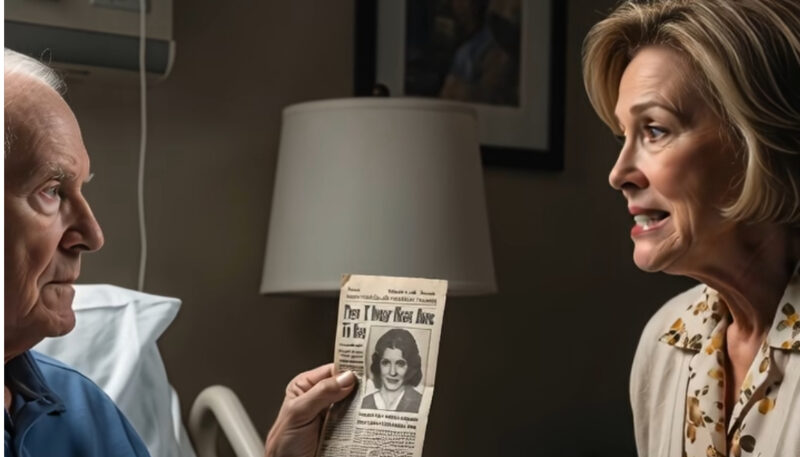
Confirmation came from the most unlikely of sources. Evelyn had brought in a stack of old newspapers one day. “Something to keep your mind sharp, Arthur,” she’d said. Days later, as I was idly flipping through them, I found a small clipping from an Ohio paper, tucked inside, used as wrapping for a scone.
And I saw it. Using the magnifying glass I always kept with me, I looked at a photo of a woman receiving an award from a police chief for “helping to dismantle a ring of con artists.” The face was ten years younger, the hair a different color, the name different—Helen Sharp—but the eyes, it was unmistakably her. I read the article. The “Angel Ring,” they’d called themselves, had preyed on wealthy seniors. And the “hero” Helen Sharp had turned on her partners in exchange for a deal and a disappearing act.
A chill went down my spine. She wasn’t just a grifter; she was an informant, a snake willing to shed its skin to survive.
I knew I couldn’t cause a scene. Who would believe an 80-year-old man, already declared “confused” by his own son, over the charming, devoted Evelyn? I had only one resource: the young nursing aide, Maria. She was kind, bright, and most importantly, she was genuinely fond of me.
The next afternoon, as Maria was checking my blood pressure, I made my move. I tapped the newspaper clipping. “Maria, my dear,” I said, my voice deliberately frail. “My old memory is so dreadful. This woman looks like an old movie star I simply can’t place. Could you do an old man a favor? Could you look up the name ‘Helen Sharp’ and the phrase ‘the Angel Ring’ online for me? It’s just a silly curiosity.”
I had planted the seed. Now I could only hope it would grow.
Maria, out of curiosity and affection, did as I asked. That evening, on her break, she sat at the nurses’ station computer. A simple search opened a rabbit hole of true-crime articles, online forums, and warnings. She found other pictures of Helen Sharp, Evelyn’s alias. She found stories of other elderly people who had died suspiciously after befriending a new “neighbor.” And then she found the jackpot: an active fugitive warrant for Helen Sharp out of Arizona for fraud and suspicion of involvement in a disappearance.
Maria was horrified. The kind Ms. Evelyn who brought pastries was a wanted woman.
The next day, Evelyn arrived, looking more radiant than ever. She was holding a stack of handsomely bound legal documents. “Good morning, dear Arthur,” she chirped. “I’ve spoken with a wonderful lawyer. We’re going to set up a trust. Just to help you get your affairs in order, to protect your legacy from those who would take advantage.” This was her final move.
As Evelyn was explaining the terms of “placing your assets in the care of a trusted friend,” the door to my room opened. Maria entered. She was not alone. With her were the facility director and two plainclothes police officers.
Evelyn started. “Well, what’s all this?” she asked, her smile not faltering.
One of the officers stepped forward. He did not look at Evelyn, but at me. “Mr. Pendelton, we received some disturbing information. Are you alright, sir?”
“I am now, officer,” I said.
The officer then turned to Evelyn. He held up a tablet, on which was the clear, damning wanted poster for Helen Sharp, with Evelyn’s picture. “Ma’am,” he said, “I believe you have a lot to answer for.”
I have seen many dramatic moments in my history books, but nothing compared to watching Evelyn’s perfect mask shatter. The charm vanished, replaced by raw panic and a flash of pure hatred in her eyes as the handcuffs clicked around her wrists.
The collapse was swift. Evelyn, a.k.a. Helen Sharp, was arrested. Faced with the warrant and incontrovertible evidence, her nationwide crime spree was over.
The investigation into Evelyn laid bare her entire scheme, including her manipulation of Robert. He was brought in for questioning. He tried to blame Evelyn, but the power of attorney he’d forced me to sign was undeniable proof of his own crime. He had tried to steal a house and ended up losing his own freedom.
I was no longer seen as “senile” or helpless. The nursing home was profoundly apologetic. All documents I was forced to sign were voided by a judge. I was free.
But I didn’t go back to the old house. It was tainted with too many sad memories. I sold it. With the money, I did two things. First, I established a trust in my late wife’s name, the Eleanor Pendelton Fund, to provide pro bono legal aid for victims of elder abuse. Second, I paid for Maria’s entire nursing school tuition, ensuring she could complete her degree without the burden of debt.
The final scene is not me alone in a dusty library. It is me, now living comfortably in a bright, modern, upscale assisted living apartment (my choice), sitting at a sun-drenched table, helping Maria study for her final exams.
“I still can’t believe it,” she said, looking up from her textbook. “You changed my life, Mr. Arthur.”
I smiled and placed my hand on hers. “You changed mine, my dear Maria. You reminded me that even when you feel most alone, there is genuine kindness to be found.”
My happy ending was not reclaiming my old life. It was building a new, meaningful legacy from the ashes of betrayal, and finding a new family, based not on blood, but on genuine care and mutual respect.