 My wife, Evelyn, informed me last Tuesday that our marriage was over. There was no sadness in her eyes, no regret in her voice. It was a declaration of victory. We were sitting in the living room of the house we had spent eight years turning into a home, and she was speaking to me with the detached finality of a corporate executioner.
“It’s over, Tom,” she said, placing a pristine file folder on the coffee table between us. The table was one I had built myself, crafted from reclaimed oak. She never liked it. “I’ve already spoken to a lawyer. These are my terms.”
I didn’t open the folder. I didn’t have to. She was more than happy to list her demands, each one a calculated blow designed to cripple me.
She wanted the house. The house my grandfather had helped me put a down payment on, a place filled not just with our memories, but with the echoes of my own family’s history.
She wanted seventy percent of our shared savings, the nest egg we had diligently built through years of careful budgeting and my summer construction jobs.
She wanted spousal support for a minimum of five years, a figure that would consume nearly half of my modest teaching salary.
It wasn’t a negotiation. It was a demand for my unconditional surrender. When she finished her list, she leaned back against the plush sofa cushions—cushions she had picked out—a confident smirk on her face.
“And I don’t want a fight on this, Tom,” she said, her voice dripping with condescending pity. It was a tone she had perfected over the years. “Let’s be realistic. You’re a high school woodshop teacher. You make a decent living, but you can’t afford a real lawyer. My guy will bury you in legal fees before you even see the inside of a courtroom. It’s better for everyone if you just agree to the terms and walk away.”
I just sat there, looking at this woman I had once loved with every fiber of my being. This woman I had built a life with, who I thought was my partner. A profound sense of coldness settled over me, chilling me to the bone. She didn’t just want to leave me; she wanted to ruin me. She saw my quiet nature not as a strength, but as a weakness. She saw me as an obstacle to be crushed and discarded on her way to something better. Her biggest weapon, she thought, was my inability to fight back.
I let the silence hang in the air for a long moment, the only sound the ticking of the grandfather clock in the hall, another family heirloom. Then I looked at her, my face a carefully constructed mask of resignation, and I said the two words she was expecting, the two words that would grant her everything she wanted.
“You’re right.”
The relief that washed over her face was immediate and absolute. She had won. The humble, simple teacher wasn’t going to put up a fight. She stood up, smoothing the front of her expensive skirt.
“Good,” she said, the condescension replaced by a brisk, business-like tone. “I’m glad you’re being sensible about this. You’ll be served with the official papers next week.”
Then she walked out of the room, her heels clicking decisively on the hardwood floors I had painstakingly refinished myself.
Here’s what Evelyn knew. She knew I was a man of simple means. She knew I didn’t have tens of thousands of dollars to throw at a legal battle. She knew that my passion was shaping wood, not navigating legal loopholes. She also knew that I had a brother, an older brother named Marcus.
What she also knew, and what she was banking on, was that Marcus and I hadn’t spoken in five years.
Marcus isn’t a teacher. Marcus is a shark. He is, without exaggeration, the most feared and expensive divorce attorney in the state. He’s a legal predator whose name, Marcus Sterling, makes other lawyers physically nervous. He operates in a world of high-stakes litigation and ruthless tactics that I could neither afford nor comprehend. And he was, for all intents and purposes, no longer a part of my life.
We had a falling out after our parents died. It was over the family home, the house we grew up in. I wanted to keep it, to preserve it as a memory, a place for our future families to gather. I’m sentimental like that. Marcus, ever the pragmatist, saw it as an illiquid asset tying up capital. He wanted to sell it, divide the money, and move on. We had a bitter, terrible argument that ended with us on opposite sides of a canyon of stubborn pride. We hadn’t spoken a single word to each other since.
Evelyn had witnessed the tail end of that fallout. She had seen my grief and my anger. She saw me as completely and permanently isolated from the only powerful person in my family. In her strategic calculation, my greatest potential asset was a dead one.
She was wrong.
For three days after her announcement, I was in a dark place. She was right about one thing: I couldn’t afford to fight her, not on her terms. The thought of losing my home, my savings, everything I had worked for, was suffocating. I felt like I was drowning. On the fourth day, I hit rock bottom. And from there, the only way to go was up.
I swallowed every last ounce of my pride, a pride that had cost me five years with my brother. With a shaking hand, I found his private cell phone number, a number I hadn’t dialed since our mother’s funeral.
I expected it to go to voicemail, or to be answered by a sharp-voiced assistant. But after two rings, a familiar, deep voice answered with a curt, “Sterling.”
My own voice sounded weak and foreign to my ears. “Marcus? It’s Tom.”
There was a long, heavy pause on the other end of the line. For a moment, I thought he was going to hang up. The silence stretched, filled with five years of unspoken words and unresolved anger.
“Tommy?” he finally said. The old nickname sounded strange after so many years, but it broke the dam inside me.
And it all came pouring out. I told him everything. I told him about Evelyn’s demands, her lawyer, her coldness, the affair I didn’t yet know about but suspected in my gut. And I told him her final, arrogant taunt. “You can’t afford a lawyer to fight me.”
Another long, heavy silence stretched between us. When he finally spoke, his voice was different. The surprise was gone, replaced by something I hadn’t heard in years. It was the sound of a protective older brother. It was the sound of steel.
“She said what?” he asked, his voice dangerously quiet.
I repeated her words.
“Okay,” he said, his tone now clipped and decisive. “When and where is the first court appearance?”
“Next Tuesday. Nine a.m. at the downtown courthouse,” I told him.
“I’ll clear my schedule,” he said. “Don’t talk to her. Don’t talk to her lawyer. Don’t sign a single thing. Just show up on Tuesday. I’ll meet you there.”
We hung up. I sat there, my heart pounding with a mixture of terror and a terrifying, unfamiliar hope. Evelyn thought she had disarmed me. She had no idea she had just handed me a secret weapon. She was about to learn a very hard lesson about what family really means.
The morning of the preliminary hearing was a miserable, rainy Tuesday. It felt appropriate. I walked into the courthouse alone, feeling every bit the part of the defeated man Evelyn expected me to be. I was wearing my best and only suit, the one I usually reserve for weddings and funerals. Today, it felt like a bit of both.
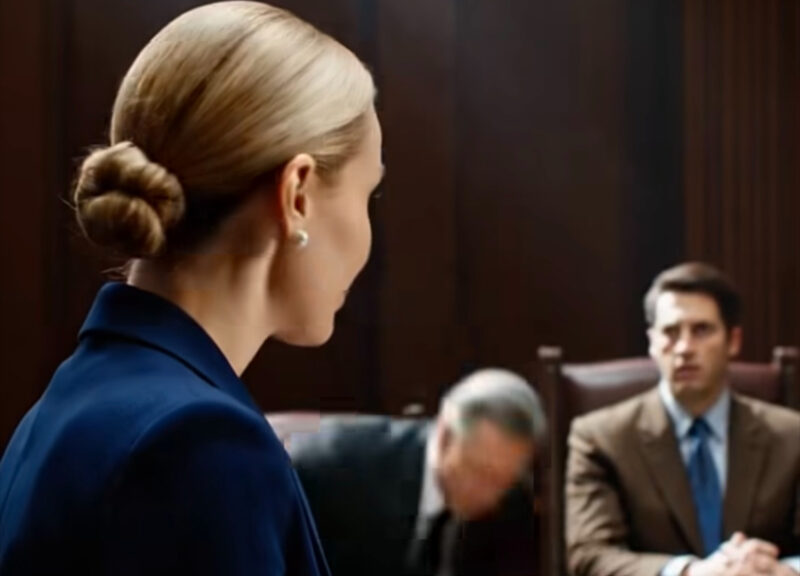
I entered the designated courtroom. It was a sterile, impersonal room that smelled of old paper and anxiety. Evelyn was already there, sitting at the plaintiff’s table. She looked incredible, wearing a sharp, dark blue power suit, her hair perfectly styled. She looked confident, smug, and ready for a corporate takeover. Next to her sat her lawyer, a man in his fifties with a self-satisfied smirk permanently affixed to his face. They were laughing quietly together as I walked in.
She saw me, and her smile faltered for just a second, replaced by a look of pity that was somehow worse than her scorn. She probably expected me to look more broken. I just met her gaze, my expression blank, and walked over to the defendant’s table. I sat down, placed my old, worn briefcase on the table, and waited.
Her lawyer, a man named Alan Davis, sauntered over. “Mr. Miller,” he said, his voice oozing condescension. “Glad to see you’re here. I trust you’ve had time to review my client’s very generous proposal. If you’re prepared to sign today, we can make this quick and painless for you.”
“I’m waiting for my counsel,” I said quietly.
He actually chuckled. “Your counsel? Right. Good luck with that. Let’s not drag this out, shall we?” He walked back to his table, shaking his head.
The bailiff called the court to order. The judge, a stern-looking woman, entered and took her seat. She looked down at the docket. “Miller versus Miller,” she announced. “Are both parties present and represented?”
Evelyn’s lawyer stood up. “Yes, Your Honor. Alan Davis representing the plaintiff, Mrs. Evelyn Miller.”
The judge looked at me. “And the defendant?”
Before I could speak, the heavy doors at the back of the courtroom swung open with a resounding thud. Every head in the room turned.
Walking down the aisle was my brother, Marcus Sterling. He wasn’t just wearing a suit; he was wearing a suit of armor tailored from what looked like spun midnight and pure intimidation. He moved with the predatory grace of a panther, his expensive leather briefcase swinging at his side. A wave of whispers rippled through the courtroom as other lawyers and court staff recognized him. His reputation preceded him.
He didn’t look at anyone else. His eyes were fixed on me. He walked directly to my table, put a hand on my shoulder, and squeezed it gently—a gesture from our childhood, a silent promise of support. Then he sat down beside me, placing his gleaming briefcase on the table with a solid, definitive click. The sound echoed in the silent room.
I looked over at Evelyn. Her smug expression had been completely wiped away. It was replaced by a mask of utter, horrified disbelief. Her jaw was slack, her eyes wide. She looked like she had just seen a ghost walk in and sit down at the opposing table.
Her lawyer looked even worse. The color had drained from his face, and his smirk was gone, replaced by a look of pure, unadulterated terror. He knew exactly who my brother was.
Marcus leaned over to me, ignoring the rest of the room. “Sorry I’m late, little brother,” he whispered, a hint of a smile playing on his lips. “Traffic was terrible.”
Then he straightened up, his demeanor all business. He looked directly at the judge. “Marcus Sterling, Your Honor,” he said, his voice a commanding baritone that filled the room. “Representing the defendant, Mr. Thomas Miller.”
The judge’s eyebrows shot up. She knew the name. Everyone did.
Then Marcus turned his gaze slowly, deliberately, towards Evelyn. He looked at her, then at her terrified lawyer, and he gave them a cold, predatory smile. “My apologies for the delay,” he said, his voice dripping with mock politeness. Then he looked Evelyn straight in the eye and delivered the line that shattered her entire world.
“He doesn’t have to afford me. I’m his older brother.”
The game had just changed. Evelyn thought she was coming to a surrender. She had just walked into an ambush.
The two months following that first court appearance were a legal onslaught. My brother Marcus does not do things by halves. He doesn’t just practice law; he conducts a campaign. Evelyn and her lawyer thought they were going to roll over me. Instead, they found themselves on the receiving end of a relentless, systematic deconstruction of their entire case.
The first thing Marcus did was file a motion for discovery that was, by all accounts, a thing of terrible beauty. It wasn’t a request; it was a demand for every single financial document Evelyn had touched for the last five years. Bank statements, credit card bills, work expense reports, Venmo transactions, everything. Her lawyer filed a motion to have it dismissed as “overly broad and harassing.” The judge, who was clearly aware of my brother’s reputation, took one look at Marcus’s justification and approved our motion in full. Evelyn was legally obligated to turn over everything.
She thought she was clever, that she had hidden her tracks. She had no idea she was dealing with a man who employed a team of forensic accountants for fun.
While Evelyn was drowning in paperwork, Marcus went after her personally. He scheduled a series of depositions, not just with her, but with her closest friends, her family, and even a few of her colleagues. His strategy was simple: apply pressure from all sides until the truth was squeezed out.
The breakthrough came during the deposition of Evelyn’s best friend, a woman named Chloe. Chloe was fiercely loyal to Evelyn, but she was no match for my brother. He was polite, charming, and utterly ruthless. For three hours, he questioned her about Evelyn’s spending habits, her work trips, her general happiness in our marriage. Then he asked the question that broke the case wide open.
“Miss Albright,” he said, his tone casual, “can you tell me about Mr. David Kincaid?”
I saw Chloe flinch. The name was unfamiliar to me. Marcus just waited, letting the silence do the work. Chloe tried to play dumb, but Marcus produced a stack of credit card statements from a card I never knew Evelyn had. A card linked to our joint savings account—an account she had been siphoning money from for over a year. He pointed to a series of charges: a hotel in wine country, jewelry from a high-end boutique, expensive dinners for two.
“Mrs. Miller was supposedly on a work conference on these dates,” Marcus said calmly. “But her employer has confirmed no such conference existed. You were not with her. So I ask you again, who is David Kincaid?”
Chloe broke. Under penalty of perjury, she admitted it. David Kincaid was the wealthy real estate developer Evelyn had been having an affair with for the last eighteen months. It all clicked into place: the secrecy, the financial demands, the unshakeable confidence. She wasn’t just leaving me; she was leaving me for someone else. She was trying to strip-mine our marriage for assets to take with her into her new, upgraded life.
The deposition of her lover, David, was even more illuminating. He was a smug, arrogant man, but his arrogance crumbled under Marcus’s relentless questioning. He admitted to the affair. He admitted that he and Evelyn had planned the divorce together. He even admitted it was his idea for her to demand the house and spousal support, telling her that I would be “too poor and too weak” to fight back.
They had underestimated me. More importantly, they had underestimated my family.
With these depositions, Evelyn’s case was not just weakened; it was annihilated. She had committed perjury in her initial filings. She had hidden assets. She was a liar and a fraud. Her lawyer called Marcus, begging to settle. He said Evelyn was willing to drop all her demands and just walk away.
Marcus’s reply was cold and final. “No. Walking away is a privilege she has not earned. We are not settling. We are going to court, and we are going to dismantle her case, piece by piece.”
She had wanted a fight. Now she had one.
It has been six months since I first walked into that courtroom, a man who thought he had lost everything. Today, I can tell you that I was wrong. I didn’t lose anything that truly mattered. I gained it all back.
The final court date was a formality. Faced with the mountain of evidence against her—the depositions, the forensic accounting reports, the proof of her affair and her conspiracy to commit fraud—Evelyn had no choice but to surrender completely. Her lawyer, looking tired and utterly defeated, advised her to accept any terms we offered.
And the terms my brother drafted were brutal, but just.
Evelyn didn’t just walk away with nothing; she walked away with less than nothing. She was forced to relinquish any claim to the house. Her demand for spousal support was dismissed with prejudice. And because Marcus proved that she had spent over sixty thousand dollars of marital assets on her affair—on hotels, gifts, and vacations with her lover—the judge ordered that amount to be deducted from her share of our savings and returned to me. She left the marriage with a small fraction of her original demand, a mountain of her own legal bills, and the public humiliation of having her entire sordid scheme laid bare.
The fallout in her personal life was just as devastating. Her lover, David Kincaid, faced with the legal and social consequences, dumped her almost immediately. He was a man attracted to a winner, and Evelyn had just suffered a spectacular public defeat. Her friends, many of whom had been forced to testify about her lies under oath, distanced themselves. She lost her fiancé, her claim to the house, her savings, her boyfriend, and her reputation, all because she underestimated the quiet man she was married to.
But the real story, the most important part, is what happened with my brother.
A few weeks after the divorce was finalized, Marcus called me. “Meet me at the old house,” he said.
I drove out to our parents’ home, the house that had been the source of our stupid, five-year feud. I found him on the front porch, just sitting on the steps. We didn’t talk about the case or about Evelyn. We talked about our dad’s terrible fishing trips and our mom’s amazing apple pie. We talked about being kids.
Finally, after a long silence, he looked at me. “I was wrong, Tommy,” he said. “I was so focused on the money, on the asset, that I forgot what this place was. It’s our home.”
“I was wrong, too,” I admitted. “I was so stuck in the past, I wasn’t willing to see that maybe there was a different future for this place.”
We didn’t sell the house. We decided to keep it, together. We’ve spent the last few weekends out there fixing it up—repairing the porch, painting the rooms, bringing it back to life. It’s not a memorial to the past anymore; it’s a project for our future, a place for our family, the real one, to gather.
Working side-by-side with my brother, tools in hand, has healed a wound I thought would be a scar forever. Evelyn’s parting shot to me was that I couldn’t afford a lawyer. Her greed and her arrogance—her belief that I was weak and alone—was the very thing that forced me to make the call that brought my brother back into my life. She thought she was isolating me. Instead, she reunited me with the most important family I have.
She tried to leave me with nothing. But as I stand here today, with my home secure and my brother by my side, I realize I have everything.