The invitation came on a Tuesday. “Mom, come for dinner Friday night. Just family, nothing fancy.”

My son Michael’s voice on the phone carried that careful tone he’d developed since his father died, the one that treated me like fine china that might crack at any moment. I was sixty-three years old, not ancient and certainly not fragile, but grief has a way of making people around you walk on eggshells.
“I’d love to,” I told him, and I meant it. The farmhouse where Robert and I had raised our children felt cavernous these days, filled with forty years of memories and the particular silence that comes after a long marriage ends. Not with a fight, but with a heart problem on a Wednesday morning while he was checking the fence line in the north pasture. Two years had passed since that morning, two years since I’d found him there, facedown in the tall grass, his work gloves still on his hands.
I arrived at Michael’s house at six-thirty, carrying a pie I’d baked that afternoon. Apple, because it was Robert’s favorite and because keeping my hands busy stopped them from shaking. My daughter-in-law, Vanessa, answered the door. She’d always been beautiful in that carefully maintained way: highlighted hair, expensive athleisure wear, a smile that never quite reached her eyes.
“Brittney,” she said, kissing the air near my cheek. “You shouldn’t have. We have dessert.”
“I wanted to,” I said simply, handing her the pie. The house smelled of roasted chicken and something else I couldn’t quite place. A cologne, maybe, tugging at a memory that slipped away before I could catch it.
“Where’s Emma?” I asked, looking for my granddaughter.
“Sleepover at Madison’s house,” Vanessa said. “We thought it would be nice, just the adults tonight.” Something in her tone made me pause, but Michael appeared from the kitchen, wiping his hands on a dishcloth.
“Mom, you made it.” He hugged me, and I felt the tension in his shoulders, the way he held me just a beat too long.
“Of course I made it,” I said, pulling back to study his face. “Are you feeling all right? You look tired.”
“Work’s been crazy,” he said, not meeting my eyes. “Come on, let’s eat. Everything’s ready.”
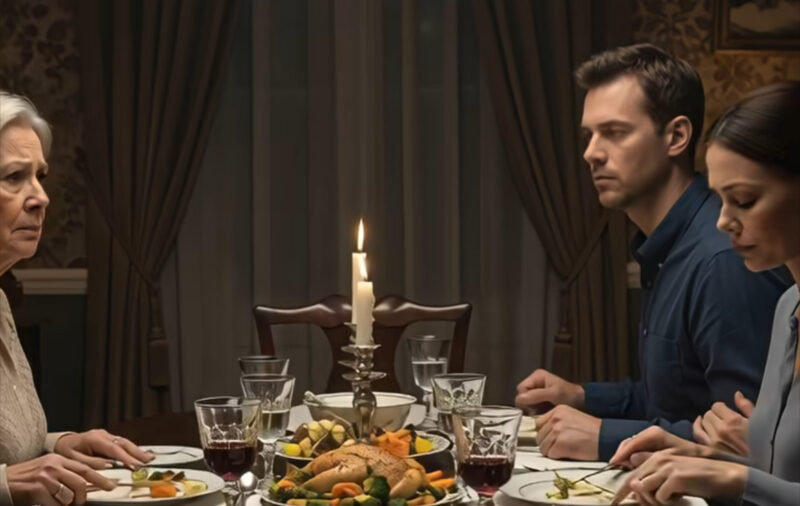
The dining room table was set with Vanessa’s good china, the cream-colored set with gold trim her mother had given them. Candles flickered in crystal holders. It was lovely and formal and completely unlike our usual casual family dinners. And then I saw it. Four place settings. Four plates, four sets of silverware, four wine glasses catching the candlelight. But there were only three of us.
The fourth place was set at the head of the table. Robert’s place. The position he’d always occupied in our own home, the seat of the patriarch, the man who was supposed to guide and protect his family.
My breath caught in my throat. “Michael?” My voice came out steadier than I felt. “Why are there four places?”
He turned pale. Actually pale, the color draining from his face like someone had opened a tap. Vanessa’s hand flew to her mouth. For a moment, nobody spoke. The classical music continued its pleasant meandering, completely at odds with the sudden tension that filled the room like smoke.
“Michael,” I said again, more firmly this time. “What’s going on?”
He exchanged a look with Vanessa, one of those married-couple looks that communicates volumes. She gave a tiny shake of her head, but he straightened his shoulders like a man preparing to jump into cold water.
“Mom,” he said slowly, carefully. “There’s something we never told you.” The room tilted slightly. I reached for the back of a chair to steady myself. “About your father.”
“Please sit down,” Vanessa said, her voice gentler than I’d heard it in months. “This is going to be difficult.”
I sat, but not in my usual place. I chose the chair closest to the door, some instinct making me want an exit nearby. “Tell me.”
Michael sat across from me, his hands flat on the table. “Dad didn’t pass away the way you think he did.”
“He had a heart issue,” my voice sounded strange to my own ears, distant and hollow. “In the north pasture. Dr. Morrison said it was massive, instantaneous. He wouldn’t have suffered.”
“That’s true,” Michael said. “But there’s more, Mom. In the months before he passed, Dad was… he was investigating something. Something that scared him.”
I stared at my son, this man whose scraped knees I’d bandaged and whose nightmares I’d soothed. “What are you talking about?”
Vanessa stood abruptly. “I’ll get the box.”
“What box?” I asked, but she was already gone.
Michael rubbed his face with both hands. “A few weeks before he passed, Dad came to me. He was agitated, more worried than I’d ever seen him. He gave me a box, a locked box, and made me promise to keep it safe. He said if anything happened to him, I should wait two years, and then… then I should tell you.”
“Two years?” I repeated numbly. “Why two years?”
“He said you’d need time to grieve first. Time to be strong enough to handle what was inside.”
Vanessa returned carrying a small wooden box with brass corners and a keyhole. She set it on the table with a soft thunk. I recognized it immediately. It was a keepsake box his father had made for him, carved from walnut with their initials intertwined on the lid: RC + JC. Robert Caldwell and James Caldwell.
“This was in the basement,” I said. “I saw it down there last month.”
“No,” Michael said quietly. “That was a different box. Dad made a replica to leave in its place. He didn’t want you to know this one was gone.”
My husband had deceived me. The man I’d slept beside for forty-one years had hidden things, created false boxes to cover his tracks.
“Open it,” I said.
Michael produced a small brass key, his hands shaking as he inserted it into the lock. The lid lifted with a soft creak. Inside, the box was lined with red velvet. But instead of keepsakes, it held documents, photographs, and on top of everything, a letter in Robert’s handwriting. My name, Brittney, written across the envelope.
Brittney,
If you’re reading this, I’m gone. I’m sorry for the secrets, but most of all, I’m sorry for what you’re about to discover. Our life together was real. My love for you was real. But my past… my past was someone else’s entirely.
Burn everything in this box after you’ve read it. Trust no one. And whatever you do, don’t let them know you know. Your life may depend on it.
R.
My hands trembled as I set the letter down. “What does this mean? Who are ‘they’?”
Michael’s face was drawn, aged beyond his years. “I don’t know, Mom. Dad never told me. He just said that when the two years were up, you’d need to know the truth about who he really was before he came to Millbrook. About why he never talked about his family… about the money.”
“What money?”
Vanessa pulled a photograph from the box. It showed a young man in his twenties, handsome and smiling, standing in front of a mansion I didn’t recognize. He wore an expensive suit and had his arm around a beautiful woman in pearls. The young man was Robert, but he looked different, his expression more arrogant, his bearing that of someone from a world I’d never known.
“Who is that woman?” I whispered.
“We don’t know,” Michael said. “But look at the date on the back.”
I flipped it over. Written in faded ink: Newport, July 1982. The month before Robert had arrived in Millbrook, looking for farm work. The month before he’d walked into the diner where I was waitressing and our life together had begun.
“There’s more,” Michael said, his voice a whisper. He pulled out a yellowed newspaper clipping. The headline read: PROMINENT BOSTON FAMILY HEIR MISSING, FOUL PLAY SUSPECTED.
I couldn’t breathe. The photograph accompanying the article showed the same young man, but the name beneath it wasn’t Robert Caldwell. It was James Whitmore III.
“Mom,” Michael said, and I heard the fear in his voice. “I think Dad was running from something… or someone. And I think… I think whoever he was running from might have found him.”
The doorbell rang. We all froze. The sound echoed through the house, jarring and wrong.
“We’re not expecting anyone,” Vanessa whispered.
Michael stood slowly, moving toward the window. He lifted the edge of the curtain and peered out. When he turned back, his expression confirmed my worst fears. “There’s a car in the driveway. Black sedan, tinted windows. Two men in suits just got out.”
The doorbell rang again, longer this time, more insistent.
“Don’t answer it,” I heard myself say. My voice sounded strange, hard. Nothing like the gentle widow everyone thought they knew. “Michael, is there a back door?”
“Mom, what are you—?”
“Is there a back door?” I repeated, louder now.
“Yes, through the kitchen.”
I grabbed the box, shoving Robert’s letter into my purse along with the photograph and the clipping. My hands moved with a certainty that surprised me.
“Listen to me very carefully,” I said, looking at both of them. “You’re going to answer that door in exactly thirty seconds. You’re going to tell them I left an hour ago. You’re going to act natural, surprised they’re here, confused about what they want. Can you do that?”
They stared at me like I’d grown a second head. The doorbell rang a third time, now accompanied by a firm, authoritative knock.
“Can you do that?” I repeated urgently. Michael nodded slowly.
“Good,” I said, moving toward the kitchen. “Don’t call me. Don’t text. I’ll contact you when it’s safe.”
“Mom, wait!” But I was already gone, slipping out the back door into the October darkness, Robert’s box clutched against my chest. My husband had been someone else, someone important enough that people were still looking for him forty-three years later. And now they were coming for me.
I drove for twenty minutes before I allowed myself to think, taking back roads to the farmhouse. When I arrived, I went inside and locked the door, throwing the deadbolt for the first time in memory. The house felt different now, every shadow hiding a secret.
I made strong, black coffee and spread the contents of Robert’s box across the kitchen table. The newspaper clipping was dated August 15, 1982. James Whitmore III, twenty-six, heir to the Whitmore textile fortune, had been missing for three weeks after bloodstains were found in his Beacon Hill apartment. His father had offered a one hundred thousand dollar reward.
I found a wedding announcement: the engagement of Miss Caroline Ashford Peyton to Mr. James Whitmore III. A June wedding had been planned. The photo showed a young woman with perfect bone structure and a smile full of old money. Caroline Ashford Peyton. Not the woman in pearls. Someone else.
I was so absorbed that I didn’t hear the car until gravel crunched in the driveway. My blood turned to ice. I switched off the kitchen light and moved to the window. A dark SUV sat in the driveway, headlights off. They were just watching the house.
My phone buzzed. A text from Michael. Mom, where are you? Those men said they were from the estate lawyer’s office. Had questions about Dad’s will. Are you okay?
I didn’t respond. Instead, I gathered the contents of the box. I needed a place to hide it. The attic. The crawl space behind the chimney.
I was halfway up the attic stairs when I heard the soft click of someone testing the back door. I moved faster, climbing into the cramped, dusty attic and pulling the stairs up behind me. I crawled to the chimney, pulled away the sheet of plywood Robert had used to cover the crawl space, and shoved the box deep inside. Below me, I heard the unmistakable sound of breaking glass. They were inside.
I stayed frozen, barely breathing, listening to footsteps moving through my house. Two sets, maybe three. They weren’t trying to be quiet anymore.
“Nothing down here,” a man’s voice—educated, Boston accent. “Check upstairs.”
Footsteps on the stairs. I pressed myself against the rafters, praying they wouldn’t think to look up.
“Bedrooms clear,” another voice called. “Car’s here, so she can’t be far. Check the outbuildings.”
The footsteps retreated. Through a gap in the attic boards, I could see flashlight beams sweeping across the yard toward the barn. I had maybe five minutes. I scrambled down from the attic, grabbed my purse, and slipped out the front door, staying in the shadows. The SUV blocked my car. I’d have to walk. The nearest neighbor was the Morrison farm, two miles through the woods. Ben Morrison had been Robert’s closest friend. He was eighty now, a widower like me, living alone with his memories and his guns.
I started running, following the old deer path. Behind me, I heard shouting. They’d figured out I’d run.
“Fan out! She can’t have gotten far!”
I ran harder, my breath coming in gasps. A flashlight beam swept across the trees to my right. Too close. I dropped to the ground behind a fallen log.
“I’ve got movement! Sector Three!” a voice called into a radio. “Pursuing!”
The footsteps came closer. I could see the outline of a man, tall and broad-shouldered. I grabbed a handful of dirt and rocks and threw it as hard as I could to my left. The man spun toward the sound, and I bolted in the opposite direction.
“There!” he shouted. “She’s running!” But I had a head start, and I knew these woods. I burst into Ben Morrison’s backyard just as lights came on in the house. The back door opened and Ben appeared, shotgun in hand.
“Brittney!” His voice was sharp with alarm. “What in the hell?”
“Ben, please,” I gasped. “I need help. There are men chasing me. They broke into my house.”
He didn’t hesitate. “Inside. Now.” I stumbled through the door and he locked it behind us, flipping off the lights.
“How many?” he asked quietly.
“Three, maybe four. They’re not just burglars, Ben. They’re looking for something to do with Robert.”
In the dim light, I saw his expression harden. “Robert and I talked, toward the end. He was worried. Said if anything happened to him, you might need protecting.”
“He told you?” The betrayal cut deep.
“I knew he had a past he didn’t want found,” Ben said carefully. “I didn’t ask questions. But he made me promise that if trouble ever came looking, I’d make sure you were safe.”
A flashlight beam swept across the yard. “They’re coming,” I whispered.
“My truck’s in the garage,” Ben said, shotgun ready. “Keys in the ignition. You go out the front. Head to the police station. Go on now. And Brittney?” He looked at me, and in his eyes, I saw the soldier he’d once been. “Robert loved you. Whatever else he lied about, that was true. He said you were the only real thing in his whole damn life.”
I squeezed his arm and ran through the dark house to the garage. The engine roared to life, and I peeled out of the driveway, headlights off. In the rearview mirror, I saw flashlights converging on Ben’s house. Then I heard the shotgun blast.
My phone rang, a number I didn’t recognize. Against my better judgment, I answered.
“Mrs. Caldwell,” a woman’s voice, cultured and cold. “Or should I say, Mrs. Whitmore? We need to talk. About your late husband, about the money he took, and about the very serious trouble you’re in unless you cooperate.”
“Who is this?”
“Someone who’s been looking for James Whitmore for forty-three years. Someone who deserves answers. Someone who has no patience left.”
The line went dead. I stared at the dark road ahead and realized with sickening certainty that this was only the beginning.
I didn’t go to the police station. Something told me that involving local law enforcement would be a mistake. These people had resources. Instead, I drove to the one place I thought they might not look: the Millbrook Public Library. I had the security code from my time on the library board. I let myself in and made my way to the computer section.
My hands trembled as I typed James Whitmore III, Boston missing, 1982. The results flooded the screen. The Whitmore family had been Boston royalty. James had been the golden child, Harvard-educated, groomed to take over the family business until he disappeared. He’d been engaged to Caroline Ashford Peyton. I searched for her name and found a recent article: BOSTON PHILANTHROPIST CAROLINE PEYTON ASHCROFT DONATES $5 MILLION TO CHILDREN’S HOSPITAL. The photo showed an elegant woman in her sixties with a practiced smile that didn’t reach her eyes. She looked like someone who didn’t forgive easily.
 I was so focused I almost didn’t hear the library’s front door open. I killed the monitor and dropped behind the circulation desk, my heart hammering.
“Mrs. Caldwell,” a man’s voice, younger, with a hint of Brooklyn. “I know you’re here. The truck outside gave you away. We’re not here to harm you. We just want to talk.”
I stayed silent.
“My name is Daniel Torres. I’m a private investigator. I was hired by the Whitmore family to find out what happened to James.” He was almost at the desk now. “Here’s what I think happened. I think James stumbled onto something he wasn’t supposed to know, something about his family’s business. I think he threatened to expose it, and someone tried to silence him. But he was smart. He survived, and he ran.”
He crouched down, and suddenly we were face to face through a gap in the desk. He had dark, sympathetic eyes. “Please,” he said, “let me help you before they find you again.”
I made a decision. I stood up slowly.
“How did you know I’d come here?”
“I’ve been watching you for three weeks, Mrs. Caldwell. Learning your patterns. You come here every Tuesday. It seemed like a logical place.”
“Three weeks? You’ve been watching me since before those people showed up?”
“I had to make sure you weren’t part of whatever James was running from. That you were innocent.” He pocketed his phone. “You are, by the way.”
“Then why did he lie to me?”
“To protect you. Because whatever he knew was dangerous enough to warrant silencing. Still is, apparently.”
“There’s a box,” I said, exhausted. “Papers, photographs. He left it with our son.”
“I need to see it.”
“Why should I trust you?”
“You don’t,” he admitted. “But consider this. If I wanted to harm you, I could have done it three weeks ago. I’m here because I want the truth. And because… because my uncle was Carlos Torres. He was the original investigator. He spent thirty years searching for James. It consumed him. I took over the case to finish what he started.”
“The woman who called me,” I said, “she said Robert—James—took money.”
“That’s what his father claimed. Twenty million disappeared. But I’ve been through the records. The money wasn’t taken. It was moved. James wasn’t running from a crime; he was documenting one.”
“Documenting what?”
“Financial irregularities. The Whitmore business wasn’t just textiles. It was a front for washing money for some very dangerous people. James found out, gathered proof, and then they came for him.”
I thought of the box hidden in my attic. My phone buzzed. A text from Michael’s number. Mom, please call me. Vanessa is in the hospital.
My world tilted. “What?” I showed Torres the text.
He cursed under his breath. “They’re escalating. Using your family to pressure you.”
“Wait,” I said, a cold dread washing over me. “Call the number. Don’t text back. If it’s really Michael, he’ll answer.”
Torres’s eyes widened with understanding. He hit the call button and put the phone on speaker. It rang four times. Then a woman’s voice answered. The same cultured, cold voice from the earlier call.
“Mrs. Caldwell. So nice of you to reach out. Your son is fine, by the way. For now. As is your daughter-in-law. But my patience is wearing thin.”
“What do you want?”
“I want what James took from my family. I want the documents he used to betray us. And I want them within twelve hours. Or people you love start to get hurt.”
“Who are you?”
“Someone you should have met a long time ago. Someone who was supposed to be family.” Her voice dripped with venom. “I’m Caroline Peyton Ashcroft. James’s fiancée. The woman he abandoned. The woman who spent forty-three years wondering why.”
The line went dead.
Torres and I stared at each other. “She wants revenge,” he said.
“She has my family,” I replied. “And she wants evidence that could destroy powerful people.” I stood up, decision made. “We need to get that box. Now.”
We approached the farm from the east, on foot, through the woods. The farmhouse blazed with light. Two vehicles were in the driveway.
“They’re not even trying to hide,” Torres said.
“The attic,” I whispered. “The box is hidden behind the chimney. We can’t get in from inside. But there’s an access panel on the roof.”
We circled the house, staying in the treeline. I climbed the old metal ladder bolted to the wall, ignoring the rose thorns that tore at my skin. Torres followed. Inside the attic, we lay still, listening to the men searching below. I crawled toward the chimney. The plywood covering the crawl space had been moved.
My heart stopped. I reached inside anyway, my fingers scrabbling in the dust. Nothing. The box was gone.
“Torres,” I whispered, my voice breaking. “It’s not here.”
“They found it.”
“No,” the realization hit me like a physical blow. “They’re still searching. If they had it, they’d be gone.”
A board creaked directly below us. “Check the attic again,” a man’s voice said.
Footsteps on the attic stairs. Torres and I scrambled into the darkest corner, behind a stack of old furniture. Flashlight beams swept across the attic.
And then my phone rang. The cheerful tone I’d set for Michael’s number, impossibly loud in the silence. Everything happened at once. The flashlight swung toward us. Torres lunged, tackling the nearest man. I scrambled for the access panel. The second man grabbed my ankle and yanked. I went down, my head cracking against a beam.
“Brittney, go!” Torres shouted. I dropped the last six feet into the rose bushes and ran.
I made it two hundred yards into the fields when headlights blazed to life ahead of me, trapping me in their glare. A car sat idling, a woman standing beside it.
“Mrs. Caldwell,” she said calmly. “Please stop running.” And she was holding Robert’s wooden box.
“My name is Jennifer Matsumoto,” she said. “I’m an attorney. I’ve been the executor of your husband’s estate for the past two years, and I think we need to talk.” Behind me, I heard shouts. “Get in the car,” she said. “Now.”
I got in. As she drove, she explained. “Mr. Torres can take care of himself. He’s former military, former FBI. Your husband hired him three years ago to investigate the people looking for him and to protect you.”
My head spun. “Torres lied.”
“He was building trust while keeping you safe. His uncle wasn’t hired by the Whitmores; he was hired by your husband thirty years ago to keep watch.” She glanced at me. “Your husband planned for everything, Mrs. Caldwell. Every contingency. He left very specific instructions, including when and how you should learn the complete truth.”
My phone buzzed. A text from Michael’s number. Mom, I know you’re reading this. They say if you don’t give them the documents by dawn, they’ll harm Emma.
“They have my granddaughter,” I said, my voice hollow.
“No,” Jennifer’s reply was firm. “Your granddaughter is safe. I have people watching her. Two trained operatives disguised as her friend’s parents.”
“Then tell me. Tell me everything.”
“Not yet. First, we get somewhere safe.” We drove to a small, hidden cabin. “Your husband prepared this. He bought it fifteen years ago.”
Inside, Jennifer opened the wooden box. The contents were more organized, more complete. “The box Michael gave you was only the trigger. The full dossier has always been with me.” She pulled out a leather-bound ledger. “This is what they’re really after.”
I opened it. Page after page of transactions, dates, names—a complete map of how the Peyton family, Caroline’s family, had used Whitmore Textiles to wash money for dangerous people.
“Page seventy-three,” Jennifer said quietly. I flipped to it. A single transaction dated July 15, 1982. Twenty million dollars. And beside it, in Robert’s handwriting: Payment Received – C.A.P. Caroline Ashford Peyton.
“She wasn’t a victim,” I whispered. “She was the architect.”
“Your husband discovered her operation,” Jennifer corrected. “When he confronted her, she ordered him silenced. But she underestimated him. He took the evidence—and the money—and ran.”
My phone buzzed. A video from Caroline. Michael and Vanessa, tied to chairs in a warehouse, bruised but alive. Then a shot of Emma, safe and unaware, at her friend’s house. “The warehouse location will be sent to you,” Caroline’s voice-over said. “Come alone. Bring the documents. No tricks.”
The location arrived: an abandoned textile mill outside Harrisburg. The time: 6 a.m.
“So I’m the bait,” I said to Jennifer.
“You’re the key,” she replied. “You’re the only person who can make her angry enough to forget her caution, to reveal herself. Caroline is a serial killer who’s evaded justice for half a century. Don’t underestimate her.”
I walked into the abandoned mill just as the sky began to lighten. On the top floor, I found them. Michael and Vanessa, tied to chairs. Four armed men. And Caroline, silhouetted against the rising sun.
“You have something of mine,” she said without preamble.
“You have something of mine,” I countered.
“The documents, please.”
I held up the folder of copies Jennifer had prepared. “First, I want to know why. Why try to silence him?”
“Because he was going to destroy everything,” she said, her voice matter-of-fact. “My family, my future. He was going to be a hero while I went to prison.”
“The real man chose me over you,” I said, taking a step forward. “And he spent forty-three years documenting every crime you committed.” I opened the folder, showing her the first page of the ledger, her signature clear as day. “You think you’ve been looking for him? He’s been watching you, building a case, waiting for the perfect moment to destroy you.”
Caroline stared at the page, her face changing from arrogance to horror. “You’re bluffing.”
“Am I?” I pulled out my phone and showed her a draft email addressed to the FBI and the Boston Globe, with attachments clearly labeled. “One button. That’s all it takes.”
I saw the crack in her armor. Her hand moved to her purse, and I knew she had a weapon. I pressed the panic button.
The windows exploded inward as Torres and his team came through on ropes. Caroline’s men were taken down before they could fire. Caroline pulled out her gun, aimed it directly at my chest, her face twisted with rage. “You took everything from me!” she screamed.
I didn’t move. “No. You took everything from yourself.”
Her finger tightened on the trigger. A shot rang out. Caroline dropped, clutching her shoulder. Torres was at my side, his weapon raised. Jennifer appeared in the doorway, flanked by FBI agents.
“Caroline Peyton Ashcroft,” Jennifer said, “you’re under arrest.”
Caroline looked up at me from the floor. “You’ve won,” she said bitterly.
I knelt beside her. “My husband spent forty-three years in hiding because of you. He died never being able to use his real name. So, no, Caroline. This isn’t about winning. This is about justice. Finally.”
Three months later, I stood in the farmhouse kitchen, watching the January sun paint gold across the fields. The criminal cases against Caroline had made national headlines. She was in custody, her empire of lies crumbling under the weight of Robert’s meticulous evidence.
Jennifer Matsumoto visited, bringing bagels and news. “The federal investigation has expanded,” she said. “Fourteen indictments so far. And the money… it’s been recovered. With interest, it’s closer to sixty million dollars. It’s yours.”
“I don’t want it,” I said. “It’s blood money.”
“Which is why you’re going to do something good with it,” Jennifer said firmly. “Robert left specific instructions. He wanted a foundation to help victims of financial crimes.” She pulled out a document. The Robert Caldwell Foundation for Financial Justice.
“Yes,” I said, a sense of peace settling over me. “Yes, I agree.”
That evening, Michael called. He and Vanessa were moving back. “The farm is home,” he said. “It always has been. I want to work with you, Mom. To learn from you while I still can.”
After we hung up, I walked through the farmhouse, seeing it not as a place of secrets, but as a living space ready for a new generation. I pulled out Robert’s letter one last time. Our life together was real. My love for you was real.
I finally believed him. He had chosen this life, this farm, me—not as a disguise, but as a destination. The lies about his past were not lies about his present. The man who died in the north pasture was Robert Caldwell. That’s who he chose to be.
I carried the letter to the fireplace, but I didn’t burn it. I placed it in my jewelry box, next to my wedding ring. A reminder that love can contain contradictions, that a person can be two things at once, and that sometimes the greatest act of love is letting someone be complicated.
Spring came early that year. The foundation opened its doors. Robert’s sister, Margaret, visited, bringing stories of the boy who became my husband. We cried together, two women mourning the same man from different angles.
One evening, as the sun set over the corn, Emma asked me if I was happy. I thought about everything I’d lost and everything I’d gained.
“Yes,” I said finally. “I think I am. Your grandfather taught me that we can survive anything if we’re brave enough to face the truth. And that sometimes the most important truths are the simplest ones. Love is real. Family matters. And home is where we choose to build it.”
I was no longer the woman who’d been deceived. I was the woman who’d discovered that strength doesn’t come from never being broken. It comes from choosing to rebuild.