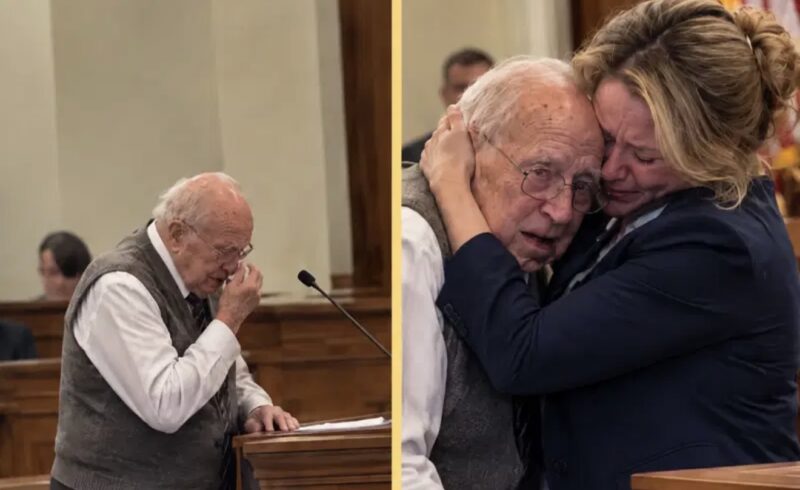
My 101-year-old neighbor was facing jail after being caught stealing more than $2,000 worth of merchandise. Even when the judge demanded an explanation, he refused to defend himself.
But I knew the secret he was protecting.
And when I finally revealed why he’d been taking baby clothes, groceries, and school supplies, the entire courtroom fell silent.
What nobody expected was that the young mother sitting in the back row had an even more emotional truth to share.
A truth that would leave my elderly neighbor crying for the first time in years.
“Mr. Walter, are you aware that you could receive a jail sentence?” the judge asked.
Walter stood before him, his frail hands resting on a wooden cane.
“Yes, Your Honor.”
“Then perhaps you can explain why you repeatedly took merchandise without paying.”
Walter lowered his eyes.
“I did it, sir. I’m responsible.”
The judge studied him carefully.
“At 101 years old, most people would expect you to be enjoying a quiet retirement, not appearing in court on theft charges.”
Walter nodded.
“I understand.”
The judge reviewed the photographs on his desk.
“Children’s clothing. Canned goods. Notebooks. School supplies.”
He paused.
“Store employees warned you several times. They initially chose not to report you because of your age, but the incidents continued.”
Walter remained silent.
“Over two thousand dollars in merchandise, Mr. Walter. Why?”
“I have no excuse, Your Honor.”
The judge leaned forward.
“Surely there’s something you’d like the court to understand before I decide what happens next.”
Walter tightened his grip on his cane.
“No, sir.”
I couldn’t remain silent any longer.
“There is something!”
Every face turned toward me.
Walter looked startled.
“Margaret, please sit down.”
I’d lived next door to Walter for thirty years.
I’d seen him weather the loss of his wife, struggle with illness, and endure years of loneliness.
But I’d never seen him look so frightened.
 “Your Honor,” I said, standing, “Walter made me promise to keep his secret. But I can’t sit here while everyone believes he was stealing for himself.”
I reached into my handbag and removed a folded letter.
“Please allow me to explain.”
The judge considered my request before giving me permission to speak.
I turned toward the back of the courtroom.
A young woman sat there with a small boy asleep against her shoulder.
“Her name is Sarah,” I began. “She’s a single mother raising three children.”
Sarah looked up, visibly confused.
“Her husband left two years ago. She works cleaning offices, but her earnings barely cover rent, groceries, and her children’s basic needs.”
Walter closed his eyes.
“Margaret, don’t.”
I continued.
“Everything Walter took from that store was intended for Sarah and her children.”
Sarah stared at me.
“What?”
“For months, Walter has been leaving bags of groceries, clothing, and school supplies outside your home.”
Her expression changed.
“But he told me he bought those things with his retirement money.”
“He did at first,” I replied. “But eventually, he ran out of savings.”
The judge turned toward Walter.
“Is that true?”
Walter nodded.
“Yes, Your Honor.”
“Why didn’t you explain that earlier?”
Walter glanced toward Sarah.
“Because she’s already carrying enough worries. I didn’t want her standing here believing this was her fault.”
Sarah covered her mouth.
Tears filled her eyes.
But there was still more the judge needed to know.
“Your Honor,” I continued, “Walter wasn’t the first person to show kindness. Sarah helped him long before he started bringing supplies to her house.”
I unfolded the letter.
It was written in Sarah’s handwriting.
“Dear Walter,” I read, “please stop trying to give me money for dinner. The children love having someone to look after. You’re part of our family now.”
The judge frowned thoughtfully.
 “Dinner?”
I nodded.
“Last winter, Walter became seriously ill.”
He was living alone.
His wife had passed away years earlier, and he had no children or close relatives nearby.
One freezing afternoon, Sarah noticed that Walter’s curtains had remained closed for two days.
Concerned, she knocked on his door.
When he finally answered, she discovered he was weak and hadn’t been eating properly.
From that evening onward, she began bringing him homemade meals.
Sometimes she invited him to join her children for dinner.
Walter usually declined, worried about becoming a burden.
He believed Sarah was simply sharing whatever leftovers her family had.
He thanked her repeatedly and offered to pay.
But she refused every time.
Then one evening, Walter noticed something unusual.
Sarah arrived carrying chicken, potatoes, and vegetables.
As he accepted the container, he asked whether she’d already eaten.
She smiled.
“I’m not hungry tonight.”
He thought nothing of it.
But several days later, Sarah’s oldest daughter delivered another meal.
“Has your mother had dinner?” Walter asked.
The girl shook her head.
“Mom says she’s not hungry again. She says we need the food because we’re still growing.”
Walter immediately understood.
Sarah hadn’t been bringing him extra food.
She’d been sacrificing her own meals to make sure an elderly neighbor didn’t go hungry.
I looked toward the judge.
“When Walter discovered what she’d been doing, he was devastated.”
Walter’s chin trembled.
“She had three children to feed,” he whispered. “And she was giving her dinner to me.”
He paused, struggling to steady his voice.
“I couldn’t stop thinking about it.”
From that moment, Walter became determined to repay her kindness.
He began purchasing additional groceries and leaving them at Sarah’s door.
He bought jackets when winter approached.
School supplies when classes resumed.
Clothes for her youngest child.
When his savings ran low, he sold his old wristwatch and several possessions.
But even that money eventually disappeared.
And instead of admitting he needed help, Walter made a terrible decision.
He began taking items from a local store without paying.
At first, employees warned him and let him leave.
But he kept returning.
Eventually, the store reported the repeated thefts.
“I knew it was wrong,” Walter told the judge.
His voice shook.
“Every time I thought about stopping, I remembered those children and their mother going without food.”
The judge listened quietly.
Walter lowered his head.
“But wanting to help doesn’t make what I did right. I understand that.”
I wiped my eyes.
“I found out when I saw him carrying several shopping bags home one afternoon. He eventually admitted what he’d been doing.”
Walter had begged me not to tell Sarah.
He worried she’d blame herself.
But now the truth was out.
Sarah began crying.
“Walter, I never wanted you to do any of this.”
“I know, sweetheart.”
“You could have told me what was happening.”
He gave a small, sad smile.
“And you would have told me to keep my money.”
“Of course I would!”
“That’s why I kept quiet.”
Sarah shook her head.
“And now you’re facing jail because you tried to help my children.”
Walter looked directly at her.
“No. I’m here because I broke the law. That decision was mine.”
For several moments, the courtroom remained silent.
Then Sarah slowly stood.
“Your Honor, may I say something?”
The judge nodded.
She adjusted the sleeping child in her arms.
“There’s something Walter doesn’t know.”
Walter looked at her.
“What is it, Sarah?”
She smiled through her tears.
“My children call you Grandpa Walter.”
His eyes widened.
“They do?”
She nodded.
“They’ve been calling you that for months. Just not when you’re around.”
A faint smile appeared on Walter’s face.
“Why not?”
“They were afraid you might think it was silly.”
Walter shook his head.
“Oh, sweetheart.”
Sarah took a breath.
“Every evening, when I set the table, the children insist on five places.”
The judge looked curious.
“Five?”
“One for me, three for my children, and one for Walter.”
She looked toward him.
“My youngest refuses to let me put your plate away until I tell him whether you’re coming to dinner.”
Walter’s eyes filled.
“He asks about me?”
“Every single evening.”
Walter covered his mouth with one trembling hand.
“I thought…” He stopped.
Sarah leaned forward.
“What did you think?”
“I thought your children were happy to see me because I brought them presents.”
Sarah shook her head.
“Walter, they were saving you a chair long before you ever brought us groceries.”
He began crying quietly.
She continued.
“Yes, those groceries helped us. I’m not going to pretend otherwise. But my children value something more than anything you could buy.”
Walter looked at her.
“What?”
“You.”
She smiled.
“They don’t need a man who brings gifts. They need the grandfather they’ve come to love.”
Walter lowered his head, overwhelmed.
For years, he’d believed he had nothing meaningful left to offer anyone.
Now he was discovering that three children had already welcomed him into their family.
The judge allowed the courtroom to settle before speaking again.
“Mr. Walter, what you’ve done is serious. The store suffered financial losses, and those losses must be addressed.”
Walter nodded.
“Yes, Your Honor.”
“However, I also believe the circumstances deserve careful consideration.”
Rather than immediately imposing a sentence, the judge postponed sentencing to allow time for a restitution plan to be developed.
I offered to contact our neighbors and organize support to help repay the store and ensure both households had enough food.
Several people in the courtroom expressed interest in helping.
Sarah promised Walter that she’d never let him face his difficulties alone again.
But Walter seemed barely aware of the conversations happening around him.
He kept looking toward Sarah.
As though he couldn’t quite believe someone had been saving him a place at the dinner table all along.
A few weeks later, I visited Sarah’s home.
The smell of roasted chicken filled the kitchen.
Her three children were sitting around the table.
And at the far end, beside the window, sat Walter.
His cane rested against his chair.
A plate of food stood in front of him.
Five places had been set.
Sarah’s youngest son climbed onto the chair beside Walter and gently took his hand.
“Grandpa Walter?”
Walter turned toward him.
“Yes, little man?”
The boy looked at him seriously.
“You don’t have to bring us groceries or presents anymore.”
Walter smiled.
“Well, what should I bring instead?”
The child wrapped both arms around him.
“Just yourself.”
Walter’s eyes filled with tears.
He held the little boy close.
For so many years, Walter had lived behind a closed door, convinced that growing older meant becoming less important to the world.
He thought he needed money or gifts to earn a place in someone else’s life.
But sitting at Sarah’s kitchen table, surrounded by three children who adored him, he finally understood something beautiful.
He hadn’t needed to buy their affection.
He’d already earned it simply by being there.
And the family he’d been trying so desperately to protect had been quietly protecting him, too.
Sometimes the greatest gift we can give someone isn’t money, food, or anything we can carry in our hands. It’s the simple assurance that they belong—and that someone will always be waiting for them at home.