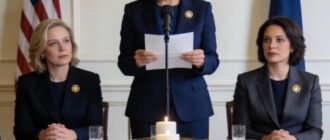
The funeral home was emptying when Tom pressed the envelope into my trembling hands. The cream-colored paper felt heavy, heavier than paper should, as if it carried the weight of secrets. “Robert wanted you to have this,” he whispered, his eyes avoiding mine, darting instead to the door where my children stood talking with the funeral director. “Open it when you’re alone.”

My husband of forty years was gone, and now his brother was handing me secrets from beyond the grave. Tom’s fingers lingered on the envelope for just a moment, like he was afraid to let it go.
“Maggie,” he said, and something in his voice made me look up at his face. He’d been crying, but there was something else in his expression. A warning. Fear. “Just remember, Robert loved you more than anything in this world.”
I waited until I was sitting in my car, hands still shaking from the day’s unbearable weight. The parking lot was nearly deserted, just a few scattered cars under the gray October sky. Through the windshield, I could see David helping Rachel with her coat, ever the protective older brother. They looked so normal, so appropriately grief-stricken. The envelope opened with a soft tear that sounded too loud in the silence.
Inside was a single brass key, old-fashioned and heavy, attached to a small tag with the number 47 written in Robert’s precise handwriting. But it was the note that stopped my heart.
My darling Maggie, it began, and I could hear his voice in those words. If you’re reading this, then I’m gone and Tom has kept his promise. I need you to know that everything I’ve done has been to protect you. Don’t trust your children.
I know how that sounds. But please, my love, trust me one last time. The truth is waiting in unit 47 at Henderson Storage on Maple Street. Tom has the access code. What you find there will explain everything. I’ve watched them dismiss you, minimize you, treat you like you’re somehow less than the woman who raised them. You always made excuses for them, my generous, forgiving Maggie. But I saw what you refused to see. They don’t deserve you.
I looked back at the funeral home, where David was now checking his phone while Rachel talked animatedly on hers. Even in grief, they were elsewhere, handling business, managing things.
I’m sorry I couldn’t tell you while I was alive, the letter concluded. I was afraid you’d confront them, give them a chance to manipulate you. You always saw the best in them. It’s time to see them clearly. All my love forever, Robert.
I sat there holding that key, feeling its edges bite into my palm. Forty years of marriage, two children, a lifetime of memories, and now this cold piece of metal that promised to shatter everything I thought I knew.
Six months earlier, our Sunday dinners were sacred. The dining room would fill with the warmth of family and the aroma of Robert’s famous ribeye. David would arrive first, always punctual, with a bouquet of yellow roses. “For the most beautiful woman in the room,” he’d say, kissing my cheek. Rachel would sweep in next with her husband, Martin, arms full of desserts, though she always brought her homemade apple pie, too. “Store-bought for backup, homemade for love,” she’d laugh.
The routine was as comfortable as a well-worn sweater. Robert would commandeer the grill, Rachel would help me set the table with my grandmother’s china, and David would pour the wine, always serving me first. “Ladies before lawyers,” he’d joke.
At dinner, David would regale us with courtroom victories, and Rachel would share marketing campaigns. Robert would beam with pride, reaching over to squeeze my hand under the table. Our kids, his expression would say, look what we made. These evenings felt like proof that every sacrifice had been worth it. We’d built something beautiful, something unshakable. “We did good, didn’t we?” he’d say as their cars disappeared down our street.
“We did perfect,” I’d answer, believing it with every fiber of my being.
The diagnosis came on a Tuesday. Pancreatic cancer, stage four. The words hung in the air of Dr. Morrison’s office like a toxic cloud. “With treatment, maybe six months,” he’d said. Robert gripped my hand so tightly I thought my bones might crack. David and Rachel arrived within the hour, a combined force of determination, already talking specialists and clinical trials. For a moment, I felt the warmth of family wrapping around us like armor.
But that evening, after Robert had gone to bed, I found them huddled in his study over papers spread across his mahogany desk.
“We need to be practical about the estate,” David said, not noticing me. “The house alone is worth two million now.”
“The investment portfolio is what, another three?” Rachel added, highlighting something with a decisive yellow stroke. “And there’s the vacation property in Tahoe.”
They hadn’t asked how I was coping. They were dividing up his life like he was already gone. When they finally saw me, David simply said, “Mom, we’re just being prepared. You’re emotional right now, which is completely understandable. Let us handle the business side of things.” The words stung like a slap, but I told myself it was fear. They were just processing in their own way.
As Robert grew weaker, my children grew more distant. Not from him, but from me. It was a slow erosion. They’d visit, sitting by his bedside sharing carefully curated memories. “Dad, remember when you taught me to throw a curveball?” David would reminisce, launching into a story as if I hadn’t been there too, catching the wild pitches and bandaging scraped knees. I’d stand in the doorway with Robert’s medications, and David would just reach out his hand without looking at me, taking the pills while continuing his story.
The nurses started directing their questions to him instead of me, even though I’d been managing Robert’s care twenty-four hours a day. “Mr. Whitmore, should we adjust your father’s pain medication?” they’d ask while I stood right there with the notebook where I’d tracked every dose.
One afternoon, I spent hours making Robert’s favorite soup, one of the few things he could still enjoy. I carried it upstairs, only to overhear Rachel on the phone in the hallway. “Martin, Mom’s just falling apart. She spent all day making soup when we have a freezer full of prepared meals. Thank God David and I can handle everything important.”
I stood frozen, holding that bowl of soup I’d made from love. That evening, when Robert weakly squeezed my hand and whispered, “Good soup, Maggie. Tastes like home,” I had to leave the room so he wouldn’t see me crying. In the bathroom mirror, I stared at my reflection. When had I become this ghost in my own life?
The hospice meeting was the final erasure. I arrived with my notebook, ready to share Robert’s carefully documented wishes, but David’s hand came down on mine. “Let me handle this, Mom.” He turned to the team with his professional smile. “Mrs. Whitmore seems overwhelmed. Perhaps we should designate medical power of attorney to someone more capable of making clear decisions.”
Rachel leaned forward, her expression rehearsed. “Mom’s always been emotional. Dad needs someone who can think logically right now.”
“I cry because I’m losing my husband,” I said, my voice smaller than I intended. “That doesn’t mean I can’t make decisions.”
But David was ready. “Just yesterday, Mom forgot to give Dad his afternoon medications. We found her in the kitchen making cookies while Dad was upstairs in pain.”
“The nurse had already given them!” I protested. “I was making his favorite cookies because the smell is one of the few pleasures he has left!” But my defense sounded weak, even to me. That night, David had the papers drawn up. “Just sign here, Mom. It’s for the best. You trust me, don’t you?”
My hand shook as I signed away my identity as Robert’s wife, protector, and advocate. I had become officially irrelevant.
The house felt cavernous after the funeral. I found myself sleeping on Robert’s side of the bed, wearing his old flannel shirt, desperate for a scent that was already fading. David had taken Robert’s watch collection for “safekeeping.” Rachel had boxed up his books to “donate appropriately,” keeping the first editions.
But it was the garage that broke me. I went looking for his old tackle box, and instead, I found emptiness. They had cleared out his entire workshop. The workbench he’d built himself, where he’d taught our children so much, was gone. The pegboard that held his tools in meticulous order had been stripped bare. I sat on the cold concrete floor and let myself truly cry, body-shaking sobs that echoed off the empty walls. They had taken every piece of him they decided I didn’t deserve to keep.
That’s when I saw it—an old photo of our wedding day, caught behind where the tool chest had been. We looked so young, so certain that together we could handle anything. Holding that photo, I wondered if I’d lost everything that mattered.
Three days later, I drove to Henderson Storage at two in the morning. The key turned easily in the lock of unit 47. The overhead light flickered on, and I gasped. The unit was an archive of our life—the real one.
The first box contained our original wedding china, the set I thought we’d sold to pay for David’s college. “You cried that night,” Robert had written on a note attached to the bubble wrap. “I couldn’t let them go.” Another box held my mother’s jewelry, pieces Rachel had claimed were lost. Each was carefully wrapped, each with a note. Rachel said these were dated. They’re timeless, like you.
But it was the manila folder marked TRUTH that made me sink to my knees. Inside were bank statements for an account in my name only, one Robert had been funding for fifteen years. Maggie’s freedom, the memos read, for when she needs it. The balance was enough to start over, to never have to ask for anything again.
Behind the statements was a folder of Robert’s letters, documenting instances I’d dismissed. Today, David told his friends you were ‘just a teacher.’ I’ve never been prouder of your career, my love. You shaped hundreds of lives while I just shaped deals. Another read: Rachel called you ‘simple’ for being content. She doesn’t understand that contentment is wisdom. You knew what mattered.
He had seen me drowning before I even knew I was in water. In a smaller box, I found copies of emails between David and Rachel, sent just after Robert’s diagnosis. Mom’s going to fall apart, Rachel had written. We need to get everything transferred to our names before she does something stupid. David’s response was worse: Already working on it. Dad’s too sick to notice, and Mom will sign anything we put in front of her. She always has.
The grief was still there, sharp as glass. But underneath it, something else stirred: clarity. Robert hadn’t just left me money. He’d left me evidence of my own value. I pulled out my phone and called Tom. It was nearly dawn.
“I found everything,” I said.
“Good,” he replied simply. “What do you want to do now?”
For the first time in months, I knew exactly what I wanted. “I want to take my life back.”
I played the grieving widow perfectly. When David called about settling the estate, I made small, non-committal humming sounds of agreement. When Rachel suggested a senior living community, I nodded absently. “Something with assistance available,” she’d said, scrolling through her phone.
“Of course, dear,” I’d replied, my voice wan and grateful. “You know best.”
Meanwhile, I met with James Chen, a lawyer Tom recommended. We learned that Robert had restructured everything six months ago. The house, the investments—it was all in an irrevocable trust. The Margaret Whitmore Living Trust. I controlled everything.
When David mentioned having me declared incompetent—“for your own good, Mom”—I recorded it. When Rachel brought papers giving her power of attorney over my accounts, I photographed every page before signing with a shaky hand, knowing the signatures were worthless. They thought my silence was surrender. They had no idea it was preparation.
The first crack appeared when David’s lawyer couldn’t find the deed to the house. The second was when Rachel discovered her name wasn’t on the investment accounts. “There must be some mistake!” she fumed at the bank manager, while I sat beside her, the picture of confusion.
I started having very visible coffee dates with my friend Grace, appearing composed and capable. I sent Robert’s friends small mementos, things my children would never miss but were priceless to the recipients. The story of my incompetence began to crumble.
The estate reading was held in Tom’s office. David and Rachel arrived with their lawyers, confident. They barely acknowledged me as I shuffled in.
“Before we begin,” David announced, “we’ve prepared a proposal for Mom’s care.”
“How thoughtful,” Tom said dryly. “Shall we proceed with your father’s actual wishes?”
He began to read. “Robert’s estate has been placed in an irrevocable trust, The Margaret Whitmore Living Trust… All assets are under Mrs. Whitmore’s sole control.”
David’s face went white. “What trust?”
Rachel stood sharply. “This is ridiculous! Mom can’t handle this! Dad must have been medicated when he signed this!”
“Actually,” Tom said, producing a tablet, “Robert insisted on recording his decision.”
Robert’s face filled the screen, thin but clear-eyed. “If you’re watching this, it means my children are attempting to take everything from their mother… This trust ensures she maintains the dignity and control they’ve been trying to strip away.”
The room went silent. Then I finally spoke, my voice steady. “Confused? Like when I managed our household for forty years? Overwhelmed? Like when I raised you both while teaching full-time?” I placed my phone on the table. Their recorded voices filled the room, plotting to manage me, to put me away.
“Your father knew exactly who you’d become,” I said, standing to my full height. “He watched you erase me. He documented all of it.”
“Mom, we were trying to protect you,” David whispered.
“No,” I said firmly. “You were trying to protect your inheritance.”
Tom then revealed the final document. Robert had also established separate “milestone trusts” for David and Rachel. A glimmer of hope flickered in their eyes. Tom handed them each a sealed envelope. I watched their faces crumple as they read the terms.
“Five hundred hours of volunteer work,” David said, his voice hollow. “At Mom’s old elementary school. Teaching.”
“Same for me,” Rachel whispered. “And a course on elder care ethics, plus a ten-thousand-word essay on the value of teachers in society.”
“Upon successful completion,” Tom continued, “you’ll each receive fifty thousand dollars. A teacher’s annual salary. Your father wanted you to understand what that means.”
“That’s it?” David’s voice cracked.
“And the house,” I added, pulling out a press release I’d prepared. “It’s being established as The Whitmore House for Educators, a residence for retired teachers facing financial hardship. The announcement runs in tomorrow’s paper. Everyone will praise Robert’s legacy, while you live with your shame.”
Their lawyer threatened to contest.
“Try it,” I said calmly. “I have recordings. I have emails. I have witnesses. Would you like to air all of that in court?”
I stood to leave. “Your father didn’t just protect me. He ensured that every time you try to diminish what I was, you’ll be reminded that it was everything to him. And now, it’s everything you’ll never have.”
Three months later, I stand in Robert’s workshop, now restored. The workbench sits exactly where he built it. On it is his last unfinished project: a jewelry box for our anniversary. I run my fingers over the smooth wood. His greatest gift wasn’t the money; it was seeing me clearly when everyone else had stopped looking.
The Witmore House for Educators welcomes its first residents next month. David has completed two hundred hours at the school. He calls sometimes, with genuine confusion in his voice. “Mom, there’s this kid… How did you handle seeing potential without resources? How did you not let it break your heart?”
“You let it break your heart,” I tell him. “Then you do what you can anyway.”
Rachel’s essays have started arriving. The third one made me cry. I watched my mother disappear, she wrote. Not all at once, but in small surrenders I mistook for simplicity… I see now that she was never small. We just stopped seeing her magnitude.
A start. It’s a start.
I keep Robert’s last letter in the jewelry box, which I finished with my own hands. Maggie, it says, you were never ‘just anything.’ You were everything. Don’t let them make you small. You’re the biggest thing that ever happened to me.
The afternoon light slants through the workshop window, golden. I’m not the woman who was erased. I’m not even the woman who fought back. I’m the woman who remembered who she was all along.