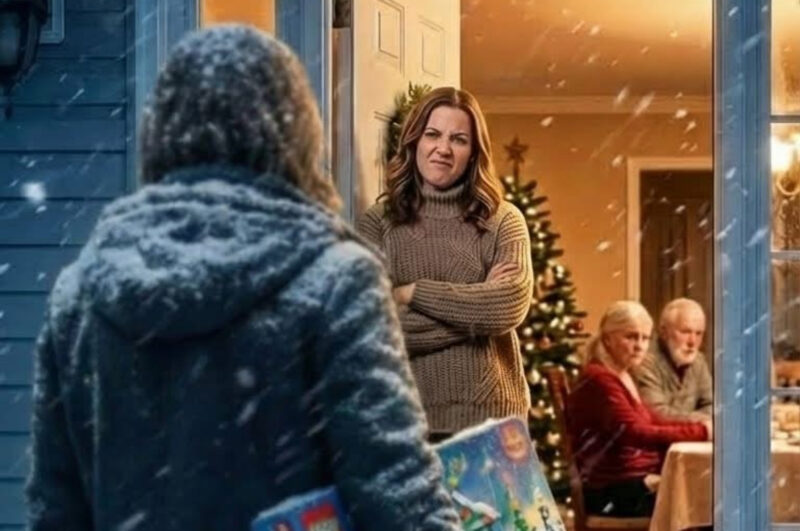
The words landed harder than the wind. “Christmas isn’t a place for losers,” my sister said, her arms crossed tightly in the doorway while the December gale stung my cheeks, turning them a raw, humiliated red.

Two oversized gift bags dug into my fingers, heavy with weeks of careful choosing. Inside were the specific LEGO sets the twins had begged for, the cashmere scarf for our mother, and a vintage watch for our father—items I had scourged the city for, items that represented overtime shifts and skipped lunches. The ribbons, once perky and bright, were now pressed flat by the relentless cold swirling behind her.
Inside the house, the warmth was palpable, a golden glow spilling out onto the porch where I stood, shivering. Our mother’s eyes flickered toward the door, then darted away, returning to the roast she was carving. Our father busied himself in the kitchen, aggressively drying a plate, pretending he didn’t hear the slur my sister had just cast at me.
Nobody moved to let me in. The silence from the living room was louder than the wind.
I nodded once, a sharp, mechanical motion. I swallowed the burn in my throat—acidic and hot—and walked back down the steps. The ice on the walkway crunched beneath my boots, a sound that felt like bones breaking.
“If my presence is such a burden,” I decided, the thought crystallizing in my mind like the frost on the railing, “then my money will be, too.”
That single thought warmed me more than any coat.
In the idling quiet of my car, I watched my breath fog the windshield, obscuring the house that had been my emotional anchor for thirty years. I tried to name what I felt. Not shock. Not even heartbreak, really. It was recognition. A late-arriving clarity that rearranged years of small betrayals into one sharp, undeniable picture.
I had always been the family’s soft landing. The designated safety net. When Amanda married Tom—a man with a charming smile and a résumé full of “potential”—and his “something better” job never materialized, I covered their rent two days before an eviction notice was taped to their door. I did it quietly, so Tom wouldn’t feel emasculated. When their car died on the highway, I paid the tow truck and the mechanic. When the twins needed laptops for remote learning, I swiped my card without blinking, telling myself it was an investment in their future.
I poured money into summer camps, school trips, and holiday mornings, telling myself that family helps family. I told myself that life is a wheel, and someday, the weight would be shared.
But I was wrong. Gratitude had eroded into expectation. And expectation had hardened into entitlement. The first time I said, “Not this month, I have my own bills,” Amanda answered with a silence designed to make me apologize. And God help me, I did. I apologized for having limits.
I drove home with the gift bags on the passenger seat like unwanted passengers. I sat in my driveway for what might have been ten minutes or an hour, the engine ticking as it cooled. I felt something inside me settle—a heavy, resolute stone dropping to the bottom of a well.
I realized I needed closure. I needed to hear the reason from her mouth, not just a snide remark in a doorway. I needed them to look me in the eye.
I backed out, drove the fifteen minutes to our parents’ house, and opened the door without knocking.
Amanda lay on the couch, scrolling through her phone, a glass of wine balanced on her chest. Our mother whispered to our father in the corner, a hushed, frantic urgency that stopped the moment they saw me. They looked like deer caught in headlights, their deep conversation a camouflage for the cowardice of not choosing a side.
“Why am I not welcome at Christmas?” I asked. My voice was calm, which terrified me more than screaming would have.
Amanda didn’t look up at first. When she did, her face held that practiced mixture of pity and superiority I’d learned to hate—the look of a queen addressing a peasant.
“You’ve been slacking off,” she said, as if we were evaluating job performance in a corporate boardroom. “The kids barely got anything from you this year for their birthdays. You missed the deposit for the ski trip.”
I stared at her. “I told you, my roof needed repairs. I had water leaking into my bedroom.”
“Excuses,” she waved a hand dismissively. “Last year you did more. This year it’s embarrassing. You’re making us look bad.”
I told her the truth: that hundreds of dollars’ worth of gifts waited in my car. That the receipts for her children’s happiness would outnumber any other contribution under that tree.
She lifted her chin, her eyes cold. “It wasn’t about presence. It never was. It was about control. You think because you help out, you get to dictate how we live? You think you’re better than Tom?”
My refusal to overspend had knocked a gear out of their machine, and the grinding sound was my consequence.
I looked to our parents, hoping for a word, a gesture, anything that resembled courage. Our mother gave a small shrug that hurt more than a slap. “You know how Tom gets when he’s stressed about money, dear,” she murmured. “Maybe if you just…”
She didn’t finish the sentence. She didn’t have to.
Our father avoided my eyes, focusing intensely on the pattern of the rug.
I left without slamming the door, because slamming a door suggests you still want it to open again. I closed it softly, with the finality of a coffin lid.
On the drive home, I replayed the conversation until the words wore down to chalk dust in my mind.
I made coffee at around 9:00 p.m., watching the steam rise like a thin prayer, and I chose a different life. No announcements on social media. No dramatic speeches. Just a terrifying, absolute change in behavior.
I would stop paying for the emergencies that were not emergencies. I would stop overcompensating at holidays to buy myself a seat at a table that now required tribute. I would stop being a pocketbook disguised as a sister.
The days after Christmas were silent in a way that felt both punishing and peaceful.
No “Merry Christmas” from our mother at 7:00 a.m. No group text from Amanda with a photo of the twins tearing into paper. New Year’s Eve passed with my phone face down on the coffee table. The house was so quiet I could hear the clock fuss its way toward midnight.
The silence spoke its own language. It said: You will call first. You will apologize. You will return to the role we assigned you.
I made tea at 10:30 p.m. and listened to the kettle confess its small grief. Then I let midnight come without witnesses.
In the morning, I woke to an odd lightness, like I’d taken off a coat I’d forgotten I was wearing. I checked my bank account. The balance was higher than usual. No holiday drain. No “loan” to Tom.
The knock arrived on a Tuesday evening while pasta bubbled on the stove at 6:30 p.m.
I wiped my hands on a dish towel and opened the door to find Amanda, flushed from the cold, and Tom standing behind her. Tom had the weary, shifting eyes of a man who recognizes the end of a good thing but refuses to admit it.
Amanda pushed past me with the entitlement of someone who has mistaken proximity for permission. She marched into my hallway, bringing the smell of cold air and expensive perfume—perfume I knew I had paid for indirectly.
“You’ve made your point,” she said, spinning around. “The silent treatment? Really? It’s childish.”
“I’m not punishing you,” I said, leaning against the doorframe. “I’m just living my life.”
“The kids barely have what they need for the new semester,” she snapped. “Tom’s bonus is delayed. Again. We need the tuition for the spring term covered. Just until March.”
I laughed. It bubbled up out of me before I could stop it—a dry, sharp sound. I looked at Tom. “Has your big opportunity finally stopped being ‘between things’ and started being a paycheck, Tom?”
He looked at his shoes, his jaw tightening. “It’s complicated. The market is volatile.”
“It’s always volatile,” I said.
Amanda did what she always does. She repositioned herself as the moral center and me as the villain. “You used to care about this family. Now you’re selfish. You’re sitting here in this house all alone, hoarding your money while your niece and nephew suffer.”
The word selfish crackled in the air like static.
I stepped forward, entering her personal space for the first time in years. “Selfish? The selfish thing would have been to keep paying until my resentment curdled into hate. The loving thing—for both of us—was to stop before I disappeared under your needs.”
“You promised Mom you’d look out for us,” she whispered, playing her trump card.
“I am,” I said softly. “I’m looking out for you by forcing you to look at him.” I pointed at Tom.
Tom flinched. Amanda’s face hardened. She jabbed a finger toward me, opened her mouth to launch whatever speech she had prepared, then lost it. She saw something in my eyes she hadn’t seen before: indifference.
She left with a door rattle that pretended to be a victory. I didn’t chase.
I turned the pasta off, poured a glass of water, and stood in the kitchen, breathing like I just finished a marathon I didn’t know I’d been running since my twenties. The house was still kind in its quiet, and I realized the thing I had feared most—being outside the family circle—had already happened long ago. All I’d done was step into the truth of it.
Two days later, an unfamiliar number flashed on my phone a little after 10:00 a.m. I nearly let it go to voicemail. But curiosity can be a hinge upon which life swings.
“Is this Khloe Harper?” A man asked. His voice belonged to a suit, a mahogany desk, and a bookshelf of framed degrees.
“Speaking.”
“My name is Daniel Ross. I am an attorney representing a client with concerns about certain financial matters involving your family. Specifically, involving a Mr. Thomas Miller.”
My stomach dropped. “Is he in trouble? Did he use my name for something?”
“I think it would be best if we spoke in person. Do you have a moment this afternoon?”
In the pause between his sentence and my answer, the house exhaled. “I do.”
The next morning, I sat in Daniel Ross’s office. It was a room designed to intimidate, with floor-to-ceiling windows overlooking the grey city skyline. Daniel sat across a polished desk that reflected my own uneasy expression. Shelves of law books lined the walls, heavy with the weight of decisions made by other people.
He slid a black folder toward me with the gravity of someone who knew exactly what it contained.
“My client is someone you know,” he said, watching my face carefully. “It’s Amanda.”
I blinked, unsure if I had misheard. “Amanda? She hired you?”
Daniel nodded. “She came to me three days ago. After your argument at your house, she went home and… started looking. She discovered irregularities in Tom’s financial dealings. She thought it was only right that you be informed, given your history of ‘loans’.”
I opened the folder.
My pulse quickened. It wasn’t just bank statements; it was a forensic autopsy of a marriage. Screenshots, receipts, proof of a hidden account in Tom’s name. The transfers matched the dates and amounts I had sent money for rent, for school fees, for emergency car repairs.
But the expenses were another story entirely.
“Online trading platforms,” Daniel said, pointing to a column of figures. “Crypto exchanges. High-stakes sports betting sites. And here…” He flipped a page. “Luxury hotels in the city, on nights he claimed to be working late.”
I felt bile rise in my throat. While I had been footing bills and cutting checks labeled Summer Camp and Emergency Repairs, Tom had been funneling that money—my money—into his own slush fund.
“He was gambling it,” I whispered. “He was gambling my money.”
“And losing it,” Daniel added evenly. “She found a bank statement in his desk drawer, hidden under a false bottom. When she confronted him, he dismissed it as harmless, claimed he was ‘investing’ for the family’s future. But the pattern is clear. This is financial infidelity.”
Daniel leaned forward. “Amanda wants you to understand that your generosity was misused. She didn’t know. She genuinely thought the money was going to bills. Tom was intercepting the funds, paying the minimums on credit cards to keep the lights on, and blowing the rest.”
I leaned back in my chair, the anger in me rising like a tide. And yet, beneath the rage was a strange, cold relief.
For years, I’d questioned myself. Was I ungrateful? Was I stingy? Was I failing them?
But here it was in black and white. I wasn’t crazy. I wasn’t cold-hearted. I was being defrauded.
“What does she plan to do?” I asked.
“She is considering separation,” Daniel said. “But her priority is the children. She has no access to funds. Tom has drained their joint accounts.”
I closed the folder and pushed it back across the desk. The texture of the leather felt cool under my palm.
“Tell her I got the message,” I said. “And tell her… tell her she’s stronger than she thinks.”
When I stepped back out into the winter air, the cold slapped me awake. For the first time in years, I felt something close to free.
Of course, Tom didn’t see it that way.
That evening, my phone lit up with his name. Against my better judgment, I answered.
“You’ve been talking to Amanda!” His voice was sharp, frantic, lacking its usual smooth charm. “Feeding her lies! You’ve ruined everything!”
I laughed, a sound void of humor. “Ruined everything, Tom? You hid money from your wife. You took thousands of dollars from me—money for your children’s education—and wasted it on day trading and hotels. That’s not ‘lies’. That’s theft.”
“It was leverage!” he screamed. “I was building capital! I was going to pay you back double! You just didn’t have the patience!”
“The free ride is over,” I cut him off. “Do not call me again.”
I hung up before he could find another excuse. My hands were shaking, but not from fear. It was adrenaline—the kind that comes from standing your ground after years of being bent into someone else’s shape.
Two days later, Amanda called. Her voice was small, tired, stripped of all pretense.
“He admitted some of it,” she confessed. “But he still says it’s not a big deal. He says I’m overreacting.”
“It was thousands of dollars, Amanda. Money you thought was keeping a roof over your kids’ heads.”
“I know,” she said quietly. “I’ve been making excuses for him for years. I didn’t want to see it. It was easier to be mad at you for closing the wallet than to be mad at him for emptying it.”
We met a week later at a coffee shop halfway between our towns.
She looked older. Lines were drawn across her face that hadn’t been there months before. No makeup, hair pulled back, hands wrapped around a cup like it was her anchor.
“I told him I need space,” she said. “He didn’t take it well. He threw a vase against the wall. But I can’t keep pretending.”
There was no smugness now. No sharp edge. Just exhaustion and a glimmer of resolve. She spoke about finding a rental, about leaving without telling him until she was ready.
“I’m sorry,” she said, looking into her coffee. “For Christmas. For calling you a loser. You didn’t deserve that.”
I didn’t tell her I forgave her instantly. Forgiveness is a process. But I told her, “You are doing the right thing. And you won’t be doing it alone.”
The unraveling happened faster than I expected.
One gray Thursday afternoon, my phone buzzed. We’re leaving today.
I called immediately. Amanda whispered that Tom was out of town for a “job interview” (likely another lie). She had hired a moving van.
“I hate to ask,” she hesitated, her voice trembling. “But I’m short on the deposit and first month’s rent for the new place. The joint account is overdrawn.”
The old resentment flickered in me, a phantom pain. But it vanished just as quickly. This wasn’t enabling. This wasn’t paying for Tom’s gambling. This was escape.
“Say no more,” I told her. “I’ll wire it directly to the landlord. Send me the details.”
Helping her leave wasn’t feeding the cycle. It was breaking it.
Tom spiraled. Within hours of finding the house empty, he called me, his voice ragged. “You did this! You poisoned her mind!”
I let him rage, listening to his curses spill out like sewage from a broken pipe. When he paused for breath, I answered calmly.
“Maybe if you’d spent less time gambling with her trust and my money, she wouldn’t have had to leave.”
I blocked his number.
In the weeks that followed, Amanda began piecing together a new life. She found a part-time job at a bookstore, enrolled the kids in a new school district, and started talking about saving for her own car.
I visited her one Saturday morning in March. Her small rental sat on a quiet street where kids biked freely. The front porch was cluttered with potted plants—evidence that she was finally building something of her own.
When she opened the door, the smell of coffee and cinnamon rolls drifted out. The children were sprawled on the living room floor, arguing about crayons in the harmless way siblings do.
“You look lighter,” I told her.
She smiled faintly. “I feel lighter. Scary, but lighter.”
We sat at the kitchen table, steam rising between us. For the first time in years, our conversation wasn’t about overdue bills or desperate requests. It was about the kids’ new friends, her co-workers, the small victories of everyday life.
At one point, she reached across the table and squeezed my hand. “I know I can’t take back the years. But I can make sure the next Christmas looks different.”
Back in my own house that night, I unpacked the gift bags that had sat untouched since December. The board games, sweaters, books.
I set aside what I would mail to her new place and kept the rest to donate. Not out of spite, but as a reminder. A reminder that generosity without boundaries turns into expectation. That family should be built on love, not transactions. That helping someone means lifting them up, not carrying them until they forget how to walk.
Tom continued to spread rumors, casting himself as the victim of a conspiracy between “bitter sisters.” Let him talk. His words had no power anymore. The more he tried to paint himself as the wounded party, the clearer his truth became to everyone else. He was a man unwilling to face his own failures, grasping for someone else to shoulder the blame.
I had finally walked away from that weight.
The holidays will come again, as they always do. But this time, I’ll be ready. Not with overflowing gift bags or emergency transfers, but with clear boundaries and an open heart.
Because sometimes the greatest gift you can give your family is the chance to stand on their own feet.
If you want more stories like this, or if you’d like to share your thoughts about what you would have done in my situation, I’d love to hear from you. Your perspective helps these stories reach more people, so don’t be shy about commenting or sharing.