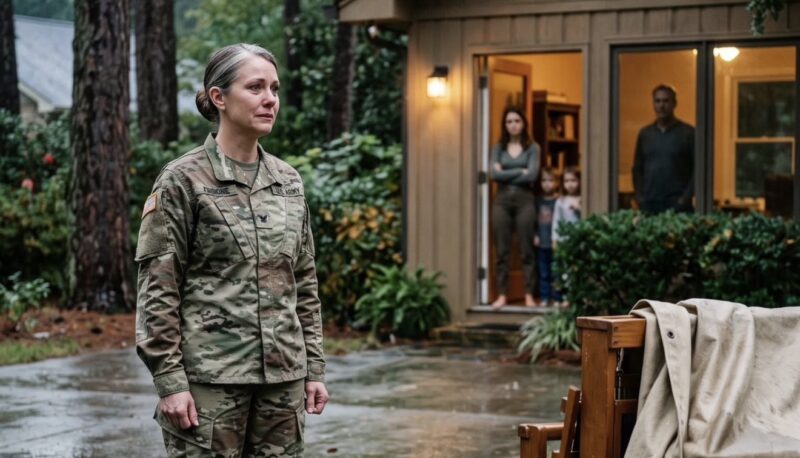
At 5:38 a.m., I returned from a twelve-day Army exercise and found my late mother’s wooden loom abandoned in the rain. My stepdaughter had moved her children into the garden studio I built for retirement, and my husband said, “She needs a home more than you need a hobby room.” I didn’t argue. By 8:15, a red notice was on the door—and then my attorney found the message proving this had never been temporary.
PART 1
At 5:38 in the morning, I returned from a twelve-day Army exercise and found my late mother’s eighty-year-old loom abandoned beside the curb in the rain.
A beige tarp covered half of it. One corner flapped in the wind, exposing the dark walnut frame and the narrow crack running through its front beam.
For twenty-six years, I had served in the United States Army. I was Colonel Rachel Donovan, responsible for logistics operations involving thousands of soldiers and equipment worth more than most people would earn in several lifetimes.
But that morning, I was simply a daughter staring at the last thing my mother had taught me to use.
The lights were on inside my garden studio.
I had built the cedar-sided workspace with Mom eight years earlier, before I married Michael. It stood behind my North Carolina home, surrounded by dogwoods and hydrangeas, with wide windows and shelves holding fabric, thread, photographs, and my mother’s handwritten patterns.
Now pink curtains hung behind the glass.
I walked through the garden in my rain-damp uniform and tried the door.
Locked.
A few seconds later, my twenty-nine-year-old stepdaughter, Kelsey, opened it. She was wearing pajamas and holding a coffee mug from my kitchen.
Behind her, a child’s mattress covered the floor. A plastic dresser stood where my cutting table had been, and a folding table had been pushed beneath the windows.
Seven-year-old Noah sat beneath a blanket watching cartoons. Four-year-old Mia was asleep on the small sofa.
Kelsey looked surprised but not ashamed.
“You’re home early.”
“Why is my mother’s loom beside the road?”
She glanced toward the curb.
“There wasn’t room for it.”
My husband appeared behind her.
Michael had dressed quickly, but his shirt was buttoned incorrectly. He avoided my eyes.
“Rachel, let’s discuss this inside.”
“We are inside.”
Kelsey folded her arms.
“Dad said we could finally stop living like guests.”
I looked at Michael.
“What did you promise her?”
He rubbed his forehead.
“Kelsey lost her apartment. The children needed stability, and you barely use the studio during training cycles.”
“That wasn’t my question.”
He finally met my eyes.
“I told her she could stay here long-term.”
The studio was legally permitted as a workspace, not a residence. It had no bedroom egress, no proper kitchen ventilation, and only one exterior door.
Michael knew that.
He also knew the property had belonged to me before our marriage.
“You gave my studio to someone without asking me?”
His face tightened.
“It’s just a studio. Kelsey needs a home more than you need a hobby room.”
The word hobby hurt almost as much as the loom in the rain.
My mother had woven blankets there while chemotherapy weakened her hands. During her final winter, she taught me to guide the shuttle slowly enough that the threads would not pull against one another.
“Strong fabric,” she used to say, “doesn’t come from one thread winning. It comes from every thread holding its place.”
Michael stepped closer.
“Please don’t turn this into a military operation.”
Something inside me became very calm.
I photographed the studio, the new lock, the mattresses, the blocked windows, and the loom outside. Then I checked the cracked beam without trying to move it.
“Did you truly believe I had agreed to this?” I asked Kelsey.
She looked toward her father.
That was answer enough.
I called my property attorney, Diane Walsh. Then I contacted the county building office and reported that two children were sleeping in an unapproved structure lacking residential safety features.
Before calling anyone else, I reserved an extended-stay suite for Kelsey and the children for seven nights.
I would not allow Michael to use their safety as a weapon against me.
At 6:22, I carried one suitcase into my car.
“Where are you going?” Michael asked.
“To work.”
“And what happens here?”
“An inspector will decide whether children can legally sleep in that building. The movers will place my property in secure storage. Kelsey has a hotel reservation.”
Kelsey stared at me.
“You’re throwing us out?”
“No. I’m giving you somewhere safe to stay while stopping an arrangement I never authorized.”
By seven, I was at Fort Liberty reviewing the morning briefing in a clean uniform.
At 8:15, the county inspector posted a red notice on the studio door prohibiting residential occupancy. Diane arrived with a licensed moving crew, while a deputy maintained a civil standby.
Michael could have resisted.
Instead, after the inspector explained the fire and egress violations, he agreed the children had to leave.
At 8:37, he called me.
“You humiliated my daughter.”
“I paid for her hotel.”
“That doesn’t change what you did.”
“No. I stopped a promise you had no right to make.”
Then Diane called from the studio.
The movers had found a cedar chest beneath one of Kelsey’s boxes. It belonged to Emily, Michael’s first wife, who had died when Kelsey was twelve.
Inside was an unopened envelope addressed to Michael and Kelsey.
Across the front, Emily had written:
For Michael and Kelsey—when helping has become another way of hiding the truth.
CLICK NEXT FOR THE NEXT PART.
Next
PART 2
I did not open Emily’s letter.
It did not belong to me.
Two days later, Michael and Kelsey agreed to read it at a mediator’s office. Diane attended as my attorney, and the children remained with a sitter at the hotel.
Michael held the envelope for several minutes before breaking the seal.
The letter was six pages long.
Emily had written it during the final months of her illness, when Kelsey was still a child. She described Michael as a good man whose greatest strength could become his greatest weakness.
He always wanted to fix pain immediately.
When Kelsey struggled at school, he completed projects beside her until midnight. When she lost a friendship, he called the other child’s parents. When she spent her allowance, he quietly replaced it so she would never feel deprived.
Emily had feared that after her death, Michael’s grief would turn protection into permanent rescue.
One sentence made his voice break.
“Give our daughter a bridge when she falls. Do not build that bridge from somebody else’s home.”
CLICK NEXT FOR THE NEXT PART.
PART 3
Nobody spoke after Michael finished reading.
The mediator, a gray-haired woman named Brenda Okafor, slid a box of tissues across the table and let the silence do its work. Outside the window, a delivery truck backed through the parking lot, beeping patiently.
Kelsey pressed the heel of her hand beneath one eye.
“Hiding the truth,” she said. “What truth, Dad?”
“Your mother was on a great deal of medication by then.” Michael folded the pages into thirds, corners aligned, the way a man closes an account. “She was frightened. People write things.”
Track Pregnancy
“She wrote six pages.”
“She wrote them when she was dying, Kels.”
Rachel watched his thumb. It ran along the crease again and again, although the paper was already flat.
In twenty-six years, she had sat across from a great many men who insisted nothing was wrong. Supply sergeants with spotless inventories. Contractors with perfect manifests. The ones who lied for profit never fidgeted. The ones who lied for love always did.
Kelsey held out her hand.
“I want to keep it.”
Michael hesitated for half a second. A few years ago, Rachel would have missed it. A few years ago, she would have filed the pause under grief and moved on.
Then he gave the letter to his daughter.
Brenda cleared her throat.
“I think this is a natural place to stop for today. Rachel, you’ve asked for the studio to be returned to its original use. Michael, you’d like—”
“I’d like to fix this properly.” Michael turned toward Rachel, and his voice dropped into the reasonable register he used with waiters and loan officers. “The county told me the structure could qualify as an accessory dwelling. With the right paperwork, it could be legal by January. Kelsey and the kids wouldn’t have to be anywhere else.”
Rachel looked at him.
“The right paperwork.”
“Applications. Inspections. It’s a process.”
Diane Walsh’s fingertips touched Rachel’s sleeve, light as a moth.
“We’ll respond through counsel,” Diane said.
Out in the hallway, a ficus stood beside the elevator, collecting dust. Diane pulled a folder from her bag. She was sixty-one, small and silver-haired, with the stillness of someone who had spent four decades watching people sign things they would later regret.
“After the red notice went up, the county was required to pull the permit history on that structure,” she said. “I asked for a copy yesterday. They emailed it at six this morning.”
“I never applied for a permit.”
“Someone did.”
Diane opened the folder. The first page was an Application for Accessory Dwelling Conversion, filed on May 14. In the box marked Owner of Record was Rachel’s name. In the box marked Authorized Agent was Michael’s.
Below it, in blue ink: Rachel Donovan, by Michael, attorney-in-fact.
“Attorney-in-fact,” Rachel said.
“He’s relying on the power of attorney.”
Rachel almost laughed. Before every field rotation, she signed a limited power of attorney so Michael could pay bills and collect mail while she was out of contact. She had signed one every year since they married. Bank. Mail. Utilities. Insurance. It was an Army spouse’s ritual, as ordinary as a duffel bag by the door.
“It authorizes bill payment,” she said.
“It authorizes what it says. I’ll read the language, but I doubt it lets him alter your real property or consent on your behalf.” Diane turned to the fourth page of the packet, where a gray rectangle sat beneath the heading Owner Consent. “This is the page I most want to see. The scan is unreadable. They’re pulling the original from the archive on Monday.”
“Why would the county accept an agent’s signature on something this large?”
“Because someone attached a consent. The question is what it says, and who signed it.”
Rachel said nothing. A thought moved at the edge of her mind and slipped away before she could look at it: a driveway before dawn, a clipboard on the hood of her truck, yellow tabs sticking out of a stack of paper.
Diane’s phone buzzed. She read the screen, and her mouth flattened.
“Luis Ortega,” she said. “The contractor named on the application. He saw the notice on the door and he’s frightened for his license. He says he was told you knew everything.” She handed the phone to Rachel. “He sent me his text messages with your husband.”
Rachel read standing beside the ficus.
The first message was dated May 17.
Michael: Run the water and sewer lines out to the studio. Make everything permanent. This isn’t a temporary thing. Kelsey and the kids are moving in for good once the work is done.
Luis: Does Mrs. Donovan know? Permit lists her as owner.
Michael: She knows what she needs to. She’s in the field half the year. Send everything to me, not her.
There were a dozen more about trenching and electrical panels. Then, at the bottom, September 30:
Luis: Want me to schedule the final inspection?
Michael: Hold off. Inspector will want to meet the owner. We’re moving them in Oct 10 while Rachel is away. She’ll be furious for a day and fine by the weekend. She always is.
Rachel read the last four words three times.
She always is.
She thought of the spring Michael’s brother had needed twelve thousand dollars and she had written the check without being asked. Of Kelsey’s wedding, when the florist’s deposit came due and Rachel had quietly paid it so no one would be embarrassed. Of the kitchen remodel she had not wanted, the lake weekend she had missed, the three Christmases she had spent on call and called duty.
She had never meant any of it as surrender. She had meant it as logistics. Absorb the shock, protect the mission, keep the family moving.
Somewhere along the way, her husband had learned to read her silence as a signature.
“Rachel?” Diane said gently.
“I’m all right.”
“You don’t have to be.”
“I know.” Rachel handed back the phone. “Does a power of attorney let him touch my accounts?”
“Depends on the language. Why?”
Rachel opened her banking app. She had not looked at it in twelve days. The field site had no signal, and by habit she switched off alerts during exercises so nothing could follow her into the training area. She scrolled past a utility payment, a grocery charge, a pharmacy refill.
Then she stopped.
Her mother’s account. The one she had never merged with anything, the one she had opened the week she sold the house on Alder Street. A hundred and eighty thousand dollars of small-town real estate and forty years of her mother’s overtime. Rachel had meant to put it toward something that mattered. She hadn’t yet decided what.
October 14. Outgoing wire. $36,400.00.
Recipient: First Carolina Trust Services. Account ending 4471. Memo: KT.
“I never approved that,” she said. Her voice sounded quiet and level and very far away.
Diane read the screen.
“KT.”
“Kelsey’s trust.” Rachel’s mind was already sorting. “Emily left insurance money for her. Michael is trustee until Kelsey turns thirty. I never asked about it. It wasn’t mine to ask about.”
“So he wired your money into his daughter’s trust.”
“Yes.”
“Why?”
“I don’t know.”
The elevator opened. Rachel did not take it. She took the stairs, because stairs gave her four flights to put each emotion into a separate box and close the lid.
On the second landing she stopped and set a hand against the cold cinder block.
Her mother had done this too. Helen Donovan had worked doubles at the textile mill for thirty years, and in all that time Rachel had never once heard her ask anyone for anything. When the car died, she took the bus. When the chemo took her hair, she bought a scarf and said it was a fashion choice. Near the end, when Rachel found the empty morphine vials in the bathroom wastebasket, her mother said only, “Don’t fuss, honey. I’m fine.”
Fine had been her mother’s whole language. Rachel had learned it the way other children learned to swim, by being dropped into it.
She counted the remaining steps, because counting was something she could do. Fourteen. Then she pushed through the door into the wind.
Michael was waiting in the parking lot beside his truck. Kelsey stood next to him with her arms crossed against the wind, the folded letter in her fist.
“We should talk about this at home,” Michael said, “like adults.”
“Whose home?” Rachel asked.
“Our home.”
“I’m glad you think so.”
She stopped three feet from him.
“What is account ending 4471?”
She had expected anger, or denial, or one of the smooth speeches he gave at neighborhood fundraisers. Instead, every drop of color left his face at once, as if someone had pulled a plug.
“Where did you see that?”
“In my mother’s account. October fourteenth. Thirty-six thousand four hundred dollars.”
Kelsey’s head turned.
“What account?”
“First Carolina Trust Services,” Rachel said. “The memo says KT.”
“That’s my trust.” Kelsey said it slowly, like someone testing ice. “That’s Mom’s trust. Dad, why would Rachel’s money go into my trust? It doesn’t need money. You said it was growing. You said it was—”
She stopped.
Michael opened his mouth and closed it again.
In all the years of their marriage, Rachel had never once seen her husband without a sentence ready.
CLICK NEXT FOR THE NEXT PART.
PART 4
Wind pushed a flattened coffee cup across the asphalt.
“Dad.” Kelsey’s voice was very controlled. “Why is Rachel’s money in my trust?”
Michael found a sentence at last, and Rachel almost admired the speed of it.
“It’s an administrative matter, sweetheart. Rachel moved some funds between accounts, and I helped route them. It’s tax-related. We’ll straighten it out.”
“I didn’t move anything,” Rachel said.
“You’ve been in the field. You wouldn’t remember.”
“I remember my own bank account.”
Kelsey looked from one of them to the other. She had her mother’s eyes, gray-green and set wide, and Rachel knew them only from the photographs on the studio shelf. They narrowed now the way a person’s do when she has decided not to believe something and cannot remember why.
“I’m not doing this in a parking lot,” Rachel said. “Kelsey, you turn thirty in eight days. You’re entitled to see that trust. Ask for the statement.”
“You’re doing this to get back at me.”
“I’m doing it because the wire has your initials on it.”
“Kels, don’t let her—” Michael began.
“Dad.” Kelsey didn’t look at him. “I’m going back to the hotel.”
She walked to her car. Michael took two steps after her and then stopped, because Rachel was still standing there. For the first time since she had known him, he seemed unsure which of the two women he was more afraid of.
Rachel did not give him the satisfaction of a speech. She got into her car, turned the key, and drove to the grocery store.
At six that evening she knocked on the door of the extended-stay suite carrying two bags of food she had no idea how to justify. Chicken tenders. Apple slices. A box of the cheese crackers shaped like fish, because she had once seen Mia reach for them in a checkout line.
Kelsey opened the door and did not step aside.
“I don’t need charity.”
“It’s dinner,” Rachel said. “I’d have brought it for a stranger’s children. I can bring it for yours.”
Something flickered in Kelsey’s face, and the door opened another six inches.
The suite smelled like laundry soap and microwave popcorn. Mia, in a T-shirt with a cartoon dog on it, shouted “Rachel!” from the sofa and then looked at her mother as if checking whether that was allowed. Noah sat cross-legged on the carpet.
He was holding the shuttle.
Rachel’s breath caught. It was a boat-shaped piece of dark walnut, about a foot long, its middle worn smooth by sixty years of thumbs. Her mother had carved two initials into the underside with a pocketknife. H.D. Helen Donovan. It had been on the studio shelf, in a shoebox of bobbins, when the movers came.
Noah was holding it like a sword, one end pointed at a lamp.
“Noah,” Kelsey said sharply, “give that back.”
“It’s all right.”
Rachel set down the bags and lowered herself to the carpet until she was at his eye level. She did not reach for the shuttle. She had spent twenty-six years learning that the fastest way to lose a frightened person was to take something out of his hands.
“Grandpa Mike said it was just a piece of wood,” Noah said.
“It is a piece of wood. Can I show you something about it?”
He studied her with the suspicion of a seven-year-old who has been told many things by adults.
“Okay.”
“Open your hand.”
He did. She laid two fingers against his thumb and moved it into the shallow groove on the shuttle’s side.
“Feel that? My mom’s thumb made that. And her mom’s before her. That’s why it fits. Nobody carved it for your hand. It just got shaped by everyone who held it carefully.”
Noah turned the shuttle over. He ran his finger across the initials.
“Is the big machine broken because of us?”
The room became very quiet.
Rachel considered the easy answer, the one she had given a hundred times. It’s nothing. Don’t worry about it. She felt it rise to her lips the way it always did, smooth as a river stone.
“It cracked because it sat in the rain,” she said. “That wasn’t your fault. You were a kid who was told it was fine to be here. That’s all.”
Noah nodded slowly.
“Can a person fix it?” Mia asked from the sofa.
“Maybe. I know someone who fixes things like that.”
She did not, in fact, know anyone. But she had a phone and a county directory, and by nine that night she had left a message for a woodworker in Pittsboro named Abel Tran.
After dinner, Kelsey carried a trash bag out to the balcony, and Rachel followed. Cars hissed along the highway below. Somewhere a television laughed at its own jokes.
“I put the tarp on it,” Kelsey said. She kept her back to Rachel. “The loom. I want you to know that.”
Rachel waited.
“Dad said it was too big for the studio and the wood was rotten and we’d have to throw it away. I said no. I said it should go in the garage, but there wasn’t room because of his boxes. It was supposed to rain at noon. I put it out at three in the morning, under the tarp, because he said it’d be fine for a few hours.” She laughed without any humor. “I didn’t think. I’m good at not thinking when it’s easier.”
“You moved it by yourself?”
“Noah helped me with the legs. He thought it was a game.”
Rachel held on to the railing. Some of what she had believed in the rain that morning loosened and rearranged itself. A woman who put a tarp over a thing she was told to discard was not the same as a woman who didn’t care.
“Kelsey. Did your father tell you the studio was temporary?”
“He said it was ours for as long as we needed it. He said you were relieved somebody would use it.” Her shoulders drew up. “Was that a lie?”
“Yes.”
“Do you hate me?”
“No.”
“Dad said you would.”
“Your father says a lot of things before he checks them.”
Kelsey turned around then. In the yellow light from the suite, she looked tired in a way that had little to do with the past two days.
“Do you know what it’s like,” she said, “to have one person in your whole life who always fixes it? Since Dean left, since Mom, since forever. Dad is the only one who ever picked up when I called. If I don’t have that—” She stopped. “I don’t know who I am without it.”
“I’m not asking you to give it up.”
“Then what do you want?”
“I want you to ask for the statement. Not from your father. There’s usually someone named as a trust protector, someone whose job is to see the books. Did your mother have a sister?”
“Aunt Carol.” The name came out slowly. “Dad says she’s bitter. She said something at the funeral. Dad said she blamed him for—for everything. We stopped talking when I was fifteen.”
“Do you have her number?”
“Somewhere.”
“Please call her.”
Kelsey stared out at the highway.
“I’ll think about it.”
It was not a yes. Rachel had run enough operations to know the difference between a refusal and a delay, and she did not push.
On Monday morning, at 6:45, she stood at attention in the office of Brigadier General Marcus Hale.
Hale was a lean man from Tennessee who had been her commander for two years and had never once raised his voice. He did not ask her to sit. That was the first sign.
“Colonel, I received a call on Friday from the Inspector General’s office,” he said. “A formal complaint came in on Saturday. It alleges that you used your rank and your professional contacts to coerce county officials into evicting two minor children from your residence. It alleges that you abandoned your spouse and his dependents without notice, and that you have made, quote, unsupported accusations of financial misconduct against family members.”
“Who filed it?”
“The complainant is Michael. There’s a supporting affidavit signed by his daughter.” Hale slid a single page across the desk. “The affidavit states you told her in May that you were happy for her family to use the studio.”
Rachel looked at the signature at the bottom.
Kelsey’s handwriting. Round and careful.
She had never said any such thing. In May, she had not even known Kelsey was in trouble.
“General, I never spoke to her about the studio in May.”
“I have to open an inquiry. You understand that.” He folded his hands. “Your promotion packet is pending before the board. I’d like to tell you it won’t matter. I can’t.”
“Copy.”
Hale’s eyes narrowed.
“That’s not an answer, Rachel.”
“It’s the one I have, sir.”
“Is there anything in this complaint that’s true?”
She thought about the phone call at 6:10 on Wednesday morning, standing in her own driveway in a damp uniform. She thought about the phrase coerce county officials.
“I called the county as a homeowner reporting a safety hazard,” she said. “I did it in my own name, on my own phone, before I put on a rank. If that’s coercion, I’ll answer for it.”
Hale nodded once.
“Lieutenant Colonel Nair will contact you. Tell her everything.”
“Yes, sir.”
She was in the parking lot, scanning for the car keys she always put in the same pocket, when her phone rang. Diane’s voice was steady, but it had the careful flatness of someone choosing every word.
“The archive pulled the original of page four this morning. I’m looking at it now.”
“And?”
“Rachel.” A pause. “It has your signature on it.”
CLICK NEXT FOR THE NEXT PART.
PART 5
Diane’s office smelled of lemon polish and old paper.
The document lay in the center of her desk, squared to the edge, as if it might bruise. Rachel did not pick it up. She read it where it lay.
Owner Consent to Alteration and Residential Use of Accessory Structure.
Dated May 9.
Intended occupants: family member (K.) and minor children.
Plan Family Trips
Duration of occupancy: Permanent.
At the bottom, in a hand she knew better than any other, was her own signature. Rachel M. Donovan. The same slanted R she had signed on three decades of leave forms and supply manifests. Beside it, on the witness line, was Michael’s.
“May ninth,” Rachel said.
“Do you remember it?”
She did, all at once, the way a smell can return a whole room.
A driveway at 4:15 in the morning. Her field bag already in the truck bed. Michael in a flannel robe, holding two coffees and a clipboard, his hair flattened on one side.
“Sorry, babe, I know you’re late. Power of attorney renewals, plus the insurance rider. Sign where the yellow tabs are.”
She had twenty minutes before the convoy rolled. She had signed on the hood of her own truck, with the clipboard tilted against the windshield so the dome light fell across the page. Twenty-three signatures. She had flipped from tab to tab without reading a word, because it was Michael, and because it was dark, and because for eight years she had trusted him with the paperwork the way she trusted her staff with a load plan.
Every lieutenant who had ever worked for her had heard the same sentence. Read what you sign. Trust, then verify.
She had never once verified him.
“I signed it,” Rachel said.
Diane watched her carefully.
“I’d like you to think before you say that again.”
“I don’t need to think. That’s my signature. I signed it in my driveway, in the dark, and I didn’t read it.” Rachel pressed her fingertips together to keep them still. “He told me they were power-of-attorney renewals.”
“Can you prove he said that?”
“No.”
“Can he prove he told you what it was?”
“No.”
“Then we have two people and a piece of paper.” Diane leaned back. “Rachel, I’m going to be blunt, because you’ve never wanted anything else from me. This changes our position. A consent to alteration is not a lease or a license to live there forever. It does not let a man hide a permit from the inspector or move children into a building without a certificate of occupancy. But Michael’s attorney will present this as proof that you approved the conversion for months and objected only when it embarrassed you.”
“I objected when I found my mother’s loom in the rain.”
“I know. A judge will hear a woman who signed a document and a man who says she knew.”
“And the inspector general?”
“Will hear the same thing, with your rank on top of it.”
Rachel looked at the window. A leaf had pasted itself to the glass.
“What does he want?”
“If I had to guess, a negotiated outcome that doesn’t involve anyone asking where your money went. He hopes you’ll be afraid enough of the complaint to let this settle quietly.”
“And if I say I signed it and didn’t read it?”
“Then you’re admitting a mistake to an investigator who can end your career.”
“It’s true.”
“Rachel—”
“I’m not going to defend myself with a lie I’d have to remember.” She said it without heat. “I’ll tell them what happened. I’ll tell them the part that’s mine. I won’t pretend it’s all of it.”
Diane studied her for a moment. Then she took off her glasses and rubbed the bridge of her nose, and Rachel saw, for the first time, that the old lawyer was almost smiling.
“Your mother raised you well.”
“My mother raised me to say I’m fine.”
“That isn’t what you just said.”
Carol Ames was already sitting in the corner booth when they arrived.
The diner was in a town neither of them had ever visited, a cinder-block building near the intersection of two state highways, chosen because it lay halfway between Asheville and Fayetteville. Carol wore a gray cardigan and reading glasses on a chain, and she had an accordion file on the seat beside her. She was fifty-eight. She had been a middle school principal until she retired, and she looked at Rachel the way principals look at someone who is probably telling the truth but has not yet proved it.
Kelsey slid into the booth across from her. The two women did not touch. A decade of silence lay between them like a table.
“I got your message,” Carol said. “I drove three hours. I did not sleep much last night.”
“I’m sorry,” Kelsey whispered. “I should have called you years ago.”
“You were fifteen, and your father is very persuasive. Let’s start with what’s in front of us.” Carol opened the file. “I’m named in Emily’s trust as the trust protector. It’s a boring title. It means I get an annual statement and I’m supposed to be able to petition a court if the trustee goes wrong. For the first six years after Emily died, I got those statements. Then they stopped.”
“Dad said you were bitter,” Kelsey said.
“I was. I said something at the funeral I can’t take back.” Carol looked at her hands. “Michael used it. He told the bank I was unstable and had asked to be removed. He told me statements weren’t required while he served as sole trustee. I didn’t have the nerve to check. I let it go. That’s mine to carry.”
Rachel stirred her coffee, though she hadn’t added anything.
“What’s in the trust?” she asked.
“At Emily’s death, two hundred thousand dollars from life insurance, invested conservatively. The last statement I saw, three years ago, showed two hundred fifty-one thousand, three hundred.” Carol turned a page. “On Kelsey’s thirtieth birthday, the trustee delivers a full accounting. The assets distribute to her outright. And there’s this.”
She slid a copy across the table and tapped a paragraph with a pen.
Upon receiving the accounting, the Beneficiary may execute a written release discharging the Trustee from all claims relating to the administration of the trust.
“A release,” Kelsey said slowly.
“If you sign it, you can’t sue him afterward for anything he did with the money. Ever.”
The waitress arrived with refills. Nobody spoke until she left.
“Emily changed the document three weeks before she died,” Carol said. “She added the trust protector clause and put my name in it. I asked her why. She was very weak. She said, ‘Michael can’t bear watching her fail, and a man who can’t bear that will do almost anything to make sure it never happens.’”
Kelsey put her hand over her mouth.
Rachel’s thoughts moved in a hard, clean line. She felt it the way she’d felt a convoy route snap into focus on a map.
Michael’s urgency about the move. His insistence that the family come in October, while Rachel was in the field, while Kelsey was weeks from her birthday. The hold on the inspection. The wire in the middle of the night.
“If the balance was what it should be,” she said, “he wouldn’t have needed my thirty-six thousand.”
“No,” Carol said.
“He moved her into the studio to keep her close. Under his roof. Grateful. Dependent. So when the papers come out—”
“She signs them,” Carol said. “Without reading, because her father has always taken care of it.”
Nobody moved. Kelsey’s eyes had filled, but she was not crying. She was staring at the release as if the print might rearrange itself.
Rachel felt something shift in her own chest, uncomfortably, like a joint resetting. For nearly two hours on Wednesday morning, in her driveway and in her car and at her desk at Fort Liberty, she had believed that the woman at the studio door was a willing conspirator, that Kelsey had known her father was taking Rachel’s home and had let him. She had not said it aloud. She had not even been proud of the thought. But it had been there, a cold, tidy explanation.
It had been wrong.
Kelsey had not been the thief of Rachel’s studio. She had been the object of the theft.
“I owe you something,” Rachel said.
Kelsey looked up.
“For about two hours on Wednesday, I thought you knew. I thought you were in on it.”
“And now?”
“Now I think your father has been standing between you and the truth for seventeen years, and he’s very good at it.”
Kelsey swallowed.
“Thank you for saying it,” she said, very low. “Nobody ever says it.”
Carol cleared her throat.
“There’s more. Do you have an invitation to dinner on Saturday?”
Kelsey opened her phone and passed it over. The text was from her father, sent at 11:42 that morning.
Birthday dinner Saturday 6 p.m. in the garden. Gerald Voss is bringing the trust handover paperwork. Just formalities. Wear something nice, Kels. Your mom would be so proud.
“Gerald Voss was Michael’s roommate at Chapel Hill,” Carol said quietly. “He is not Emily’s lawyer. Emily’s lawyer was Harold Brooks.”
“Dad said Harold died,” Kelsey said.
“Harold is alive and retired in Wilmington. I talked to him this morning.”
Nobody said anything.
“I’m filing a petition for an accounting in superior court tomorrow,” Carol went on. “It will take weeks to be heard. The dinner is in five days. Once Kelsey signs that release, any money that’s gone is gone.”
Kelsey set down the phone with a care that bordered on violence.
“I signed something yesterday,” she said.
Rachel’s stomach tightened.
“Dad brought me a page at the hotel. He said it was for the county. He said it would help get the studio approved and make everything go away. I was holding Mia. I signed where he pointed.” Her voice rose and cracked. “I didn’t read it. I never read anything he gives me. I just—it’s Dad.”
Rachel took out her phone and found the photograph of the affidavit that Hale had slid across his desk. She turned the screen toward Kelsey.
Kelsey read the first line. Her face emptied.
“I never said that. You never said that to me.”
“I know.”
“He told me it was a form.”
“I know,” Rachel said again, and this time she let her hand rest on Kelsey’s wrist. “I signed one too. In May. Same excuse.”
For a moment the three women sat in the fluorescent light of a diner nobody would remember, each holding a piece of the same truth, none of them speaking.
Then Kelsey drew a breath that sounded like tearing cloth.
“What else have I signed?” she said.
CLICK NEXT FOR THE NEXT PART.
PART 6
The key did not turn.
Rachel tried it again, slowly, the way a person tries a thing that has worked ten thousand times. The brass slid into the lock and stopped a quarter inch short of the pin. She withdrew it, studied the teeth, and tried a third time.
It was a quarter past ten. Rain had come in from the west an hour earlier and settled over the street as if it intended to stay. The porch light burned. In the front window, behind the sheer curtain, a small figure in white wings was spinning in circles.
Mia.
She was wearing the ladybug costume. Somebody had already bought her a Halloween costume, five days early, and she was wearing it to bed.
Rachel took her hand off the doorknob.
Her phone buzzed against her ribs.
Michael: Kelsey and the kids are home with me now. I picked them up from the hotel this evening. You’ve done enough. Please give us until after the birthday. I’ll talk then. I promise.
She read it twice.
The hotel. She had extended the reservation on Saturday; she’d forgotten to tell Kelsey. Michael must have called the front desk, said he was the guest’s father, and checked them out. She had paid for seven nights. He had collected the refund.
She stood on the porch of the house she had owned for eleven years and listened to her four-year-old stepgranddaughter laugh behind the door.
She could call Diane. She knew exactly what Diane would say. Her name was on the deed. A spouse cannot lawfully be excluded from the marital residence by self-help. Rachel could phone the sheriff’s civil unit, present her license, and have the lock opened by midnight.
She could also imagine what Mia would see.
A uniformed woman and a deputy at the door. A father shouting. A mother crying. A child in ladybug wings standing at the top of the stairs while the grown-ups she trusted took turns frightening each other.
Rachel had made this choice before. She’d made it at twenty-three, at thirty-four, at forty-one. When the cost of winning was paid by someone smaller, she lowered her weapon and walked away, and she called that duty.
She turned and walked down the steps.
In the driveway the rain was cold enough to sting. She passed the dark outline of the studio at the end of the garden, the red notice pale on its door. A light was on in the kitchen. Michael’s silhouette crossed it, a mug in his hand.
He did not look out.
She sat in her car for a long time with the engine off.
She did not cry. She laid out the situation instead, the way she would a map. She was locked out of her home, under investigation by her own service, and facing a husband with a lawyer, a paper trail with her own signature on it, and a stepdaughter who thought she was telling the truth. Her promotion packet was on hold. In four days a lawyer would hand a young woman a document that could erase a quarter of a million dollars.
Everything was moving, and she was parked at the curb.
“Fine,” she said aloud, to nobody, in a voice she did not recognize. “It’s fine.”
The word sat in the cold car like something dead.
On Tuesday morning she reported to the Inspector General’s office with her uniform pressed to a knife’s edge. Lieutenant Colonel Priya Nair was a small, brisk officer with a legal pad and the unhurried patience of someone who had interviewed generals.
“Colonel Donovan, you’re entitled to bring counsel.”
“My attorney advised me to say as little as possible.”
“And are you going to follow that advice?”
“No, ma’am.”
Nair put down her pen.
“Then begin wherever you like.”
Rachel told her everything. She laid out the cedar-sided studio and the loom in the rain, the call to the county, and the reservation she had paid for. She described the permit, the contractor’s messages, and the wire from her mother’s account. She told her about the May morning in the driveway and the twenty-three signatures.
“You signed the consent,” Nair said. “Without reading it.”
“Yes, ma’am.”
“You understand that this admission may be used against you in the complaint.”
“I do.”
“Most officers in your position would hire someone to say less.”
“I did. She told me to.” Rachel almost smiled. “I’m a logistics officer. I spent twenty-six years teaching people that the only unforgivable error is the one you hide. I’m not going to make an exception for myself.”
Nair studied her for a long moment. Then she wrote something down, underlined it, and did not show it to Rachel.
Outside the building, General Hale was waiting in the corridor.
“I’ve been informed that your name is being removed from the roster for the spring rotation,” he said. “Pending resolution. It isn’t a punishment.”
“It feels like one, sir.”
“It should. If it didn’t, I’d worry about you.”
By the time she reached her car, Rachel had lost two things she had spent her life earning. A command, and the calm assumption that her word would be believed.
At noon, Kelsey’s text arrived.
Dad says you’ve been inventing problems with the trust to punish him for the studio. I want to believe you. I can’t do this right now. Please don’t contact me until after Saturday. I’ll find you after. I need to see for myself.
Then, at three, Carol’s.
Petition filed. Hearing set for November 18. I’m sorry. The court can’t move faster.
Eighteen days after the dinner. Rachel stared at the numbers and felt the shape of the trap close around her, patient and complete. A woman in a hotel room, a woman in a kitchen, a woman in a diner. All of them waiting for Saturday. All of them powerless to stop it.
At nine that night she drove to the self-storage facility off Highway 87.
Unit 114 was a ten-by-fifteen steel box with a roll-up door. The movers had stored the loom there on Wednesday afternoon, under moving blankets, along with the cedar shelves and her mother’s boxes of thread. She had not been back. She rolled up the door and switched on the single bulb and stood looking at the dark shape beneath the quilted gray.
She pulled the blanket back.
Even in the poor light, the crack was ugly. It ran six inches along the front beam, a pale, splintered seam in the walnut, where the rain had gotten in and the wood had swelled.
Rachel sat down on an overturned crate and laid her hand against the frame.
The roof ticked with rain. Somewhere a gate chain rattled.
She remembered the last winter. Her mother at this loom, a blanket over her knees, her hands shaking so badly that Rachel had to guide the shuttle. The doctor had told Helen Donovan she had six months. Helen had told Rachel eight, then ten, then a year. By the time the truth was unavoidable, the cancer had spread to her spine, and Rachel had sat in the car in the hospital parking lot, beating the steering wheel with the flat of her hand.
“Why didn’t you tell me?” she had asked.
“I didn’t want you carrying it, honey.”
It had been love. Rachel understood that. It had also taken from her the chance to say goodbye properly, to ask the questions, to be afraid next to her mother instead of behind her.
Hiding the truth to protect someone.
She lifted her head.
Emily’s sentence. Michael and her mother and Michael’s first wife and Rachel herself. They had all been loving people. They had all swallowed the hard thing and offered the smooth one. Helping as hiding.
And Michael had looked at that quiet woman, her wife, her silence, and found it useful.
Something heavy came down in her chest and did not lift.
“Ma’am?”
Rachel startled. A flashlight beam wavered at the door of the unit.
Command Sergeant Major Dolores Pierce stood in the rain wearing civilian clothes and a face like a closed fist. She was fifty-two, built like a fireplug, and had been Rachel’s senior enlisted advisor for six years. She carried a thermos in one hand.
“Your driver said you didn’t go to the quarters,” Pierce said. “Nobody could find you. I found your phone’s last location.”
“You tracked my phone?”
“I’m very good at my job, ma’am.” Pierce stepped in, set the thermos on the crate, and looked at the loom. “Is that the thing?”
“That’s the thing.”
Pierce poured coffee into the cap and handed it over. Then she lowered herself to the concrete with the care of a woman whose knees had marched too far, and sat with her back against a shelf.
“I’ve been with you six years, ma’am,” she said. “Can I say something that’s not in my lane?”
“You’re about to.”
“You keep everyone else’s ledger. You know when Sergeant Alvarez’s kid has a recital. You knew Specialist Brooks’s mother was in hospice before he did. You handed your own lunch to a private last week and called it a logistics adjustment.” Pierce’s voice stayed flat. “I’ve watched you for six years supply everyone else’s line. Who resupplies yours?”
Rachel opened her mouth and found nothing in it.
“Because from where I’m sitting, ma’am, that husband of yours didn’t wake up one morning and decide to rob you. He just kept finding out you wouldn’t stop him.”
The words landed cleanly. Rachel felt them go in.
“I’m not saying you did anything wrong. You didn’t. I’m saying silence is a supply line too, and somebody’s been drawing on yours for years.”
For a minute the only sound was the rain on the steel.
“What would you do?” Rachel asked.
“I’m a sergeant major. I’d stop waiting for permission.”
Rachel looked at the loom. She looked at the long, ugly seam in the walnut.
All week she had been waiting. For Kelsey to call. For the inspector, the board, the court date, the dinner. She had waited for the truth to arrive and protect her the way she had protected everyone else.
Nobody was going to supply her line.
She stood up. The coffee had gone cold in her hand, and she set it on the crate.
“Sergeant Major, I need the number for Abel Tran in Pittsboro. I left him a message. I’d like him to see this tomorrow.” She pulled out her phone. “And I need to call my attorney.”
“At this hour?”
“She’ll answer.”
Diane did, on the second ring.
“I want a forensic accountant,” Rachel said. “Someone who can reconstruct three years of trust activity in forty-eight hours. I’ll pay whatever it costs. I’m going to give the Inspector General everything, including my own mistake. And Diane—”
“Yes?”
“I’m going to talk to Michael myself.”
A silence stretched down the line.
“On the record?”
“On the record,” Rachel said. “I’m done being fine.”
CLICK NEXT FOR THE NEXT PART.
 PART 7
Ruth Calloway arrived at Diane’s office on Wednesday night with a rolling suitcase of printouts and a thermos of tea.
She was seventy, retired from thirty years as an Army finance sergeant major, and she had a way of looking at a ledger that made Rachel think of a surgeon looking at an X-ray. She had worked on three court-martial cases and one federal embezzlement trial. She charged by the hour and she did not make small talk.
Get Writing Tools
“Tell me what you have,” she said.
“A wire receipt,” Rachel said. “An account number ending in 4471. A trust document. And a trust protector who will have the statements by morning, if the bank complies.”
“The bank will comply. Banks are afraid of three things. Regulators, trust protectors, and Tuesday’s newspaper.” Ruth cracked a legal pad. “Go home and sleep. I need the data, not you.”
Rachel did not go home, since she no longer had one to go to. She slept four hours in the extended-stay suite next to the one Kelsey had left, on top of the covers, in her uniform.
The statements arrived at nine on Thursday morning. First Carolina’s compliance office sent them to Carol Ames in a single encrypted file, thirty-six months of activity, because the trust instrument named her as protector and the bank’s attorney had read it twice. Carol forwarded them to Diane within eleven minutes.
By noon the long table in Diane’s conference room was covered in paper.
Ruth worked without speaking. She highlighted, cross-checked, and ran a pencil down columns, occasionally murmuring a number. At one o’clock she asked for Rachel’s bank records, then Michael’s joint statements, then the brewery filings Diane’s paralegal had pulled from the Secretary of State.
At three, she put down her pen.
“It’s not what you think,” she said.
Rachel’s pulse went still.
“It’s worse and it’s better. Not everything here is theft. A trust exists to be spent on the beneficiary. About sixty-two thousand dollars over three years went to Kelsey’s actual expenses. Rent. A car repair. Pediatric dentist for the boy. Legal fees for her divorce. That part is exactly what Emily wanted. Michael is a man who shows up.”
“And the rest?”
Ruth turned a page toward her.
“A hundred and forty thousand dollars lent, in two installments, to a company called Harbor Ridge Brewing. The promissory note is signed by Michael as trustee. It’s an unsecured loan to a business owned by one Walter Gentry, who I understand to be a friend of your husband.”
“His fishing partner,” Diane said.
“Harbor Ridge filed Chapter 11 in March. The note is worthless.” Ruth turned another page. “Then fifty-seven thousand four hundred dollars in what the ledger calls trustee advances. Paid to Michael’s personal checking account. The trust instrument allows a modest annual fee. This is eleven times that. There’s another thirty-one thousand in transfers marked ‘family expenses’ that I would call, politely, unexplained.”
“The balance?” Rachel asked.
“As of October thirteenth, nine thousand eight hundred twelve dollars.”
She said it so evenly that it took a moment to understand.
Kelsey’s inheritance had been two hundred fifty-one thousand dollars three years ago. It was now less than ten.
“On October fourteenth,” Ruth said, “a wire arrives in the amount of thirty-six thousand four hundred. Your money. That brings the balance to forty-six thousand, two hundred twelve.” She tapped the figure. “He needed the account to look like a trust that had been, shall we say, managed. At the handover, nobody checks the history. They check the number. A number in the forties is a disappointing return. A number in the nine thousands is a crime.”
“How much is missing?” Diane asked.
“With the growth Emily’s money should have earned? Two hundred forty-three thousand, six hundred dollars.”
Nobody spoke.
Rachel thought of the wire memo. KT. Two letters, typed with care. He had not even had the nerve to write Kelsey’s name.
“Print me a one-page summary,” she said. “Plain English. No jargon. I want the number and where every dollar went.”
Ruth looked at her over her glasses.
“You’re going to show it to him.”
“I’m going to show it to him before I show it to anyone else.”
“Is that wise?”
“No,” Rachel said. “But it’s right.”
She went on Friday morning, at 7:10, before Michael left for work.
She did not go to the front door. She went around the side of the house, through the gate, and into the garden, where hydrangeas had gone brown at the edges and the first frost had silvered the grass. The studio stood in the corner of the yard, its windows blank, the red notice still on the door. A small plastic sandal lay on its side beneath the dogwood.
She sat on the bench beside the garden path, set a small recorder on the armrest, pressed the red button, and waited.
Michael came out at 7:22 with a travel mug. He saw her and stopped on the back step.
“Rachel.”
“Good morning.”
He glanced at the recorder.
“Is that—”
“North Carolina requires one party to consent to a recording. I’m one party. I’m telling you so you know, because I’ve spent a week finding out what happens when I don’t.”
He came down slowly, set the mug on the rail, and sat on the other end of the bench. He looked as if he hadn’t slept. His shirt was the right size and the right color and ironed to a point, and the skin beneath his eyes was bruised.
“You want to ruin me,” he said.
“I want to hand you a piece of paper.”
She took the one-page summary out of her jacket and gave it to him. He read it twice. His lips moved on the second pass.
“Where did you get this?”
“A forensic accountant who spent thirty years in Army finance. The trust protector got the bank statements yesterday.”
“Carol.” Michael said it like a diagnosis. “She’s been waiting seventeen years to take this away from me.”
“Carol has been waiting for someone to tell her the truth.”
“I was going to put it back.”
“With what?”
His mouth worked.
“Walt said eighteen percent. He had contracts with grocery chains. He showed me the equipment. I thought—” He covered his eyes with one hand. “I thought if I grew it, if I could turn two-fifty into four hundred by the time she was thirty, I could hand her a down payment for a house. Something real. She wouldn’t have to live off me, off anyone, ever again.”
“Instead you lent her inheritance to a friend.”
“I was going to fix it.”
“You were going to fix it with my mother’s house.”
He flinched.
“I was going to pay you back. Every penny.”
“Michael, you used a power of attorney for my electric bill to move my mother’s money into a trust you’d emptied.”
“I knew you’d forgive me.”
The words hung in the cold air between them.
“You knew I’d stay quiet,” Rachel said.
He didn’t answer.
Somewhere in the house, a child laughed, a bright sound, and then the thump of small feet on a staircase.
“Tell me about the day Emily died,” Rachel said.
She had not planned to say it. She watched his face change.
“Kelsey was twelve. We were in the hallway outside the hospice room. She had this stuffed rabbit.” His voice thinned. “She looked up and said, ‘Daddy, don’t let anything bad happen to me again.’ And I said I wouldn’t. I looked her in the eye and promised.” He pressed his thumb into his eyebrow until the skin went white. “I’ve never let her fail. Not once. Not in seventeen years. I am not going to start the week she turns thirty.”
It was, Rachel realized, the truest thing he had ever said to her.
It did not change what he’d done.
“Michael, there’s another way,” she said. “Listen to me for a minute. Tell Kelsey yourself before anyone signs anything. Tonight. Tomorrow morning. Resign as trustee. Tell her about Walt and the note and the advances. I’ll sit beside you if you want me there. I’ll hold your hand, if that’s what it takes. Carol will petition the court either way, but there are different kinds of ending. You can be a man who confessed. Or you can be a man who was caught.”
“She’ll never forgive me.”
“Maybe not for a long time.”
“She’ll look at me the way she looked at the casket.”
“She’ll look at you the way someone looks at a father who lied to her for years. That’s real, and it’s awful. It’s not the same.”
His jaw tightened. She watched the old calculation resume behind his eyes.
“If you do this,” he said quietly, “I’ll tell the Inspector General what I told them. That you knew about the conversion. That you signed it with your eyes open. I’ve got your signature.”
“I know you do.”
“They’ll take your promotion. They’ll take your retirement. Twenty-six years.”
“Yes.”
“You won’t do it.” He almost smiled. It was awful, how gentle he sounded. “You never do. You’ll be angry for a day, and then you’ll be fine by the weekend. You always are.”
The sentence landed exactly where it was aimed.
Rachel looked at her husband for a long moment. She thought of her mother’s tidy bathroom wastebasket. Of a driveway at four in the morning, twenty-three tabs, yellow as caution tape. Of every night she had absorbed the blow and called it peace.
“I was never fine, Michael,” she said. “I was quiet. They aren’t the same thing. I should have told you that years ago. That part’s mine.”
He stared at her.
“I signed your paper. I’m going to say so to every person who asks. I’m going to say I didn’t read it, and I’m going to say you told me it was something else, and let them decide which of us they believe.” She pressed the button on the recorder. “I’m also going to give them this. You can’t hurt me with a thing I’ve already told.”
She stood up. Her knees were shaking, and she was glad he couldn’t see.
“Rachel—”
She did not turn around.
By eleven she was in Lieutenant Colonel Nair’s office. By noon, Diane had delivered a sworn statement and a USB drive to the Inspector General, to Carol’s attorney, and to the superior court clerk. The statement said, on page one: I signed the owner consent dated May 9. I did not read it. I take responsibility for that failure.
It did not feel like a loss.
It felt like setting down a rucksack she had carried since she was eleven years old.
At 9:40 that night, someone knocked on the door of Rachel’s hotel room.
She opened it expecting Pierce or a delivery.
Kelsey stood in the corridor in a thin gray sweatshirt, hair loose, face blotched. Mia slept on her shoulder, a ladybug wing crushed against her neck. In her free hand she held a stapled packet of papers, gripped so hard the edges had curled.
“Gerald’s assistant dropped these at the house tonight,” she said. “Dad said to review them. Items one through eight.”
Her voice broke, and she lifted her chin to steady it.
“I read item seven,” she said. “Three times. I don’t understand it. Will you read it to me?”
CLICK NEXT FOR THE NEXT PART.
PART 8
Noah was asleep in the back seat of Kelsey’s car, buckled into his booster, a blanket pulled up to his chin.
Rachel carried him upstairs herself. He weighed almost nothing, the way sleeping children do, and he did not wake when she laid him on the second bed. Kelsey laid Mia beside him and pulled the ladybug wings off over her head with the tenderness of someone defusing something.
Then she sat at the little table, put the stapled packet down, and said, “Read it.”
Rachel read it standing up.
Items one through six were the dull architecture of a handover. A schedule of distribution. A certificate of trust. A receipt for documents. A waiver of notice. A statement that the beneficiary had been provided a full and complete accounting, which, she noticed, was not attached.
Item seven was a page and a half.
“It says you acknowledge receipt of the accounting,” Rachel said. “It says you have reviewed it and have had the opportunity to consult counsel. And it says you release the trustee, your father, from any and all claims, known or unknown, arising from his administration of the trust.”
“Even the things I don’t know about.”
“Especially those.”
“And if I sign—”
“You can’t recover anything he took. Not from him, not from Walt, not from anyone. The court would treat it the way you’d treat a receipt.”
Kelsey nodded, very slowly.
“I’d have signed it. I’d have signed it with a pen he bought me, at a table he set, while he gave a toast.” She laughed, and the laugh broke apart in the middle. “I’d have thanked him.”
Rachel set the packet down. She took the folded sheets of Emily’s letter from the inside pocket of her jacket. Kelsey had given them to her on the stairs. She had asked Rachel to read the final page.
“Aloud?”
“Please.”
Rachel smoothed it flat. Emily’s handwriting was fine and slanting, and the ink had gone brown at the edges.
“If you are reading this, one of you has probably been protected from something. I hope someone loved you enough to tell you the truth. Michael, I forgive you in advance, and I want you to forgive yourself in advance, because the next thing I have to ask is the hardest. When Kelsey falls, let her. Stand close. Catch what you can. But don’t catch it so completely that she never learns she can land.”
Rachel stopped. Her throat had closed.
Kelsey put both hands over her face, and her shoulders began to shake. She did not cry loudly. She cried the way people cry in rooms where children are sleeping, a pressure of breath, a silence that moved.
Rachel sat down beside her, close enough that their sleeves touched.
Eventually Kelsey said, through her fingers, “You’ve known for three days.”
“I knew pieces. I gave you each piece as soon as I had it.”
“I thought you were trying to take him away from me.”
“I know.”
“I stood in that garden on the tenth and said thank you to him. I hugged him. He cried.” She dropped her hands. “How do I even know which parts were real?”
“I don’t think it has to be one or the other. I think he loves you more than he’s ever loved anything.” Rachel looked at the sleeping boys. “And I think that’s the dangerous part.”
Kelsey wiped her face with her wrist.
“What happens now? To him?”
Rachel had been waiting for the question. She had rehearsed the answer four times in the car and discarded all four.
“Carol’s petition goes to court. They’ll order an accounting, and they’ll almost certainly remove him as trustee. A judge can order him to repay what he took. That could mean his retirement, the lake cabin, whatever else he owns.” She kept her voice level. “And there’s a possibility that the district attorney will look at it. What he did has a name. It’s called misapplication of fiduciary funds. It can be a felony.”
“Prison?”
“Maybe. I don’t know. I won’t lie to you about that.”
“The kids—”
“Will have a grandfather in a very hard place. Or they won’t. I can’t promise either way. I can only tell you what’s true so that you get to choose with your eyes open.”
Kelsey was silent for a long time.
“I want to hear him say it,” she said at last. “Not in an office. Not through lawyers. I want to be standing in that garden, and I want him to look at me.”
“Then we go to the dinner.”
“You’d come?”
“If you want me.”
“Aunt Carol too.”
“I think she’s already in the car.”
Kelsey gave a damp half-laugh.
Rachel’s phone rang at 5:51 the next morning.
She had slept in the armchair, one foot against the door, in the position she’d once slept in tents outside Kandahar. She groped for the phone and saw the name.
Michael.
She answered without speaking.
“I read Ruth’s summary,” he said. His voice was scraped raw. It sounded like a man who had been awake for two days, and a part of her ached for him anyway. “I want you to hear me out.”
“I’m listening.”
“Two hundred forty-three thousand, six hundred. That’s the number. I’ve been thinking.” He drew a breath. “You have your mother’s house money, and your savings, and the TSP. You could cover it. Today. Wire it into the trust before six tonight. Kelsey signs, Gerald files, I resign quietly as trustee, and nobody ever has to see the court. You keep your rank. The inspector general closes the file. I’ll pay you back, Rach. Every cent. From my pension.”
She sat very still.
“It’s your money,” he said, reasonably. “So no one’s committing a crime. There’s no victim. Kelsey gets her inheritance whole. The kids never find out. You could end this in a phone call.”
It was a good offer. It was, in a terrible way, a loving one.
“You want me to patch it.”
“I want to protect everyone.”
“That’s what Emily wrote about,” Rachel said. “In the letter. You’re asking me to build a bridge out of somebody else’s home.”
“It’s your home.”
“It’s my mother’s. And it’s not a bridge. It’s a blindfold.”
“Think about what you’re throwing away.”
“I’ll call you after the dinner.”
“Rachel—”
She ended the call.
Then she sat in the dim suite with her hands between her knees, and the phone on the cushion beside her, and the shape of what she’d been offered settling in around her like weather.
Because the offer was real. That was the problem. She could do it. She would have almost nothing left, but she could do it. She could make the whole mess disappear by Saturday dusk, and everyone would be grateful, and no one would ever know what she’d paid.
And there it was, the oldest instinct she owned. The one that had walked her down the lockout steps. The one that had said it’s fine in the rain.
Pierce and two soldiers met her at Unit 114 at nine.
Sergeant Alvarez was a broad, soft-spoken man with a toddler’s drawing taped inside his helmet. Specialist Brooks was twenty-two and treated every piece of furniture as a potential grenade. Between them they had rolled the loom out of the unit and onto a flatbed, wrapped in moving blankets, and Pierce had checked each strap twice.
Abel Tran stood beside the truck with his hands in the pockets of a canvas apron. He was a quiet, silver-bearded man of sixty-odd who had come on Thursday evening, run a thumb along the crack, and said, “Someone loved this thing. I’d rather not hurry.”
He had worked on it for two days.
Rachel pulled back the blanket.
The crack was still there. He had not hidden it. Across the seam, set into the front beam, was a small bow-tie of pale maple, two triangles joined at the point, glued and clamped and sanded flush with the walnut. It crossed the split from side to side and held it shut.
“A butterfly key,” Tran said. “Old joinery. It won’t make the crack disappear. Cracked wood doesn’t go back to whole.” He shrugged. “But it stops the spreading. And you can see exactly where the hurt was. I figured you’d want to.”
Rachel put her palm flat on the wood.
It was cold, and solid, and a little rough where the key had been planed.
“Thank you,” she said.
“You’re welcome. Where’s it going?”
“To a garden. For about two hours. Then back to the studio, where it belongs.”
Tran considered this with perfect gravity.
“Handle it like it’s still hurt,” he said.
When the truck pulled away, Rachel stayed in the empty unit, alone for the first time in days, and took out her phone.
She opened the banking app.
Her mother’s account. The balance, which had never before frightened her. She selected Transfer, then Wire. The routing number for First Carolina Trust Services sat in her saved contacts from the October fourteenth entry that had started everything. Her thumb hovered above the amount field.
Two hundred forty-three thousand, six hundred dollars.
She typed the first digit.
She could see it. Kelsey signing, relieved. Michael sagging into a chair, his face finally unclenched. The inspector general’s file closing without ceremony. Mia and Noah never knowing there had been a storm. It would be a good ending. It would be a quiet one.
And in thirty years, Kelsey would sit in some room like this one, reading some paper someone had put in her hand, and she would realize that the only difference between her father and the woman who loved her was the size of the sacrifice.
Rachel thought of her mother’s wastebasket.
She thought of Helen Donovan driving to the hospital alone for six months, not asking anyone, so that nobody could be hurt by the asking. She thought of Michael on the back step saying, You always are.
She deleted the digit.
She locked the phone, and put it away, and stood up.
Then she called Carol.
“Tell the court everything,” she said. “Walt. The note. The advances. Don’t soften any of it.”
“Rachel, he may be charged.”
“Then he’s charged for what he did.”
“You’re sure?”
“No,” Rachel said. “I’m just not going to hide it anymore.”
At 5:48 that evening the sky above the garden was the color of a bruise healing.
String lights hung between the dogwoods, and a long table had been set on the lawn with a white cloth and eight chairs. Paper lanterns stood along the path. Someone had tied balloons to the studio fence. A jazz playlist drifted from a speaker. Neighbors in good jackets stood in small groups holding wine, and Gerald Voss, a heavyset man with a leather folio under his arm, was laughing at something Michael said.
Michael had dressed for it. Pressed shirt. The gray tie Kelsey had given him for Father’s Day. He looked, from the gate, like a man who loved his family.
Rachel stood outside the fence with Kelsey on her left and Carol on her right.
Behind them, Pierce, Alvarez, and Brooks lowered the loom from the flatbed with a grunt and a silence. They carried it between them up the side path like a coffin, or a bride. The wood gleamed under the lanterns.
At the table, someone saw it and stopped talking.
Then another.
Michael turned.
He looked at the loom first, because it was impossible not to. Then he looked past it, at his wife, his daughter, and his dead wife’s sister standing together in the half-dark. For one moment his face held no calculation at all.
Mia ran across the grass in her ladybug wings.
“Mama! Rachel! Come see the balloons!”
Kelsey took a long, shaking breath.
She did not look at Rachel. She reached out, found her hand, and held it.
“Okay,” she said. “Let’s go.”
CLICK NEXT FOR THE NEXT PART.
PART 9
The jazz kept playing for four more seconds before someone thought to turn it off.
Pierce and the soldiers set the loom down at the edge of the lawn, in the pool of light between the table and the studio, and stepped back with their hands behind them. Nobody told them to leave. Nobody told them to stay. Alvarez positioned himself beside the studio fence, and the other two fell in on either side of Pierce, the way soldiers do when they have decided a place is theirs to hold.
Michael came across the grass with a smile fixed on his face.
“Kels. You’re here. And—Carol, my God, it’s been years.” His voice was warm, welcoming, a host’s. “Everyone, you remember Kelsey’s aunt. And Rachel. Please, sit. We were about to begin.”
“Thank you, Michael,” Carol said. “I’ll stand.”
He held the smile for another heartbeat.
Gerald Voss stepped forward, hand out. He was a good-looking man going to seed, with the practiced geniality of someone who billed in fifteen-minute increments.
“Kelsey, happy birthday in advance. Why don’t we all sit down and get the formalities out of the way before the cake? I have the packet right here—”
“I read it,” Kelsey said.
“Wonderful.”
“Item seven in particular.”
“That’s a standard release, sweetheart. Nothing unusual.”
“Mr. Voss, was there an accounting attached?”
The smile moved a quarter inch.
“The trustee will provide—”
“Did you review it?”
“I relied on the trustee’s summary.”
“What did the summary say?”
Gerald looked at Michael. Michael looked at the table.
The neighbors had gone silent. A woman in a green scarf set down her wineglass, very carefully, the way people do when they have understood that something is happening and want to be able to say they did not touch it.
“Dad,” Kelsey said.
Michael turned.
“What’s my balance?”
“Honey, it’s all in the packet.”
“I don’t want the packet. I want the number. You’ve been telling me for seventeen years that you’d take care of it. Say the number.”
Michael’s mouth opened.
Rachel did not move. She did not step forward or speak. This was not hers. She had understood that in the car, with a clarity almost like grief: that the most useful thing she could do for the woman beside her was to refuse to do the next thing for her.
The silence lengthened.
Finally Michael said, “It’s complicated.”
“Say it.”
“It’s lower than it should be.”
“How much lower?”
“There were—market conditions.” He raised a hand toward the neighbors, toward the lanterns, toward the whole decorated yard. “Kels, this isn’t the place for this. Let’s go inside and I’ll explain every—”
“Mr. Voss,” Carol said.
She had opened her accordion file on the end of the table. She drew out a single sheet and held it out to Gerald across the white cloth.
“I’m the trust protector. This is a petition for an accounting and for removal of the trustee, filed in superior court Tuesday. This is a reconstruction of the trust’s activity for the last thirty-six months, prepared by a certified forensic accountant. The balance on October thirteenth was nine thousand, eight hundred and twelve dollars.”
A murmur went through the neighbors, low and appalled.
Gerald took the page. He read it. His color left him in stages, first the cheeks, then the forehead, then the lips.
“Michael,” he said. “Is this accurate?”
“Gerald—”
“Is it accurate?”
“It’s a temporary shortfall. I was going to restore—”
“I can’t be part of this.” Gerald snapped the folio shut. The sound was a small gunshot. “I’m withdrawing, Michael. I’m sorry. I didn’t know.” He turned to Kelsey. “I’m sorry. I would never have brought you that release.”
He walked to the gate and out, without looking back.
Michael watched him go. Then he did what a cornered man does, and went for the throat.
“She did this.” He rounded on Rachel, and his voice cracked with fury, with fear. “This is her doing. My wife, and she’s been poisoning you against me from the day she found out about the studio. She’s under investigation, Kelsey. She signed the consent. She approved the whole conversion for six months and now she’s trying to blame me when it blew up in her face.”
Heads turned toward Rachel.
She had imagined this moment many times in the last three days. She’d imagined defending herself, rehearsed it in the shower, in the car, on the cold concrete of the storage unit. She had imagined the heat of her own shame.
Instead she felt something she hadn’t expected.
Quiet. A level, steady quiet, like the ground after weather.
“Yes,” she said. “I signed it.”
Michael stopped.
“I signed it in my driveway at four in the morning, on the hood of my truck, with twenty-two other pages I didn’t read. You told me they were power-of-attorney renewals.” She kept her voice low enough that they had to lean in. “I told the Inspector General that on Tuesday. I gave her a sworn statement on Friday. My failure to read a document before signing it is mine, and I’ve said so under oath. I’m not hiding it from anybody here.”
She turned slightly, so that all of them could see her face.
“Is there anything else you hoped I’d hide?”
His hand dropped to his side.
For a moment he looked like what he was. A tired man in his late fifties, in a pressed shirt and a gray tie, standing on a lawn he’d decorated for a party. The fury drained out of him all at once, and left him seeming smaller than he was.
“I thought,” he said, “you’d be fine.”
“I know you did.”
“I wasn’t trying to hurt you.”
“I know that too.”
Kelsey stepped forward.
She did not hurry. She walked across the grass until she stood three feet from her father and looked up at him. In the lantern light, she was her mother’s daughter, gray-green eyes, level, unafraid.
“Dad, I’m going to ask you one more time. Where is my money?”
Michael’s shoulders folded.
He told her.
He did not tell it well. It came out in pieces, in the wrong order, with the stammer of a man who had rehearsed a different story. Walt Gentry and the brewery. The note he signed in his own handwriting. The advances to himself, which he’d called fees. The second loan after the first one went sour, because he’d believed that if he just put in a little more, it would turn. The failure in March. Seven months of lying to everyone, including himself. The wire from Rachel’s account.
When he got to the part about the wire, he stopped and looked at Rachel.
“I’m sorry,” he said. His mouth shook. “I’m so sorry. I used you.”
“Yes.”
Then he turned back to his daughter, and the neighbors, who had come to a party and were witnessing a confession, studied the grass.
“I broke the only promise your mother ever asked me to keep,” he said. “I thought if I could just make sure you never had to be afraid, I’d have kept the other one.”
Mia, who had been standing at the edge of the light holding a balloon string, said in a small clear voice:
“Grandpa, why are you crying?”
No one answered.
Kelsey knelt, took her daughter’s face between her hands, and kissed her forehead.
“Go sit with Noah and Miss Dolores, baby,” she said. “Grown-up talking.”
Pierce was there before the sentence finished. She took Mia’s hand and Noah’s, and led them both to the studio steps, where Alvarez produced from his pocket, with an air of miraculous discovery, a roll of butterscotch candies.
Kelsey stood.
She walked to the table. Gerald’s packet still lay there, abandoned beside the cake. She picked up item seven, held it a moment, and read the last line aloud.
“I, the undersigned, hereby release my father from any and all claims.”
Then she tore it in half.
She tore it again. She let the pieces fall onto the white cloth like snow.
“I’m not signing anything tonight, Dad. I’m not signing anything until I’ve read every page, and Aunt Carol has read it, and a lawyer who’s mine has read it.” She wiped her face, finally, with the back of her hand. “You’re going to resign as trustee. Not next week. Tonight. Carol drafted it.”
Carol, without a word, produced a paper and a pen.
Michael looked at them for a long time.
“And if I don’t?”
“Then I testify on the eighteenth,” Kelsey said. “Either way, I’m going to tell the truth.”
He took the pen.
His hand shook so badly that the signature slid across the line, uneven, almost unreadable. He signed it anyway. When he finished, he put the pen down on the table, quietly, as if it might break, and stood with his head bowed in the middle of his own yard.
Nobody applauded. Nobody said anything.
The neighbors began leaving, one at a time, in murmurs and apologies. The woman in the green scarf touched Kelsey’s arm on her way out. Carol put a hand on Michael’s shoulder, not forgiving, not condemning. Just there.
Rachel waited until the lawn was empty.
“I’m filing for separation on Monday,” she said.
Michael nodded without looking up.
“Would you have forgiven me?” he asked. “If I’d asked. In the beginning. Before any of it.”
She thought about it honestly.
“Maybe,” she said. “You never asked.”
In the end, the courts did what courts do, slowly and without drama.
The petition was granted on the eighteenth. A judge named Alma Reyes removed Michael as trustee, appointed Carol successor, and ordered an accounting that confirmed Ruth Calloway’s numbers to the dollar. Michael signed a stipulated judgment. He sold the lake cabin and surrendered his retirement account, and the trust recovered a little more than two hundred thousand dollars, enough to put Kelsey’s life on a floor if not a ceiling. The district attorney’s office reviewed the file. Kelsey did not ask them to charge him. She did not ask them not to.
The Inspector General closed the inquiry in January with a one-page memorandum. It found the complaint unsubstantiated. It noted, in a final paragraph, that Colonel Donovan’s candor had been unusual, and it recommended she review any document before signing it.
Rachel laughed out loud when she read that. It was the first time in weeks.
She did not touch her mother’s house money. She kept it in the account where it had always been, and left the wire form blank.
On a gray Saturday in December, the county inspector, a thin man named Dalton, pulled his truck into the driveway of the house with the dogwoods. He walked around the side, through the gate, past the hydrangeas.
He took a small utility knife from his pocket and slit the tape on the red notice.
“Water lines capped, panel disconnected, egress verified,” he said. “Back to workspace. You’re good, ma’am.”
“Thank you.”
He peeled the notice from the door and folded it once, and handed it to her. She did not know what to do with it, so she put it in her pocket.
The studio was bare. The pink curtains were gone. The plastic dresser, the mattress, the folding table. The movers had brought back her cedar shelves and her mother’s thread, and Pierce’s soldiers had carried in the loom on a Sunday afternoon and set it by the south window, where the light was good. Abel Tran’s butterfly key glowed pale on the front beam.
Kelsey and the children had moved into a rented duplex across town, three miles away. It had two bedrooms and a small yard. Rachel had not paid the deposit. She had offered, once, and Kelsey had said, “Not this time. I want to do one thing for myself,” and Rachel had said, “Then I’ll teach you to weave,” and they had both laughed because it was the wrong size of answer.
Michael lived in an apartment in Raleigh. He wrote Kelsey a letter in November. She put it unopened on her mantel, between two photographs, and said she’d read it when she was ready. Rachel had not asked what ready meant.
At ten that morning, a red Subaru pulled in.
Noah came through the gate first, carrying a shoebox. Mia followed, dragging a stuffed rabbit by one ear. Kelsey came last, in jeans and a gray cardigan, holding a thermos and looking slightly embarrassed.
“We said we’d come at ten,” she said.
“You’re on time.”
“Mia insisted on bringing Rabbit.”
“Rabbit is welcome.”
Noah set the shoebox on the cutting table, which had come back too, scarred and dear, and opened it. Inside, wrapped in a dishtowel, lay the shuttle. Walnut, boat-shaped, the groove worn smooth.
“I’m giving it back,” he said gravely.
“You can keep it for the day.”
“Really?”
“It likes being held.”
He took it out, set his thumb into the groove, and held it exactly as she’d shown him.
Rachel sat down on the bench. She had threaded the loom the night before with a warp of undyed wool, the same cream-colored yarn her mother had used for the blankets that last winter. She brought Mia onto her lap. Mia’s hands were tiny and sticky and certain.
“Slow,” Rachel said.
“Slow.”
“It’s not a race. The threads have to learn each other.”
Kelsey leaned against the doorframe with the thermos in both hands. She said nothing. Her face, in the window light, was soft in the way faces are when nobody is asking anything of them.
Mia passed the shuttle between the warp threads, careful, tongue between her teeth. It slipped across and into Rachel’s waiting palm. Rachel returned it. Mia pressed the beam forward, and the weft settled against the cloth.
An inch of fabric. Cream and pale and a little crooked.
Rachel looked down at the loom. At the walnut frame and the maple key across the old crack.
Outside, the first thin snow of the season began to fall on the garden, quiet as a thread laid down.
The weave held.
CLICK NEXT FOR THE NEXT PART.
THE END