arrived at my ex-wife’s funeral and was stopped by a 7-year-old boy who looked exactly like me. My former mother-in-law was crying, while my own mother shouted over the phone, “Get out of there right now!” I hung up without saying a word and opened the letter Lucía had left for me. Inside was an ultrasound and a photograph that changed everything.
Part 1 of 3
PART 1
“DON’T COME NEAR MY MOTHER! YOU HAVE NO RIGHT TO SAY GOODBYE TO HER! WHERE WERE YOU WHEN SHE STILL NEEDED YOU?”
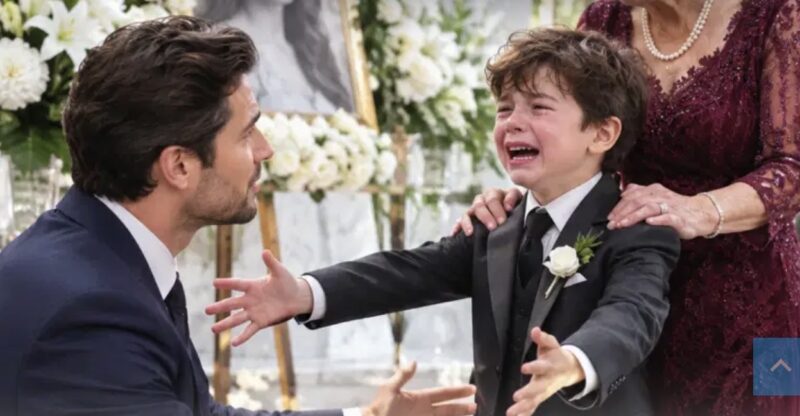
The shout from a seven-year-old boy froze the funeral chapel in Dayton, Ohio.
The mourners stopped murmuring, and every eye turned to the man who had just walked in holding a bouquet of white roses.
Grant Whitaker, a thirty-eight-year-old Chicago businessman, stood motionless.
The boy wore a gray suit too big for his shoulders. His eyes were swollen, and a white rose was pinned to his lapel. His arms stretched wide, blocking Grant from the casket.
But what took the businessman’s breath away wasn’t the rejection.
It was the face.
The same thick eyebrows. The same straight nose. Even the little mole beneath the left eye that Grant had inherited from his grandfather.
It was like looking at a photograph of his own childhood.
“What’s your name?” he asked, his voice breaking.
“None of your business!”
“And your father?”
The boy pressed his lips together.
“My mom said my dad disappeared a long time ago. And that he never wanted anything to do with us!”
Grant felt the floor give way beneath him.
Seven years earlier, he had signed his divorce papers with Lauren Hayes after three years of marriage. Back then he ran a small real estate development firm in Chicago. Now he controlled a company worth many millions. He had never seen Lauren again.
The marriage had ended the day he received photographs of her leaving a hotel with a stranger. His mother, Marilyn Whitaker, insisted the pictures proved infidelity. Grant had believed every word.
He remembered that afternoon perfectly. He had thrown the divorce papers on the table.
“Take whatever money you want, but don’t ever come looking for me.”
Lauren, pale and trembling, had asked only one thing.
“Grant, do you really think I’d be capable of doing that to you?”
“I don’t believe anything from you anymore.”
She had signed without asking for a cent. And she had vanished.
For seven years, Grant never tried to find her. Not until that morning, when an old college friend told him Lauren had died after a long illness.
He had driven from Chicago to Dayton without understanding why he needed to say goodbye.
Now a boy who seemed to wear his own face stood in front of him.
“GRANT WHITAKER!”
An older woman stepped out beside the altar. It was Carol Hayes, Lauren’s mother. Her hair had gone completely white, and her eyes held an enormous weariness. She crossed the floor and slapped him.
“How dare you show your face here?”
Grant barely reacted.
“Carol… is that boy…?”
“Don’t you dare call me family!”
She pulled the child into her arms.
“For seven years my daughter went through everything alone. And now you show up with flowers?”
“I need to know if he’s my son.”
Carol said nothing.
“Why didn’t Lauren ever tell me?”
The woman let out a bitter laugh.
“Who told you she didn’t try?”
A chill ran through Grant.
“What does that mean?”
“Ask your mother.”
At that moment his phone rang. It was Marilyn.
“Grant, where are you?”
“At Lauren’s funeral.”
There was a silence.
“Have you talked to anyone? Has anyone shown you any documents?”
“Mother… was Lauren pregnant when we divorced?”
“Of course not!”
“Then explain why there’s a seven-year-old boy here who looks exactly like me.”
Something thudded on the other end of the line.
“Get out of there right now!”
Carol snatched the phone from his hand.
“Marilyn, are you still trying to hide what you did?”
The call ended.
Then Carol took out a yellowed envelope. Lauren’s handwriting was on the front:
For Grant. Open only after I’m gone.
“My daughter left very clear instructions,” Carol whispered. “If you came to say goodbye, I was to give you this.”
The boy started to cry.
“Grandma, Mom said no! She said if that man found out the truth, they’d come and take me away!”
Grant looked at the envelope.
And he understood that his marriage had not ended the way he had always believed.
PART 2
A black Mercedes pulled up in front of the funeral home just as Grant was about to open the envelope.
Marilyn Whitaker stepped out. She was sixty-six, accustomed to running family gatherings and deciding things for everyone, and she hurried into the chapel. When she saw the envelope, the color drained from her face.
“Grant, don’t open it!”
Carol stepped in front of her.
“It’s too late to keep lying.”
Marilyn looked at the boy, then at her son.
“We can fix this. Carol, tell me how much you need.”
“How much is a childhood without a father worth?” the older woman answered. “How much do the nights my daughter spent crying cost, while you celebrated getting rid of her?”
“You don’t know what you’re talking about.”
“I know exactly what you did.”
Grant tore open the envelope.
Inside were a letter, a medical report from seven years earlier, and an old photograph.
The report came from a Chicago clinic. Its date was nineteen days before Lauren had signed the divorce. It confirmed a pregnancy of seven weeks.
Grant had to lean on a chair.
“She knew,” he murmured. “Lauren was expecting a child.”
Marilyn tried to take the papers from him.
“There are things you don’t understand.”
Grant pulled away.
The photograph showed Lauren outside the hotel where she had supposedly cheated on him. But it was a wider shot than the one he’d received during the divorce. In it, the man beside her was perfectly clear.
Grant recognized him.
Jeff Ortman. His best friend since college. His business partner for twelve years. The man he had trusted with the company’s books.
On the back, Lauren had written:
Grant, if you ever find out what happened that night, look for the documents Jeff Ortman hid. Your mother knew why I met him.
Marilyn sank into a chair.
“Son, listen to me…”
Grant began to read.
Lauren explained that she had found irregularities in the company’s accounting. Duplicate invoices. Transfers to unfamiliar shell companies. Transactions that could seriously jeopardize Grant’s assets.
Jeff had asked her to meet him at the hotel, saying he had documents to prove his innocence. But someone photographed the meeting. The images reached Marilyn before they reached her son. Soon afterward, those photographs became the supposed proof of a marital betrayal.
“You handed them to me,” Grant said, looking at his mother.
Marilyn said nothing.
“You told me a private investigator had followed Lauren.”
“I was only trying to protect you.”
“From what?”
“From a woman who was digging into matters that weren’t her business!”
Carol let out a gasp of disbelief.
Grant kept reading. Lauren had tried to reach him after the divorce. She had sent certified letters. She had called his office. She had even gone to the offices in person when she was five months pregnant. But she never got to speak with him.
One line was underlined:
Your mother told me that if I insisted on telling you about the child, she would use every resource you have to take him from me.
The little boy clung to Carol.
“Grandma, does that man want to take me?”
Grant felt shame at the sound of his fear.
“No, buddy. Nobody is taking you anywhere.”
Then he found something more. A bank receipt and a note in Lauren’s hand.
The money didn’t disappear. Jeff moved it with Marilyn’s help. She still has the proof.
Grant slowly raised his head.
Home Stories I arrived at my ex-wife’s funeral and was stopped by a 7-year-old boy who looked exactly like me. My former mother-in-law was crying, while my own mother shouted over the phone, “Get out of there right now!” I hung up without saying a word and opened the letter Lucía had left for me. Inside was an ultrasound and a photograph that changed everything.
Part 2 of 3
“Mother… how much money did you steal?”
Marilyn began to cry. But Carol cut in before she could answer.
“The money wasn’t the worst of it, Grant. Your mother knew Lauren was sick. And eight months ago she received one last plea for help.”
Grant felt the air leave him.
“What plea?”
Carol handed him another sheet. It was a letter addressed to Marilyn, dated during Lauren’s treatment. It held only a single request:
If something happens to me, please let Grant meet his son.
Beneath it was a handwritten reply.
My son already has another life. Don’t bother us again.
Grant recognized his mother’s handwriting at once.
PART 3
The silence that followed was so deep that Grant could hear the faint crackle of the candles beside Lauren’s portrait.
Marilyn tried to step closer.
“Son, let me explain…”
Grant backed away.
For thirty-eight years he had regarded this woman as the center of his family. After his father died when Grant was seventeen, Marilyn had taken charge of everything: his schooling, his first businesses, even the important decisions of his marriage. She always said no one could love him the way she did.
Now he saw that her so-called protection had destroyed the life of the woman he had loved.
“Did you know Lauren was pregnant?” he asked.
Marilyn lowered her eyes.
“I found out after the divorce.”
“And you didn’t tell me?”
“I thought it was for the best.”
“For whom?”
His mother didn’t answer.
“For Lauren, who had to raise our son alone? For that boy, who grew up believing his father didn’t want him? Or for you, because you couldn’t stand the thought that anyone might matter more than you in my life?”
Marilyn began to weep.
“Jeff said Lauren wanted to ruin us. He showed me documents that seemed to prove it.”
“And that’s why you took part in that lie?”
“I didn’t know it would end like this.”
Carol stepped forward.
“Liar. You knew perfectly well she was pregnant. You knew where they lived. And when my daughter needed help, you chose to ignore her.”
Grant looked at his former mother-in-law. Until now he had assumed Carol despised him only for abandoning Lauren. Now he understood that she had spent seven years watching the consequences of his family’s silence.
“Carol, I need to know what really happened.”
The older woman gazed at her daughter’s portrait.
“Lauren discovered that Jeff had used several shell companies to siphon money out of your firm. Your mother had authorized some of the transactions because she trusted him. When Lauren started asking questions, Jeff realized he could lose everything.”
Marilyn covered her face.
“Jeff told me that if it came out, Grant would be in trouble too.”
“And you decided to sacrifice my marriage to hide it?” her son asked.
Carol continued.
“Jeff set up the hotel meeting. He needed to convince Lauren he was ready to hand over the evidence. Then he arranged the photographs to make it look like a secret rendezvous.”
“I only wanted to avoid a scandal,” Marilyn murmured.
“No,” Grant said. “You wanted to control what I was allowed to know.”
The words seemed to hit Marilyn harder than any earlier reproach. For the first time, her son wasn’t searching for an explanation that would absolve her. He was seeing what she had actually done.
Grant looked again at the boy. The child stood beside his grandmother, studying him with a mix of fear and curiosity.
His name was Matthew.
Carol said it when the little boy began to sway with exhaustion. Grant felt a knot in his throat.
Matthew.
He had imagined many times what it would be like to become a father. He had never dreamed his own son was growing up less than five hundred miles away, and he didn’t even know his name.
He knelt to get down to the boy’s level.
“Matthew, I’m not going to make you talk to me.”
The boy eyed him warily.
“Did you know my mom?”
Grant swallowed.
“Yes. For a long time she was the most important person in my life.”
“Then why did you make her cry?”
The question landed with unbearable precision. Grant could have talked about doctored photographs, family lies, or business betrayals. But no explanation changed one fact. He had chosen to believe an accusation without listening to his wife.
“Because I made a terrible mistake,” he answered. “And because I was too proud to admit it.”
Matthew looked down.
“Mom said good people make mistakes too.”
Tears slid down Grant’s cheeks.
“Your mother was right.”
“But she also said saying sorry doesn’t fix everything.”
“She was right about that, too.”
The boy fell silent. Then he went back to stand beside Carol. Grant didn’t try to stop him.
That afternoon, as the mourners drifted out of the funeral home, Carol invited Grant into a small side room. She handed him a wooden box Lauren had kept in her bedroom.
Inside were photographs, children’s drawings, several notebooks, and a USB drive.
The first photo showed Matthew as a newborn, eyes closed, one tiny hand resting on his mother’s chest. On the back Lauren had written:
March 15. Matthew is here. He has his father’s hands.
Grant stared at that image for a long time.
In another picture, Matthew celebrated his first birthday with a homemade cake. In the next, he walked through Carillon Park holding Carol’s hand. Then came his first day of school, his first bicycle, and a Christmas pageant where he wore a shepherd’s costume.
Seven years of life, summed up in a box. Seven years no one could give back.
“Lauren kept one picture of you,” Carol said. “She never wanted to show it to the boy, but she couldn’t bring herself to tear it up.”
Grant found it between two notebooks. It was a photograph from their wedding. Lauren was smiling in the September sun in front of a small country church. He had his arm around her waist. They both looked certain they had a whole lifetime ahead of them.
On the back, Lauren had written:
There was a time when we were both happy. I don’t want to forget that it existed.
Grant closed his eyes.
Carol waited until he composed himself.
“My daughter wasn’t perfect,” she said at last. “She was proud. She had trouble asking for help. But she never cheated on you.”
“I know.”
“No, Grant. Now you know. When it mattered, you preferred not to.”
He accepted her words without defending himself.
Carol opened one of the notebooks. It held notes about the pregnancy, medical bills, and memories of Matthew. One page had a date circled. It was the day Lauren had gone to the Chicago offices.
“She waited almost four hours,” Carol said. “She had an ultrasound in her purse. They told her you were out of town and didn’t want news from her.”
Grant vaguely remembered that week. He had been working in Chicago. He hadn’t left the city.
“My mother…”
“Your mother was there. Lauren saw her walk into the building.”
The businessman rested his elbows on his knees. For the first time, he understood that Lauren’s silence had not meant she’d given up trying to reach him. And he understood something more painful.
He had never tried to find her. Not once.
The days after the funeral changed Grant’s life completely.
He went back to Chicago and called an emergency meeting with his attorney, Irene Kessler, and an independent auditor. He ordered a review of the company’s old transactions. The USB drive held copies of invoices, emails, and bank transfers Lauren had managed to preserve. On their own they weren’t definitive proof of every suspected crime, but they pointed to several transactions that demanded explanation.
Jeff Ortman tried to calm him down.
“Grant, you’re going through a hard time. You shouldn’t be making business decisions right now.”
“For twelve years you’ve been telling me what to do,” Grant said. “This time you’re going to hand over all the documentation.”
Jeff went pale.
“What documentation?”
“The documentation Lauren spent years trying to show me.”
His old friend stopped smiling.
Over the following weeks, the auditors found unjustified transfers and contracts signed with companies tied to Jeff. They also found authorizations from Marilyn on transactions that had never been properly reported to the board. The attorneys prepared the necessary actions and turned the relevant information over to the proper authorities. Grant removed Jeff from his duties while the investigation went forward.
Marilyn called repeatedly. He agreed to see her only after the first reports were ready. They met at the old family house in Lake Forest. His mother looked as if she had aged years.
“I’ve lost my son,” she said as he walked in.
Grant sat across from her.
“I’ve lost seven years with mine.”
She started to cry.
“You can’t understand what I felt when I thought you were going to lose the company you built.”
“The company could have been recovered.”
“I was afraid.”
“Lauren was afraid, too. And you used that fear against her.”
Marilyn bowed her head.
“Will you ever be able to forgive me?”
Home Stories I arrived at my ex-wife’s funeral and was stopped by a 7-year-old boy who looked exactly like me. My former mother-in-law was crying, while my own mother shouted over the phone, “Get out of there right now!” I hung up without saying a word and opened the letter Lucía had left for me. Inside was an ultrasound and a photograph that changed everything.
Part 3 of 3
Grant took a long time to answer.
“I don’t know. But even if someday I manage to, that doesn’t mean you can avoid the consequences.”
He set a copy of the documents his attorney had prepared on the table.
“You’ll have to account for your part in this. And you will never again make decisions about my life, or about Matthew’s.”
Marilyn tried to touch his hand. He stood up gently.
“Mom, love doesn’t give you the right to destroy other people.”
And he walked out without looking back.
Meanwhile, back in Dayton, Matthew kept asking about the man who had shown up at the funeral.
Carol didn’t try to convince him he should love Grant. She didn’t feed his rejection, either. She explained, in words suited to his age, that the adults had made very serious mistakes and that his mother had done everything she could to take care of him.
One afternoon, Matthew asked, “Grandma, is that man really my dad?”
Carol stopped folding laundry. She sat down beside him.
“He’s the man your mother knew before you were born. And there are many reasons to think he’s your father.”
“Why didn’t he come before?”
The old woman felt her eyes grow damp.
“Because he didn’t know you existed.”
Matthew frowned.
“Then why didn’t Mom tell him?”
Carol hugged him.
“She tried, sweetheart. But some people wouldn’t let her be heard.”
It took the boy several days to bring it up again. Then he asked to see a picture of Grant. Carol showed him an old photograph of Grant standing beside Lauren. Matthew studied the man’s face closely.
“He has my nose.”
“Yes.”
“And the same mole.”
“That too.”
The boy held the photograph for a long time. Then he asked something Carol would never forget.
“Do you think Mom would’ve wanted me to meet him?”
Carol remembered the last conversation she’d had with her daughter. Lauren had been very weak. She knew the treatment was no longer working the way they’d hoped. She asked her mother to protect Matthew and respect his feelings. But she had also added:
“Mom, if Grant finds out the truth, don’t teach our son to hate him. Let him meet him when he’s ready. And let him decide for himself.”
Carol wrapped her arms around the boy.
“I think your mom wanted you to have the chance to decide.”
Three weeks later, Grant returned to Dayton. He didn’t arrive with expensive gifts or lawyers in tow. He carried a small stack of children’s books and a photograph of Lauren he had found among his belongings.
Carol met him at the door.
“Matthew knows you’re here. He says you can come in.”
The boy sat in the living room, building a castle out of wooden blocks. Grant stayed by the entrance.
“Hi, Matthew.”
“Hi.”
An awkward silence settled over them.
“Your grandma tells me you like castles.”
“Real ones too.”
“I know a really nice one in Kentucky. A reconstructed one, out near Versailles.”
Matthew looked up.
“You’ve been there?”
“Yes.”
“Does it have a dungeon?”
Grant smiled faintly.
“It has a pretty interesting history.”
The boy kept stacking blocks. Then he pointed to a chair.
“You can sit, but don’t touch my castle.”
Grant obeyed.
They stayed together almost an hour. They talked about dinosaurs, school, and a classmate who kept hiding everyone’s pencils. Matthew didn’t call him Dad. Grant didn’t ask him to.
Before leaving, he set the books on the table.
“You don’t have to read them if you don’t want to.”
The boy picked one up. It was an illustrated book about American forts.
“This one I like.”
Grant felt a small, fragile, completely new joy.
Over the following months he came back every weekend Matthew wanted to see him. Some visits lasted barely thirty minutes. Others ended with a snack at a nearby diner. With the help of Carol and a child psychologist, they moved forward without forcing the boy into decisions he wasn’t ready to make.
Grant also began the legal steps to establish paternity and take on whatever responsibilities were his. He didn’t ask to take Matthew away from his grandmother. He understood that Carol had been the boy’s refuge his whole life, and he didn’t want to become one more person trying to take him.
One spring afternoon, Carol decided to give Grant the last page of Lauren’s letter. She had held it back because she needed to see first what his real intentions were.
Grant read it sitting on the same bench where Lauren used to bring Matthew after school. The handwriting was uneven. In places, it looked as though it had been written with enormous effort.
Grant,
For a long time I hoped you would come looking for me. Then I stopped hoping. Not because I’d stopped loving you, but because I understood I couldn’t force you to trust me.
When Matthew was born, I was afraid someone would take him from me. I was also afraid he would grow up wondering why his father never showed up. I didn’t always find the right answers. But I did the best I could.
Matthew is a sensitive boy. He loves thunderstorms when he can watch them from a window, clementines, and stories that end well. He has your way of frowning when something won’t work out. And your habit of going quiet when he’s thinking.
 If you ever get to know him, don’t try to make up for the lost years by buying him things. Listen to him. Be patient when he doesn’t want to hug you. Respect my mother, because she has been his other home. And above all, don’t let him grow up believing he has to earn anyone’s love.
I’m not asking you to remember me as a perfect woman. I only hope that when you think of us, you’ll understand that a family can be lost to a lie, but also to a refusal to hear the truth.
Take care of our son, if he lets you be part of his life.
Lauren
Grant folded the paper carefully.
He cried for a long time. Not over the lost money, or Jeff’s betrayal, or even his mother’s choices. He cried because Lauren had spent her last days thinking about the happiness of a son Grant didn’t yet know. And because he would never be able to thank her.
On the first anniversary of Lauren’s death, Carol, Matthew, and Grant went to the cemetery together. The boy carried a small bunch of daisies. Grant held the white roses he had never been able to lay beside the casket that first day.
Matthew set the daisies in front of the headstone.
“Hi, Mom. I got an A in science.”
Carol smiled through her tears.
“I’m sure she’d be very proud.”
The boy stood quietly for a moment. Then he looked at Grant.
“Can I tell you something?”
“Of course.”
“Yesterday I dreamed about Mom.”
Grant knelt beside him.
“What happened in the dream?”
“We were at the park. She was sitting on a bench and you were walking toward us.”
Grant waited.
“I wanted to hide, but Mom told me not to be scared.”
The boy took a breath.
“I think I’m not so scared anymore.”
Grant’s voice cracked.
“I’m really glad, Matthew.”
The boy looked at the flowers.
“I still miss her every day.”
“Me too.”
“But now I have Grandma… and I have you.”
Grant couldn’t answer right away.
Matthew held out a hand. It was the same small hand that a year earlier had been raised to keep Grant from approaching his mother’s casket. This time he wasn’t pushing him away. He was inviting him to walk beside him.
Grant took it gently.
“You know what?” the boy asked.
“Tell me.”
“Mom used to say some people arrive late, but what matters is what they do once they finally get there.”
Grant hugged him only after Matthew took the first step. Carol watched in silence. And for the first time since saying goodbye to her daughter, she felt that this family might find a little peace.
Before leaving, Matthew turned back to the headstone.
“Mom, don’t worry. Grandma’s still taking care of me.”
He paused and squeezed Grant’s hand.
“And I think Dad’s learning.”
Grant closed his eyes. It had taken him seven years, a letter, and a final goodbye to understand what Lauren had always known: love isn’t about being right. It’s about being willing to listen, even when the truth is painful.
He would never get back the birthdays he missed, the first words he never heard, or the nights Lauren held their son alone. But he could still offer him something. His presence. His patience. And a promise that didn’t need to be spoken.
That afternoon, when they left the cemetery, Matthew walked between Carol and Grant, holding one hand of each. On the headstone, the white roses stayed behind, the same flowers Grant had carried in too late to say goodbye to Lauren.
But this time, thanks to her, he was still in time to learn how to be a father.