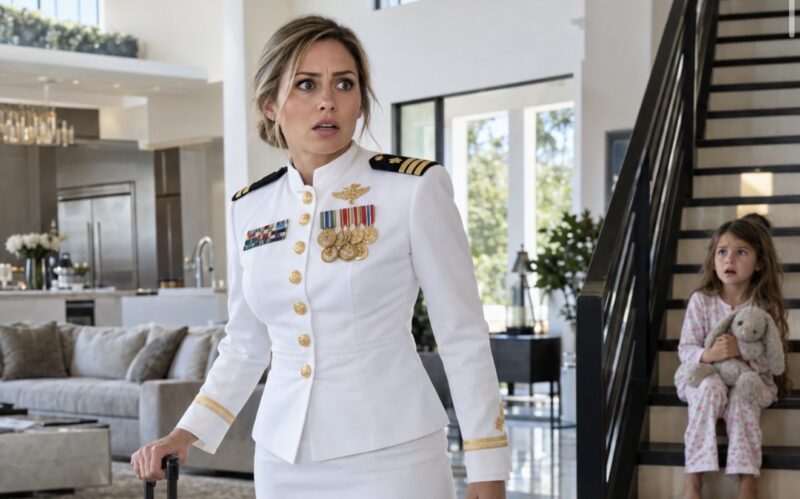
Part 1: The Question My Daughter Asked When I Came Home
“Let’s raise a glass to Lucy. Other women stay home and raise their children, but she prefers wearing a uniform. At least her paycheck always arrives.”
My husband, George, made the toast in front of his entire family the night before I left for a three-month medical assignment at a military hospital in the north.
His mother, Teresa, laughed first. His sister, Fiona, followed.
I stood still and watched my five-year-old daughter, Chloe, push her spoon through a piece of cake without taking a bite.
“Mom,” she whispered, “I want you to stay.”
The laughter stopped.
I had served as a military physician for eighteen years, and the assignment was not a personal choice. The northern district had a critical shortage of anesthesiologists, and George had been the one urging me to accept it.
“Go without worrying,” he kept telling me. “I will take care of Chloe. The extra stipend will finally let us finish remodeling the house.”
The house.
That was always the center of everything.
It did not belong to George and me jointly. My Aunt Ellen left it to me four years before I ever met him: a spacious two-story house with a small courtyard and a separate storefront in front.
Fiona had opened a nail salon in that storefront without paying rent because George believed “family helps family.”
Before I left, I gave George a secondary debit card connected only to an account for groceries, tuition, medications, and household utilities.
“The main savings account is not to be touched,” I told him.
For the briefest moment, his face changed. Then he kissed my forehead.
“Of course, sweetheart. Who do you think I am?”
During the first few weeks, everything appeared normal. Chloe showed me drawings over video calls and laughed at the uneven braids George tried to give her.
But as April passed, our calls became shorter.
Then Chloe began repeating the same strange sentence.
“Everything’s okay, Mommy. Don’t worry about anything.”
No five-year-old speaks like that unless someone has taught her to.
I asked George directly whether she was ever being left alone. He became offended immediately.
“Now you are monitoring me from a thousand miles away? You should trust your family a little more, Lucy.”
We had security cameras at the front gate and in the kitchen. Soon after that conversation, my phone stopped receiving notifications from the system.
George claimed Fiona’s contractors had accidentally cut a main line while expanding the salon.
I wanted to believe him.
My assignment was supposed to end in June, but in early May, my replacement arrived ahead of schedule. I decided not to call George.
I wanted to surprise Chloe.
On May 6th, I came home around noon.
The house was unnaturally quiet.
A small child’s jacket lay abandoned in the foyer. In the kitchen, a bowl with dried oatmeal sat in the sink.
I opened the refrigerator.
There was mustard, half a lemon, and one bottle of water.
Nothing else.
 Then I heard slow, unsteady footsteps upstairs.
Chloe appeared at the top of the staircase in an oversized T-shirt. Her hair was tangled, her lips were pale and dry, and she looked at me as though she were seeing a ghost.
“Mommy?”
I ran upstairs and pulled her into my arms. Her skin was burning hot.
“Where is your father, sweetheart?”
She looked down at her bare feet.
“He went to the beach.”
“Who is here with you?”
“Nobody.”
My heart seemed to stop.
“Since when?”
Chloe held up two small fingers.
Two days.
My five-year-old daughter had been alone in that house for nearly forty-eight hours. She had eaten one yogurt, dry cereal, and the heel of a loaf of bread.
She had even tried to cook pasta, but she could not figure out how to turn on the stove.
I called 911 and Child Protective Services immediately.
As we waited for paramedics, Chloe clung to my uniform.
“Daddy said I should not bother grown-ups,” she whispered.
At the hospital, doctors confirmed dehydration, low blood sugar, and serious stomach irritation.
An hour later, George called.
His first question was not about Chloe.
“Why did you decline my card transfer?”
Sitting beside my daughter’s bed, I understood those two days had not been an accident.
George’s family was hiding something much larger.
And I had only begun to see what they were willing to do to protect it.
Part 2: The Messages George Tried to Invent
The next morning, George entered Chloe’s hospital room with Teresa and Fiona beside him. All three looked as though they had just returned from the coast: George’s face was sunburned, Teresa carried a gift-shop bag from an upscale beach resort, and Fiona still wore an all-inclusive hotel wristband.
“I’m here to pick up my daughter,” George said.
“No, you are not,” I replied.
Teresa scoffed. “Do not be so dramatic, Lucy. I was going to drop by and check on her.”
“When?” I asked.
“Every day.”
“Then explain why she had been alone since Sunday.”
Teresa went quiet.
George changed his approach and raised his voice so the nurses in the hallway could hear him.
“You have been leaving your family for months to chase your military career, and now you want to act like the perfect mother?”
That accusation might once have hurt me. Now I saw him clearly: a man who asked about a blocked bank transfer before asking about his hospitalized daughter.
When child welfare officers arrived, George, Teresa, and Fiona immediately began blaming one another. George claimed Teresa was supposed to stay at the house, Teresa insisted Fiona was meant to pick Chloe up, and Fiona said George had told her their mother was already there.
There were too many excuses.
Then George produced screenshots of messages supposedly sent from my account.
In one, I had allegedly written, “Chloe is big enough to stay by herself for a few hours.” In another, I supposedly told Teresa not to bother sleeping over.