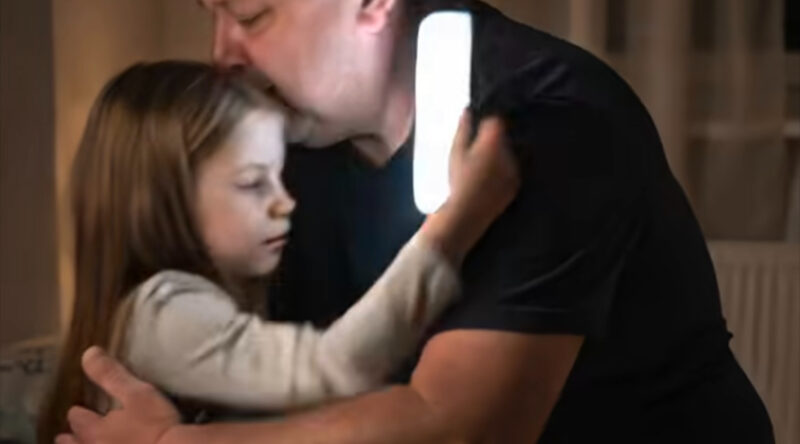
The phone call came like a stray bullet into the middle of my Tuesday afternoon. I was at my desk, drowning in spreadsheets, when the school’s number flashed on my screen. It was my daughter’s teacher, Miss Yit, and her voice was a high, tight wire of indignation.

“Mr. Alistair? Your daughter, Dilly, has been in a serious incident. She split a classmate’s head open. She was throwing rocks at her.”
The words didn’t compute. My Dilly? My quiet, bookish, ten-year-old Dilly? The world went numb. I mumbled something about being there immediately and grabbed my keys. The drive was a blur of self-recrimination and white-hot anger. Anger at her, for a violence I couldn’t fathom, and at myself, for clearly failing so profoundly as a father.
When I walked into the principal’s office, the scene was a tableau of sterile judgment. Dilly sat in a chair that was too big for her, her hands dirty, a smear of blood on the sleeve of her uniform. She wasn’t crying. Her jaw was set, and she stared straight ahead at a point on the wall only she could see.
Miss Yit was practically vibrating with rage. “She attacked Veronica during recess! Multiple witnesses saw her throwing rocks. This wasn’t a scuffle, Mr. Alistair. This was an assault.”
The principal, a man whose expression never seemed to shift from one of mild disappointment, slid a photo across his desk. Veronica, her face contorted in a tearful grimace, had a nasty gash on her forehead, blood matting her blonde hair.
“We’re suspending Dilly immediately, of course,” the principal said, his tone final. “And we are seriously considering expulsion. This level of violence is unprecedented.”
I looked at my daughter, this stranger with a stone-cold expression. “Dilly? What happened?”
Her voice was calm, devoid of emotion. “I did it. I threw the rocks.”
Miss Yit let out a small, triumphant smirk. “Well, at least she’s honest about her savagery. She’s suspended for three days, effective immediately.”
That night, dinner was a silent, agonizing affair. Dilly poked at her food, her face a closed door.
“We need to talk about this,” I said, my voice softer than I intended.
She just shook her head, refusing to look at me.
“Dilly, you could have blinded her. You could have seriously, permanently hurt her. This isn’t you. Help me understand what could possibly have made you do this.”
She finally looked at me, and her eyes were ancient. “You wouldn’t believe me anyway,” she muttered.
“Try me.”
A bitter, weary little smile touched her lips. “Nobody ever believes kids like me when we tell the truth about kids like Veronica.” She pulled out her phone. Texts from classmates were flooding in. You’re so mean. I’m gonna throw rocks at you next. Group chats were a wildfire of rumors and condemnation. But there was something else, something strange. For every cruel message from a girl in her class, there was another one, a different kind. Thank you. You’re brave. We love you. Every single one was from a boy in her grade.
“Dilly, why are all the boys…”
“You wouldn’t understand,” she said, shutting the phone off. “Nobody ever does.”
The next two days were a special kind of hell. I tried everything. Gentle questions over breakfast, firm demands after dinner. I called the parents of some of the boys who had sent the supportive texts. Their responses were curt and evasive. “Our son is just… going through something,” they’d say before hanging up.
Dilly remained a fortress. My questions were met with a stony silence that was more infuriating than any argument. The school community was in an uproar. Parents were calling for her expulsion, their outrage fueled by Veronica’s family, who were prominent and wealthy. My son, two years older than Dilly, got into two fights at his own school defending her honor. Our family was an island, and the tide was rising.
On the third night, I found her in her room, staring at her phone, silent tears finally tracking paths through the dust on her cheeks. I sat on the edge of her bed, my anger long since replaced by a desperate, aching fear.
“Sweetheart, I can’t help you if you won’t talk to me. I’m on your side, no matter what. But you have to let me in.”
She looked up, her eyes exhausted, aged by a burden no child should carry. “Dad, do you really want to know?” Her voice was a fragile whisper. “Because once I tell you, you can’t pretend it’s not happening anymore.”
I took her small, cold hand in mine. “I promise. I will never ignore what’s hurting you.”
She took a shuddering breath. “Veronica… she’s been cornering the second-grade boys in the equipment shed. She… she makes them pull their pants down. She takes pictures with her phone and tells them she’ll show everyone if they tell anyone.”
The air left my lungs. A cold, nauseating sickness washed over me.
“Did you tell someone?” My voice was hoarse.
“I told Miss Yit. Three times,” she said, her voice flat with remembered defeat. “She said little boys make up stories about popular girls for attention. I told the principal. He said Veronica is a model student and I was just jealous. I showed them Max crying after it happened. I showed them the bruises on Luke’s arm from where he tried to get away. Nobody listened. Because pretty, popular girls… they don’t do things like that.”
“How long?” I whispered.

“Two months. Yesterday, I saw her dragging Ben’s little brother behind the shed. He’s only six, Dad. Six. He was crying so hard he couldn’t breathe.” Her voice finally cracked, the armor crumbling. “I screamed at her to stop. She just laughed. She said no one would ever believe me over her. So… I picked up rocks.”
She showed me her phone. It wasn’t just the texts. It was screenshots of desperate messages from the older siblings of younger kids, begging someone to help. Reports filed with the school and dismissed. There was even a blurry video of Veronica grabbing a small boy, but the administration had deemed it “inconclusive.”
“I tried everything else first, Dad,” Dilly whispered, tears flowing freely now. “Everything.”
My despair curdled into a rage so pure and cold it felt like a physical force. I had been angry at my daughter for throwing rocks. Now, I was furious she hadn’t thrown more.
The next morning, I went nuclear. When the police interviewed the younger boys, away from the intimidating presence of Miss Yit and the principal, the floodgates opened. Five of them, through heartbreaking sobs, confirmed everything. They found the pictures on Veronica’s phone. Miss Yit was fired. Criminal charges were filed against Veronica. Justice, it seemed, had finally arrived.
Or so I thought.
Three weeks later, Dilly came home from school, her face puffy and stained with fresh tears. She shoved me away when I tried to comfort her. “You promised!” she sobbed. “You promised you would help!”
“Honey, what is it? She’s gone.”
“She’s back!” she wailed. “Veronica is back at school.”
My blood boiled. A quick phone call confirmed the unbelievable. Veronica’s father had made a quiet, five-figure “donation” to the school’s new gymnasium fund. And just like that, his daughter was back, walking the halls as if nothing had happened, more untouchable than ever.
I looked at my daughter’s devastated face, and my hands clenched into fists. This was not over. I called the detective on the case, my fingers shaking with rage. He sounded tired, defeated.
“Juvenile cases are complicated,” he explained. “The donation is suspicious, but not technically illegal. Families with money find loopholes.”
That night, my wife and I sat at the kitchen table until 2 a.m., drafting emails to every single member of the school board. We removed the rage, the accusations of corruption, and stuck to the cold, hard facts. The next day, I took a family emergency day and demanded a meeting with the principal. I dropped the stack of police reports and witness statements on his desk. It made a solid, satisfying thump.
He wouldn’t meet my eye. “We have to follow due process, Mr. Alistair. Everyone deserves a second chance.”
“What about the kids she hurt?” I demanded. “What about their second chance at feeling safe in this school?”
He mumbled something about a “safety plan” and “supervised recess.” I left his office feeling dirtier than when I’d entered. The system wasn’t broken; it was working exactly as designed, protecting the powerful at the expense of the vulnerable.
But we weren’t giving up. That evening, on the advice of a lawyer friend, I called Audrey Armstrong, an attorney who specialized in education law. She met with us that same afternoon. She spent an hour reviewing our mountain of documentation, her expression growing grimmer with each page.
“The school has violated at least four state and federal policies regarding student safety,” she said finally, her voice crisp and professional. “We can file formal complaints. We can create a paper trail they cannot ignore.” For the first time in weeks, I felt a flicker of hope.
The fight consumed our lives. Our son got into another fight defending Dilly from a bully who called her a snitch. The online harassment intensified, with anonymous accounts threatening Dilly. I started driving both kids to and from school, my own work suffering. We formed a support group with other parents whose children had been victimized. Their stories were chillingly similar: reports dismissed, concerns ignored, a culture of protecting the abuser. We met every Saturday, sharing information, building a case, our collective evidence growing thicker each week.
The pressure began to mount. A district compliance officer, a woman named Allison Hutchinson, launched a formal investigation after receiving our meticulously documented complaints. A local journalist, Orion Castillo, heard my speech at a school board meeting—where I spoke of child safety being sold to the highest bidder—and began his own investigation. His article, published without naming names but detailing the systemic failures, went viral in our community. The principal, seeing the tide turn, released a defensive, meaningless letter to parents about “reviewing protocols.” It only fanned the flames.
The district’s lawyers proposed mediation. Audrey coached us to stay firm. In the middle of a tense, three-hour session, I received a text from an unknown number. It was a leaked psychological evaluation of Veronica. It suggested she was acting out learned behaviors, that she herself may have been a victim at some point. It didn’t excuse her actions, but it complicated everything.
That night, our family talked. Dilly, with a wisdom beyond her years, said she just wanted to feel safe and for the little kids to be protected. We agreed. Fixing the system was more important than just punishing one troubled child.
Our focused demands broke the stalemate. The district agreed to expunge Dilly’s suspension. They would implement an anonymous reporting system and fund additional, specially trained playground supervisors. Veronica would be placed on home instruction with a private tutor, barred from school property. It wasn’t a total victory, but it was a start.
The fallout was swift. The principal was reassigned. Miss Yit’s teaching license was put under review when it was discovered she had a history of dismissing similar complaints at a previous school. Veronica’s family, facing social and legal ruin, sold their house and moved out of state in the middle of the night.
The school began to change. New locks, new cameras, new protocols. More importantly, a new atmosphere. The cloud of fear that had hung over the playground began to lift. And Dilly, my brave, fierce Dilly, started to heal. With the help of a therapist, she began to process the trauma, to understand that she had been placed in an impossible situation where the adults had failed, and she had been forced to act. She started rejoining her art club, reclaiming the parts of her life that had been stolen.
At his first wrestling tournament, my son won his match. He took the announcer’s microphone and, in front of the entire gym, said, “This one’s for my sister, Dilly, who always fights for what’s right.” The crowd turned to look at us. Dilly’s face went bright red, but underneath the blush, she was smiling. A real, genuine smile, for the first time in months.

The system isn’t perfect. We didn’t get a Hollywood ending where every villain was vanquished. But we got something real. We got change. We got a safer school for our kids. And I got to see my daughter, the girl who threw rocks, learn that her voice—and her courage—had the power to move mountains.