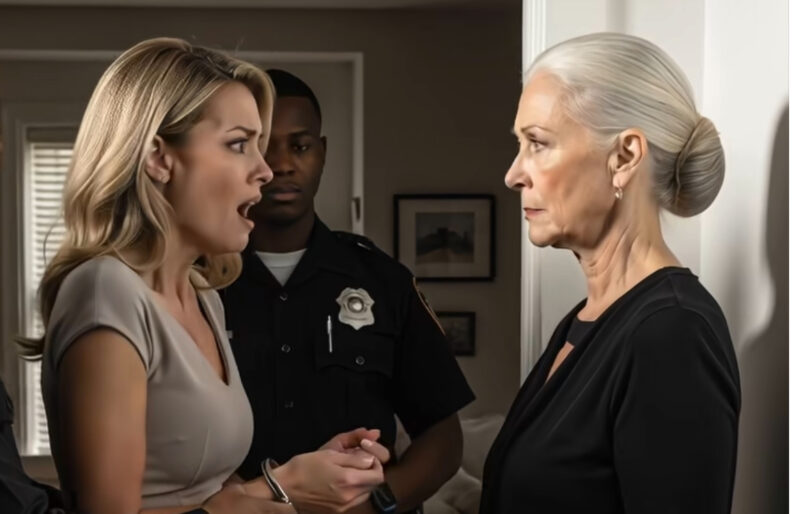
The phone went straight to voicemail for the third time in two days. That’s when I knew something was profoundly wrong. Michael always answered my calls, even when he was busy, even when his perfect wife, Sarah, rolled her eyes in the background. Always.

The thing about being a mother is that you develop a sixth sense about your children. Call it intuition, call it a maternal instinct, but when something is amiss, you feel it in your bones. And I’d been feeling it for weeks. My name is Barbara Wilson, and I’m sixty-seven years old. Three months ago, I thought my biggest worry was whether to plant roses or lavender in my front garden.
It started with the phone calls that came less frequently. Then the missed Sunday dinners became a pattern. Michael had always been reliable, but after marrying Sarah Collins in that whirlwind April wedding, everything changed.
“Mom, Sarah thinks we need to establish better boundaries,” he’d explained during our last conversation two weeks ago. His voice sounded different, hollow, like he was reading from a script. “We’re trying to build our own family traditions.”
Boundaries. That’s what she called cutting me out of their lives, bit by bit.
I picked up my phone again and dialed Michael’s work number. The receptionist’s cheerful voice made my heart skip a beat. “Wilson Construction, this is Jenny.”
“Hi, this is Barbara Wilson, Michael’s mother. Is he available?”
A pause. “Oh, Mrs. Wilson. I’m sorry, but Michael hasn’t been in for over a week. We thought he was taking vacation time.”
The room started to spin. Michael never took unplanned vacations. He was methodical, organized, just like his father had been. “Did he call in? Leave any message?”
“No, ma’am. Actually, we’ve been trying to reach him, too. We have that Henderson project deadline coming up.”
I thanked Jenny and hung up, my hands trembling. A week? What kind of mother doesn’t know when her child disappears for a week? The answer was simple: the kind whose son married a woman who made isolation her specialty.
Sarah Collins had seemed perfect when Michael first brought her home in January. Beautiful, articulate, charming. She asked all the right questions about my garden, complimented my cooking, and gazed at Michael like he hung the moon. “Too perfect,” my neighbor Dorothy had whispered after meeting her. “That girl’s performing, not living.”
But Michael was so happy, so completely smitten, that I’d pushed my doubts aside. When they announced their engagement after just two months, I’d bitten my tongue. When Sarah insisted on a small wedding with just immediate family, I’d smiled and agreed. The wedding photo showed a radiant bride and a grinning groom, but I remembered how Sarah’s eyes had scanned the room during the ceremony—calculating, measuring, like she was already planning her next move.
Now, sitting in my empty house with unanswered calls and a growing dread, I realized Dorothy had been right. Sarah had been performing. The question was, what was the final act?
The call came at 6:47 a.m. on a Tuesday, jolting me from a restless sleep. Sarah’s name lit up the screen, and my heart hammered against my ribs.
“Barbara, it’s Sarah.” Her voice was flat, emotionless. No tears, no cracking, just cold efficiency.
“Sarah, thank God. I’ve been trying to reach you both for days. Where is Michael?”
A silence stretched between us like a chasm. When she finally spoke, her words hit me like physical blows. “Michael is gone, Barbara. There was a car incident on Highway 50 three days ago.”
The phone slipped from my hand and clattered onto the kitchen floor. Gone. My son. My Michael. I scrambled to pick it up, my vision blurring. “Sarah, I’m so sorry. Oh, God. When is the service? I need to book a flight to Nevada immediately. I need to—”
“The service was yesterday.” Her voice cut through my panic like ice. “Close family only. It was what Michael wanted.”
Yesterday. The service was yesterday, and she was just telling me now. My son was in the ground, and I wasn’t there. “What do you mean, ‘close family’? I’m his mother!”
“Barbara, I understand you’re upset, but you need to respect our privacy during this difficult time. Michael and I discussed this situation before what happened. He wanted things kept small.”
Discuss this situation. She was talking about my son’s final moments like it was a business arrangement. And the Michael I’d raised would never, ever have wanted me excluded.
“Sarah, please. I need to understand. How did this happen? Was he alone? Was he—”
“I have to go, Barbara. I have arrangements to make. I’ll call you when I’m ready to talk.”
The line went dead. I sat on my kitchen floor, still holding the phone, trying to process the impossible. My son was gone and buried, and his wife had excluded me from saying goodbye. The woman who’d smiled so sweetly at our Sunday dinners had just delivered the worst news of my life with all the warmth of a telemarketer. Something was deeply wrong.
Over the next few days, every call to Sarah went straight to voicemail. I called the Nevada State Police, the Clark County Sheriff’s Department, and finally, the coroner’s office in Las Vegas.
“Ma’am, I need a case number or approximate date to search our records,” a clerk explained patiently.
“June 3rd, 2024. Highway 50. Michael Wilson, twenty-nine years old.”
I waited, my heart pounding. Please let there be a mistake. Please let him be alive somewhere, angry at me for checking up on him.
“Ma’am, I’m not finding any traffic incidents with that name on that date. Are you sure about the spelling?”
The room went cold. No accident report, no death certificate, no body. Either Sarah Collins was lying about how my son’s life ended, or she was lying about it ending at all. I booked a flight to Las Vegas that same afternoon.
Michael and Sarah lived in an upscale neighborhood called Summerlin. Their house sat at the end of a cul-de-sac, Sarah’s white BMW gleaming in the driveway. The doorbell chimed pleasantly. Sarah opened the door wearing a black sundress and dark sunglasses. No tears, no red eyes. She looked like she was dressed for a lunch date.
“Barbara.” Her voice held no surprise. “What are you doing here?”
“I came to see where my son lived, where he passed, since you didn’t think I deserved to attend his final service.”
She glanced over my shoulder, checking if anyone was watching. “You can’t just show up here. I’m still processing.”
“Your grief? You sound about as grieved as someone discussing the weather. Where is Michael’s final resting place?”
A flicker of something—annoyance? fear?—crossed her face. “Mountain View Cemetery. Now, if you’ll excuse me…”
“I’d like to see his room. His belongings.”
“That’s not possible. I’ve already donated most of his things. It’s too painful to keep reminders around.”
Donated his things. He had been gone for less than a week, and she’d already erased him. What widow donates her husband’s belongings before the flowers have wilted?
“Show me the death certificate,” I demanded. The words hung between us like a challenge.
Sarah’s composure wavered for just a moment. “I don’t have to show you anything. You’re not next of kin.”
“Not next of kin? I’ve been his emergency contact for twenty-nine years. Unless someone changed that very recently.”
Her jaw tightened. “After we got married. It’s what married couples do.”
But I already knew the answer. She’d isolated him so completely that even in his final chapter, I’d been erased.
Mountain View Cemetery sprawled across rolling hills. I drove through the gates with directions to section G, plot 247. “Fresh arrangements, ma’am,” the elderly groundskeeper had said. “Just last week.”
But when I found the plot, it was empty. Just grass and a small temporary marker that looked like it had been placed there yesterday. The grass wasn’t disturbed. There was no indication that earth had been dug up and replaced.
Twenty minutes later, I sat in the cemetery office. “Mrs. Wilson,” the director said, frustrated. “We have a payment for plot 247 in your son’s name, but no burial has taken place. The plot was purchased last Tuesday, the same day you’re saying the service occurred.”
Purchased as a pre-need arrangement. Planning for a demise that hadn’t officially happened yet. I drove back to Sarah’s house, my mind racing. This time, I didn’t bother with the front door. I walked around to the backyard, peering through windows. The house was staged like a model home. No photographs, no personal items. But in the master bedroom, I saw something that made my blood run cold: a suitcase, packed and sitting by the door. Sarah wasn’t grieving. She was getting ready to leave.
I was pulling out my phone to call the police when a neighbor appeared at the fence. “Excuse me, are you looking for someone?”
I took a chance. “I’m Barbara Wilson, Michael’s mother.”
Her face softened. “Oh, honey. I’m so sorry. Such a tragedy.”
“You saw what happened?”
She looked confused. “The incident? No, dear. I saw the ambulance last Wednesday morning, around ten. They brought him out on a stretcher, but he was covered up. Sarah was crying. Said he’d had some kind of medical emergency.”
Wednesday morning. Three days before Sarah claimed he’d perished on Highway 50.
That night, in a hotel room, I called the police again and spoke to a Detective Rodriguez.
“Ma’am, I understand your frustration,” he said, his skepticism audible. “But without a body or evidence of foul play, there’s not much we can do. Sometimes people just need space.”
“Detective, there’s no death certificate, no accident report, and no burial. Either my son is alive and being held against his will, or someone ended his life and is covering it up.” After hanging up in frustration, I decided to build a case myself.
Around noon the next day, Sarah emerged from the house with the suitcase. She loaded it into her BMW and drove to a storage facility called Secure Space. She disappeared inside unit 247—the same number as Michael’s cemetery plot. It couldn’t be a coincidence. Thirty minutes later, she emerged empty-handed and drove toward the airport.
I followed her into the terminal. After she checked in, I approached the ticket agent. “Excuse me, I think that woman dropped something. Could you tell me what flight she’s on so I can catch her?”
“That passenger is on flight 847 to Portland, Oregon,” the agent said.
Portland. My city. Sarah was heading to my hometown. I bought a ticket on the same flight and called Detective Rodriguez from the gate. “Detective, you need to check Secure Space, Unit 247. Sarah Collins is on a flight to Portland. If you don’t stop her, you’ll never find her.”
But Sarah Collins wasn’t on the Portland flight. She’d vanished between security and the gate. At 11 p.m., exhausted and defeated in the Portland airport, my phone rang. It was Detective Rodriguez.
“Mrs. Wilson, we got that warrant for the storage unit. You need to get back to Las Vegas. Immediately.”
The next morning, he led me into a conference room filled with evidence. Michael’s watch, his wallet, his college ring. And a manila folder filled with documents: marriage certificates, death certificates, life insurance policies, all in different names, but all with the same woman. Sarah Collins, Sarah Fletcher, Sarah Kim.
“We’ve identified at least four previous marriages,” Rodriguez said grimly. “Three of the husbands passed under suspicious circumstances within six months of the wedding. Your son was supposed to be number four. Her real name is Margaret Winters.”
“Detective, where is Michael? Is he alive?”
His expression softened. “Mrs. Wilson, we found your son’s body this morning, buried in the desert. The coroner estimates he’s been gone for about ten days. The cause was poisoning. Ricin, specifically. It’s a toxin derived from castor beans. It looks like natural causes unless you know what to look for.”
I sank into a chair, the weight of it all hitting me. My son, poisoned slowly by the woman he loved.
“We have an APB out on Margaret Winters,” Rodriguez continued. “But Mrs. Wilson, without your persistence, we never would have discovered this pattern. You saved other potential victims.”
But I hadn’t saved Michael.
Three weeks after Michael’s real funeral, I was sitting in a coffee shop in downtown Portland when I spotted her. Margaret Winters was standing in line, her hair changed from blonde to auburn, wearing glasses. But I knew that practiced smile that never reached her eyes.
“Rodriguez, it’s Barbara. I found her. She’s in Portland at Pioneer Square.”
“Mrs. Wilson, are you certain? Don’t approach her. I’m contacting Portland PD.”
But Margaret was already moving. I followed at a distance, my phone line open with Rodriguez. She got into a silver Honda with Washington plates and drove to a modest apartment complex in southeast Portland, disappearing into unit 237. I relayed the address and settled in to wait.
An hour later, three Portland police cars arrived quietly. A Detective Thompson from Portland PD approached my car. “Mrs. Wilson, we’re going to need you to make a positive identification.”
“She’s not going to come quietly,” I warned.
As we spoke, I saw movement in her second-floor window. She was packing again. A fire escape ladder dropped down the back of the building, and I caught a glimpse of auburn hair as she climbed down. A motorcycle was waiting in the alley. She kicked it to life just as the first officer rounded the corner. The bike roared away, disappearing into traffic. She had escaped again.
But this time, she’d revealed something important. She was still in Portland. There was something keeping her here, something worth the risk. That something, I realized with growing dread, might be me.
The answer came at 3 a.m. when my house alarm started screaming. The kitchen door had been breached. By the time police arrived, Margaret was gone. But she’d left something on my kitchen table: Michael’s college ring. The same ring that had been buried with him.
“She went back to Nevada and disturbed my son’s final resting place,” I whispered to the officer. This wasn’t random. This was personal.
I couldn’t stay in my house. I went to my neighbor, Dorothy. She was seventy-three, a retired army nurse who kept a shotgun by her door and wasn’t afraid to use it. After I told her everything, her voice was sharp with anger. “That woman has some nerve. She picked the wrong mother to mess with.”
“We need to think like she thinks,” I told Dorothy. We spent the next hour poring over my research.
“Older men, financially stable, recently widowed or divorced,” Dorothy observed, studying the photos of Margaret’s previous victims. “She has a type.”
“She’s not just hiding here,” I said. “She’s hunting. There’s another target in this city.”
We found him in a local newspaper article: Robert Chen, fifty-eight, a successful business owner whose wife had passed from an illness six months ago. His social media profile was filled with posts about loneliness. And sympathetic comments from someone named “Rebecca Fletcher.”
We approached Robert at his business the next morning. When I showed him the photographs, his face went pale. “You’re telling me that Rebecca… that she’s a predator?”
“Mr. Chen,” Dorothy said gently, “this woman has a history of causing harm to her husbands for financial gain. You’re not falling in love. You’re being set up.”
It took hours, but eventually, Robert agreed to cooperate. Detective Thompson provided recording equipment. The plan was for Robert to propose, forcing Margaret to accelerate her timeline. That week, from a surveillance van, I listened as he played his part perfectly.
On Thursday evening, we heard Margaret on the phone. “I need to move the timeline up,” she said. “There’s too much heat here. I’ll finish this job and disappear permanently.”
That night, Robert invited her for dinner. The house was surrounded by undercover officers. I watched the surveillance feed as she served him a casserole she’d made and poured him wine. We waited until she excused herself to the bathroom, then moved in. Officers entered through the back while Robert quickly switched his plate with a clean one Dorothy had prepared.
When Margaret returned, she seemed nervous. “Robert, you seem tired. Maybe you should lie down.”
“I do feel a bit dizzy,” he said, following the script.
As she helped him to his feet, Detective Thompson’s voice came through our earpieces. “Move in. Now.”
The front door burst open. Margaret’s carefully constructed persona shattered. “You set me up,” she snarled at Robert.
“Mrs. Margaret Winters,” Detective Thompson said, pulling out handcuffs. “You’re under arrest for what happened to Michael Wilson and the attempted harm of Robert Chen.”
As they led her away, her eyes met mine. For the first time, I saw it in her carefully controlled expression: fear.
The trial lasted six weeks and revealed a pattern of deception stretching back twelve years. I attended every day, sitting in the front row where Margaret couldn’t avoid seeing me. Robert Chen’s testimony about her feigned love and calculated plans sealed her fate.
On the day of sentencing, I delivered a victim impact statement. “Your Honor,” I began, “Margaret Winters didn’t just take my son’s life. She took the future we would have shared. The grandchildren I’ll never hold. The holidays we’ll never celebrate. She ended his life slowly, over weeks, while he trusted her completely. That’s not just a crime. That’s torture.”
I turned to face her directly. “You chose to become a predator. You chose to hunt good men who were only guilty of being lonely. You didn’t count on a mother who would never stop fighting for her son.”
The judge sentenced her to life in prison without the possibility of parole.
Six months later, I received an unexpected phone call. It was a detective from the Portland Cold Case Unit. “Mrs. Wilson, we’ve connected Margaret Winters to at least four additional cases across three states. We also found evidence she had a partner who helped her. We were hoping you might consider joining our cold case task force as a consultant. Your insights have been invaluable.”
A year ago, I was a retired librarian. Now, the police were asking me to help hunt for predators. It felt right. Using what I’d learned from losing Michael to save other people’s children.
Three weeks later, I was in the cold case conference room. My official title was Victim Advocate and Behavioral Consultant. My first case involved a suspicious food contamination case from 2013. The methods were different, but the pattern was Margaret’s. We identified the suspect and found her in Spokane, Washington, six weeks into a relationship with a recently divorced businessman. This time, we moved fast and arrested her before she could cause him harm.
On the first anniversary of Michael’s passing, I visited his grave. The headstone was simple: Michael Wilson, Beloved Son. Margaret Winters had taken my son, but she’d also given me something unexpected: a purpose bigger than my own grief, a way to honor Michael’s memory by protecting other families. The hunt was over, but my work was just beginning.