I used to believe that success was a structure you built, brick by gold brick. I thought that if the walls were high enough, the bank accounts full enough, and the suits tailored sharply enough, nothing could touch the people inside. I was the architect of my own life, or so I told myself. I was Daniel Miller, the man who could close a million-dollar deal before breakfast but couldn’t see the rot spreading in his own living room.

My mother, Rosa, was the foundation of my world. She was a woman of calloused hands and a spine made of steel, a widow who had scrubbed other people’s floors for thirty years so I wouldn’t have to. When I finally “made it”—when the company went public and the dividends started pouring in—my first act was to move her into the mansion I had purchased in the hills. I wanted her to rest. I wanted her to drink tea on the veranda and watch the sunset.
Then there was my wife, Lauren.
Beautiful, articulate, and poised, Lauren was the trophy I thought I deserved. She moved through high society with the grace of a swan, hiding the paddling feet beneath the water. She spoke of charity, of image, of legacy. When she gave birth to our twin sons, Leo and Sam, I thought my life was complete. I had the heir, the spare, the queen, and the matriarch all under one roof.
“I’ll handle the house, Daniel,” Lauren had said, her voice smooth as silk. “You focus on the expansion. Your mother is in good hands. She’s… adjusting.”
“Adjusting.” That was the word she used whenever I asked why Mom looked so tired, or why she retreated to her room the moment I came home.
“She’s just old, darling,” Lauren would sigh, pouring me a glass of aged scotch. “Her mind is wandering a bit. She insists on cleaning. I try to stop her, but you know how stubborn she is. She says it gives her purpose.”
I drank the scotch. I swallowed the lie. I buried myself in work, traveling four days a week, convinced that my absence was a necessary sacrifice to maintain the paradise I had built. I was providing. That was my job.
But the human instinct is a funny thing. It screams at you in whispers.
It started with the phone calls. When I called home to speak to Mom, Lauren would always intercept. “She’s napping, Daniel.” “She’s in the garden and forgot her phone.” “She’s watching a soap opera and doesn’t want to be disturbed.”
Then came the weight loss. On the rare weekends I was home, Mom looked frail. Her eyes, once bright with the fire of a woman who had defied poverty, were dull and darting. She flinched when doors slammed.
“Mom, are you okay?” I asked her once, finding her folding laundry in the hallway.
She froze, her eyes shifting to the shadow at the top of the stairs where Lauren stood. “I am fine, mijo. Just tired. Go back to your work. You are a busy man.”
I let it go. God help me, I let it go because it was easier to believe the lie than to dig for the truth. I was a coward wrapped in Armani.
But the universe has a way of forcing your eyes open.
It was a Tuesday in November. A merger meeting in the city had been cancelled at the last minute. I was three hours away from home, but a sudden, icy dread gripped my chest. It wasn’t a thought; it was a physical pull, a nausea that settled deep in my gut. I didn’t call Lauren to tell her I was coming. I didn’t call the nanny.
I got in my car and drove. The closer I got to the house, the heavier the air felt.
Cliffhanger:
I pulled into the driveway, killing the engine to avoid the noise. The house loomed above me, a massive structure of stone and glass. It looked perfect. But as I stepped onto the porch, I realized the front door was slightly ajar, and from the depths of the hallway, I heard a sound that stopped my heart cold—not a cry, but a low, rhythmic whimper of absolute submission.
Chapter 2: The View from the Bathroom Door
The house was cold. That was the first thing I noticed. Lauren always kept the thermostat perfectly regulated, yet the air in the foyer bit at my skin.
I set my briefcase down, the soft thud sounding like a gunshot in the silence.
“Lauren?” I called out, but my voice was weak, strangled by that growing knot of dread.
Silence.
I walked past the living room. Pristine. The kitchen. Spotless. It was like walking through a museum, not a home where two infant boys lived. Where were the toys? Where was the noise? Leo and Sam were ten months old; they should be babbling, crawling, banging pots and pans.
I moved toward the east wing, where the guest suites and the main family bathroom were located. As I got closer, I heard it again.
“I’m sorry, Ma’am. I’m trying. It hurts, Ma’am.”
My blood turned to ice. That was my mother’s voice. But it was broken, thin, devoid of the dignity she had carried her entire life.
I crept closer to the bathroom door, which was cracked open. The smell of bleach was overpowering, burning my nostrils. I pushed the door open, my hand trembling.
The sight before me shattered my reality instantly.
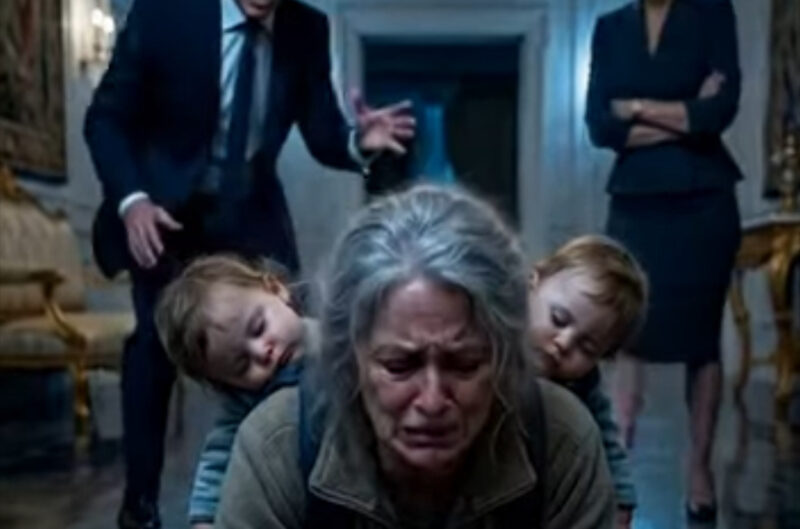
The floor was wet and icy, covered in harsh chemical foam. My mother, Rosa, a woman of seventy years, was on her hands and knees. She was scrubbing the grout with a toothbrush. Her hands were red, raw, and trembling.
But that wasn’t the nightmare.
Strapped to her back with a makeshift, tight sheet were my sons. Leo and Sam. They were heavy, dead weight against her frail spine. She was struggling to balance, her breath coming in ragged gasps as the weight threatened to topple her onto the wet tile.
And there, leaning against the marble vanity, was Lauren.
She was scrolling through her phone, a glass of wine in her other hand. She looked bored. She looked calm. She looked like a slave driver overseeing a plantation, not a daughter-in-law watching the grandmother of her children.
“Missed a spot near the tub, Rosa,” Lauren said, her voice devoid of emotion. “If you want dinner tonight, the grout needs to be white. Not gray. White.”
“Yes, Ma’am,” my mother whispered, tears dripping off her nose onto the suds. “My back… the babies are heavy today…”
“They are your punishment for being a burden, Rosa,” Lauren replied casually, taking a sip of wine. “If you want to live in my house, you contribute. You’re not a guest. You’re help. And barely competent help at that.”
I stood there, paralyzed by a rage so pure, so white-hot, that for a second, I couldn’t breathe. The woman I had married was gone. In her place stood a monster.
I stepped into the room. The sound of my shoe on the wet tile made Lauren look up.
Her eyes went wide. The glass of wine slipped from her fingers and shattered on the floor, sending red shards skittering toward my mother’s knees.
Cliffhanger:
Lauren didn’t scream. She didn’t apologize. She simply narrowed her eyes, smoothed her dress, and looked me dead in the face with a chilling smile. “You’re home early, Daniel. This isn’t what it looks like—it’s actually for her own good.”
Chapter 3: The Monster Revealed
“Get away from her,” I growled, my voice sounding foreign to my own ears. It was a guttural, animalistic sound.
I didn’t wait for her to move. I rushed to my mother, dropping to my knees in the chemicals, ruining my suit, not caring a damn bit.
“Daniel…” Mom sobbed, trying to shield her face. “Don’t look, mijo. Please don’t look.”
“It’s okay, Mama. I’m here.” I fumbled with the knots of the sheet tied around her chest. It was tied so tightly it had cut into her skin.
I pulled the twins off her back. They were disturbingly heavy and limp. I set them gently in the hallway in their carriers and turned back to help my mother up. She couldn’t stand. Her knees were bruised, her hands swollen.
I lifted her in my arms—she felt lighter than air, a bird made of hollow bones—and carried her out of the toxic fumes of the bathroom, setting her on the chaise in the hallway.
Then, I turned to Lauren.
She was still standing there, arms crossed, defiant.
“Explanation. Now,” I said. The volume of my voice was low, but the vibration of it shook the walls.
“Oh, stop being so dramatic, Daniel,” Lauren scoffed, stepping over the broken wine glass. “She needs structure. She mopes around here all day. I’m giving her purpose. She helps with the cleaning, she watches the boys. It’s a fair exchange for the roof over her head.”
“A fair exchange?” I stepped closer, invading her personal space. “She is seventy years old. You have her scrubbing floors on her knees? You strapped my children to her back like she’s a pack mule?”
“She offered!” Lauren lied, though her eyes flickered. “She said she wanted to feel useful!”
“Liar!”
The scream came from the chaise. My mother, who had never raised her voice in my presence, was sitting up, trembling with a rage I had never seen.
“I never offered!” Rosa cried out, the dam finally breaking. “She forces me. She tells me if I don’t clean, she will tell you I am senile. She said she would have me put in a home. She said… she said I would never see my grandchildren again.”
Rosa looked at me, tears streaming down her face. “She hits me, Daniel. When you are gone. She shoves me. She calls me a dirty beggar. She makes me eat scraps after she finishes dinner.”
The words hit me like physical blows. Every trip I took, every late night at the office, I had left my mother in a torture chamber.
“You’re pathetic,” Lauren spat at Rosa. “Look at you, sniveling to him. He doesn’t care. He’s never here.”
“I am here now,” I said, my voice shaking. “And you are done.”
I walked over to the twins. Leo and Sam. They hadn’t moved. They hadn’t cried during the shouting. They were just… staring. Their eyes were glassy, their pupils dilated.
I touched Leo’s cheek. He barely reacted.
“Why are they so quiet?” I asked, the dread returning, colder than before. “Lauren, why aren’t they crying?”
Lauren shifted her weight, looking toward the door. “They’re just well-behaved. Unlike your mother.”
I leaned down and sniffed Sam’s breath. Beneath the scent of baby formula, there was something chemical. Sweet. Medicinal.
I looked at the counter in the bathroom. Hidden behind a row of expensive perfumes was a bottle of adult-strength sedative syrup.
I grabbed the bottle. It was half empty.
“You drugged them,” I whispered. The horror was total. “You drugged our children so they wouldn’t bother you while you tortured my mother.”
Cliffhanger:
Lauren lunged for the bottle, her face twisting into a snarl. “Give me that! You don’t know what it’s like! They scream all day! I needed peace!” I shoved her back, and she stumbled, her mask of perfection finally slipping to reveal the psychopath underneath. But before I could do something I would regret, the front doorbell rang—long, insistent, and authoritative.
Chapter 4: The Cavalry
I didn’t move to answer it. I was standing guard over my mother and children. But the door opened anyway.
“Daniel Miller? Police!”
Two men walked into the hallway. One was Officer Parker, a man I knew from the local precinct. The other was Mark Reynolds, my family attorney.
Lauren’s face went white. “Who called you? You can’t just walk in here!”
Mark stepped forward, holding a tablet. “Daniel, I got the alert from the security system you had me install last week. The one you asked to keep off the main network?”
I blinked. In my haze of work and suspicion, I had asked Mark to install hidden cameras in the common areas a week ago, after Mom sounded particularly strange on the phone. I hadn’t checked the feed yet—I had been too cowardly to look. But Mark monitored the server.
“We have everything recorded, Mrs. Miller,” Mark said, his voice cold and professional. “The last six days. The physical abuse of Mrs. Rosa Miller. The verbal assault. And just now… the administration of unprescribed substances to minors.”
Officer Parker stepped forward, handcuffs glinting in the harsh hallway light. “Lauren Miller, you are under arrest for elder abuse, child endangerment, and domestic battery.”
Lauren screamed. It wasn’t a scream of fear; it was a scream of entitlement. “You can’t touch me! This is my house! He’s lying! That old witch is lying!”
I watched as they grabbed her arms. She kicked and thrashed, spitting venom at my mother, at me, at the world.
“Daniel! Tell them!” she shrieked as they dragged her toward the door. “I did this for us! To keep the house perfect! For your image!”
I looked at her, really looked at her, for the last time. “My image?” I said quietly. “You destroyed my family for an image. Take her away.”
The door slammed shut.
The silence that followed was different. It wasn’t the cold, sterile silence of the last year. It was the silence of a storm that had finally passed.
I sank to the floor beside the chaise. My mother reached out her bruised hand and touched my face.
“I am sorry, mijo,” she whispered. “I didn’t want to worry you.”
I buried my face in her lap and wept. I wept for my blindness. I wept for her pain. I wept for my sons, who were sleeping a chemical sleep in their carriers.
“Never again, Mama,” I promised, my voice muffled by her apron. “I swear to you, never again.”
But promises are words. I needed action.
Cliffhanger:
The next morning, the doctors confirmed the twins would be okay, though the withdrawal would be difficult. But as I sat in the hospital waiting room, Mark handed me a file regarding Lauren’s finances. It turned out the abuse wasn’t the only secret she was keeping. She hadn’t just been hurting my family physically; she had been systematically draining my accounts to fund a secret life I couldn’t even fathom.
Chapter 5: Rebuilding from the Ashes
The divorce was a war, but I had the nuclear option: the video tapes. Lauren lost everything. Custody, alimony, her reputation. She was sentenced to ten years in prison. I didn’t go to the sentencing. I didn’t care. She was a ghost to me now.
The real work was at home.
I took a sabbatical from the company. The board was furious, but I told them to fire me if they wanted. They didn’t.
I sold the mansion. That place was a tomb, haunted by the memories of my mother on her knees. I couldn’t walk past that bathroom without shivering.
We moved to a smaller place. A sprawling ranch-style house with no stairs, big windows, and a garden full of sunlight.
For the first few months, Rosa flinched if I spoke too loudly. She would try to stand up when I entered the room. It took time, patience, and therapy to undo the conditioning Lauren had instilled in her.
“Mom, you sit,” I would tell her, bringing her tea. “I’m making dinner.”
“But Daniel, you are the CEO…”
“I am your son,” I corrected her. “And tonight, I am the chef. Sit.”
Slowly, the light returned to her eyes. She started gardening again. She started singing to Leo and Sam, who were recovering well, growing into loud, chaotic, happy toddlers.
But I knew that just fixing my own home wasn’t enough. I kept thinking about how easily it had happened. How a man with all the resources in the world could be so blind to the suffering under his own roof.
I thought about other elderly people, trapped in homes with family members who saw them as burdens. I thought about children without voices.
One evening, watching Mom teach the twins how to plant tomatoes, the idea struck me.
I liquidated a significant portion of my stock options. I didn’t need the excess. I needed purpose.
I founded Golden Dignity.
It wasn’t just a charity; it was a shield. We established a network of social workers, lawyers, and safe houses specifically for elderly victims of familial abuse. We created a hotline that wasn’t monitored by the police, but by advocates who could intervene before things got criminal.
I poured my business acumen into it. I ran it like a Fortune 500 company, but the profit was human safety.
Cliffhanger:
A year after the nightmare, I was giving a speech at the opening of our first dedicated shelter. The applause was deafening, but my eyes were scanning the crowd. I saw my mother in the front row, holding a twin by each hand. She looked radiant. But as I stepped off the stage, a young woman approached me, looking terrified. She handed me a note and disappeared into the crowd. The note read: “My husband is doing what your wife did. Help me.”
Epilogue: The True Measure of a Man
I found that woman. We got her and her father out that very night. That was the first of hundreds we would save.
My life looks very different now. I don’t wear Italian suits as often. My hands are sometimes dirty from the garden. I drive a practical SUV because it fits the twins’ car seats and my mother’s wheelchair—which she only uses when she’s tired, because she’s still stubborn as a mule.
We sit on the porch of our modest home, watching the sun dip below the horizon. The twins are chasing fireflies in the grass, their laughter ringing out clear and true, no sedatives to dull their joy.
My mother reaches over and pats my hand. “You did good, Daniel.”
“We did good, Mama,” I say.
I look at her—really look at her. I see the lines on her face, the map of her sacrifice. I see the woman who scrubbed floors so I could sit in boardrooms. And I realize that for years, I was chasing the wrong currency.
I thought wealth was protection. I thought money bought peace.
I was wrong.
Wealth is the ability to protect the people you love. Wealth is the time to sit on a porch and listen to your children laugh. Wealth is the peace of knowing that when you lay your head down at night, the silence in your home is born of contentment, not fear.
I am Daniel Miller. I was a wealthy man who lost his way. But now, in this warm, noisy, messy house, I am finally, truly rich.
If you want more stories like this, or if you’d like to share your thoughts about what you would have done in my situation, I’d love to hear from you. Your perspective helps these stories reach more people, so don’t be shy about commenting or sharing.