This is not a story of revenge, but of resonance. It is the chronicle of how a life spent in the margins, polished to a state of near-invisibility, can sometimes reflect a light so brilliant it shatters the gilded cages of others. It began where my old life had ended and my new one had been forged: in the hushed, cavernous halls of the Grand Meridian Hotel.

For six years, I had been a ghost in its opulent corridors. My name is Clare Rodriguez, and my uniform was my cloak of invisibility. At thirty-four, I was a widow, a mother, and a polisher of surfaces that reflected lives I could never touch. The hotel was my sanctuary after my husband, Carlos, was stolen from me in a scaffold collapse two years prior. It was a place of sterile beauty and predictable silence, a fortress where I could earn a living for my ten-year-old son, Miguel, and keep the wolves of grief from the door of our tiny apartment.
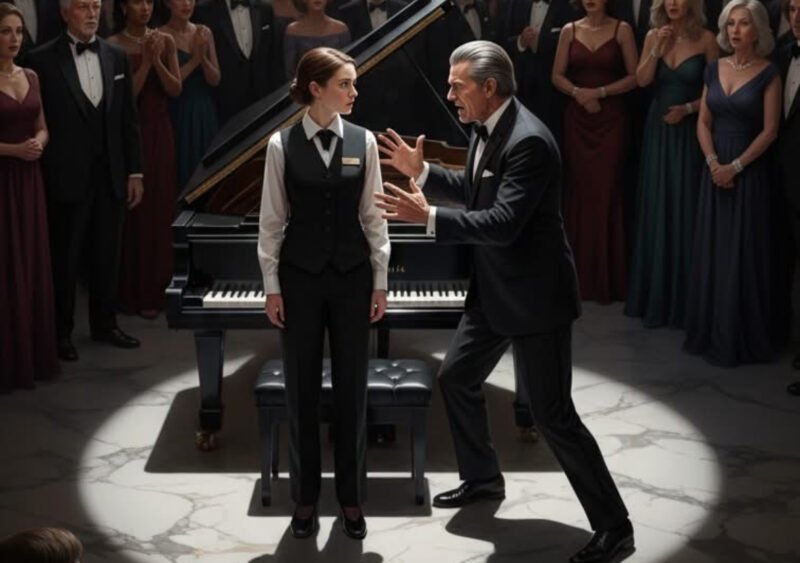
Tonight, the hotel was anything but silent. It was the annual gala for the Children’s Cancer Research Foundation, and the Marble Ballroom was a swirling vortex of champagne, diamonds, and counterfeit laughter. I moved along the edges of the room, my cleaning cloth a familiar weight in my hand, my presence as unremarkable as the potted palms. But I saw everything. I saw the desperation behind the smiles, the loneliness in the eyes of the city’s most powerful figures. And tonight, my gaze was drawn to one man in particular.
He stood near the French doors leading to the terrace, a titan of the tech world named Nathan Cross. I knew of him, of course; his face was plastered on business magazines. At forty-two, he possessed the kind of wealth that reshaped skylines, yet he looked like a man standing on the edge of a precipice. His expensive suit hung on a frame hollowed out by a sorrow so profound it seemed to suck the very light from the air around him. It was a grief I recognized, a mirror to the chasm that had opened in my own life when Carlos died. I knew he had lost his daughter three months ago. A little girl named Sophia. Leukemia.
My fingers, tracing the cool, lacquered wood of the magnificent Steinway grand piano I was tasked with polishing, paused. Before Miguel, before the crushing weight of practicality had demanded I abandon my dreams, I had studied classical music at the University of Washington. Carlos had been my greatest champion, working double shifts so I could practice, his applause the only audience I ever needed. My hands moved unconsciously over the closed lid of the piano, a phantom melody stirring in the muscle memory of my fingers. It was a ghost of a life I no longer lived.
“Nathan, you’ve got to circulate. These people are the lifeblood of our empire,” a voice oozing with false sincerity cut through the din. It was his business partner, Richard Blackwell, a man whose smile never quite reached his predatory eyes.
“I’m fine right here,” Nathan Cross replied, his voice a low growl of fractured ice. His jaw was a tight knot of controlled rage. The world kept spinning, but his had ground to a halt. I understood that feeling all too well.
Richard Blackwell’s gaze swept the room and landed, with disdainful amusement, on me. He leaned in and chuckled to Nathan. “Look at that. Even the help pretends to have a taste for the finer things. I bet she imagines she can actually play that instrument.”
A tremor of humiliation ran through me. I had long grown accustomed to the casual cruelty of the wealthy, their ability to look straight through the people who cleaned up their messes. But tonight, at an event for dying children, the barb struck a raw, exposed nerve.
Something inside Nathan Cross seemed to rupture. All the unspeakable agony of watching his daughter’s small hands grow too frail to press the keys of her own piano, all the fury at a universe that had become arbitrary and cruel, coalesced into a single, venomous point and aimed it directly at me. The grief, having nowhere else to go, transformed into a weapon.
His voice, sharp and loud, sliced through the nearby conversations. “You know what? I bet she thinks she’s some kind of virtuoso.”
He started walking toward me, a man propelled by a storm of his own making. The guests nearby fell silent, their faces turning into a gallery of curious, expectant masks. My cheeks burned. This was a spectacle, and I was the unwilling centerpiece.
“Excuse me,” he said, his voice resonating with a brittle authority that demanded attention. The ballroom was quieting now, a ripple of drama spreading outwards. “My associate here has a theory. He seems to think you harbor a secret talent for this piano. Is there any truth to that?”
My hands froze on the polished mahogany. I could feel the collective weight of their stares, the cruel anticipation of my public humiliation. I was a novelty, a piece of furniture that had suddenly spoken out of turn. “I… I should return to my duties, sir,” I stammered, my voice barely a whisper.
“Oh, but the night is young,” Nathan pressed, stepping closer. There was something about my quiet composure that seemed to enrage him further, as if my refusal to break highlighted the very grace his world had lost. “It’s a simple inquiry. Can you play, or can you not?”
My heart hammered against my ribs like a trapped bird. I saw my supervisor, Mrs. Patterson, hurrying toward me, her face a mask of panic. This job, this fragile stability I had built for Miguel, was hanging by a thread. I could apologize, retreat, and disappear back into the shadows where I belonged.
But then I thought of Carlos. I thought of his calloused hands turning the pages of my sheet music, his proud smile as I mastered a difficult passage. I thought of my sweet Miguel, of the lullabies I’d play for him on an old, out-of-tune keyboard to chase away the nightmares after his father died. Music was not a pretension for me. It was a lifeline. It was the language of my deepest love and my most profound sorrow.
My spine straightened. The fear didn’t vanish, but a different feeling rose to meet it: a fierce, protective dignity.
Cliffhanger: I lifted my chin and met the billionaire’s haunted gaze. The entire ballroom was now watching, a silent theater of the privileged waiting for the cleaning woman to crumble. And in that suffocating silence, I heard myself speak, my voice no longer a whisper, but a clear, steady bell ringing in the charged air. “Actually, sir,” I said, “I would be honored.”
A collective gasp, soft and sibilant, rippled through the ballroom. It was a sound of surprise, of discomfort, of morbid curiosity. Richard Blackwell wore a smirk of triumphant cruelty, convinced he was about to witness a delightful train wreck. Mrs. Patterson looked as though she might faint, her frantic hand gestures for me to stand down going completely ignored. But it was the flicker of uncertainty in Nathan Cross’s eyes that held my attention. My quiet acceptance was not the reaction he had anticipated. He had expected me to shatter, but I had chosen to stand.
With a grace I didn’t know I still possessed, I walked toward the piano. My simple, black uniform was a stark island of austerity in a sea of silk and jewels. Each step felt both impossibly long and terrifyingly short. The marble floor was cold beneath my worn shoes, but a fire was building in my chest. As I lifted the polished fallboard, revealing the pristine expanse of ivory and ebony keys, a hush fell over the room so complete that I could hear the frantic beat of my own heart.
I adjusted the leather bench, my movements slow and deliberate. This was a ritual I hadn’t performed in years, but my body remembered. My hands remembered. This magnificent instrument, a Steinway concert grand, was an old friend I had long thought lost to me.
I turned my head slightly, not to the crowd, but to the broken man who had issued the challenge. “What would you like me to play?” I asked, my voice even.
A muscle twitched in his jaw. “Anything,” he bit out, his bravado beginning to fray at the edges. “Surprise us.”
I closed my eyes. For a single, fleeting moment, the opulent ballroom dissolved. I was no longer a servant on display. I was back in the small apartment Carlos and I had shared, the afternoon sun streaming through the window as I practiced. I could almost smell the sawdust on his clothes and feel the warmth of his hand on my shoulder. “Don’t ever let them silence your music, mi amor,” he used to say. “It’s the part of you that flies.”
When I opened my eyes, the fear was gone, replaced by a quiet resolve. I knew exactly what to play. It was a piece I had been working on when Carlos died, a melody that had since become an elegy, a lullaby, a prayer. It was the vessel for every unspoken word, every unshed tear.
My fingers found their place on the keys. There was a moment of perfect, suspended silence, a breath held by two hundred people. Then, I began.
The first crystalline notes of Chopin’s Nocturne in E-flat Major floated into the air. They were as delicate as spun glass, yet they carried the weight of a lifetime of sorrow. The melody, heartbreakingly beautiful, wrapped itself around the silent room, silencing the clinking of glasses, the rustle of gowns, the very rhythm of breathing. It wasn’t just music; it was a confession.
I saw Nathan Cross’s hand, the one holding a flute of champagne, tighten until his knuckles were white. A wave of recognition, so potent it was almost violent, washed over his features. His face, once a mask of cold fury, began to crumble. This was not just any piece of music. It was her music. It was Sophia’s favorite. It was the song she had been trying to master, her small fingers struggling with the complex passages, before the illness had stolen her strength, her breath, her life.
 The music flowed through me, a current of pure, unvarnished emotion. I poured into those keys my grief for Carlos, my fierce love for Miguel, my years of deferred dreams and silent longing. The piece was a conversation with the ghosts of my past, and as my fingers danced across the keys with a confidence I had thought long buried, I realized I was not just playing for myself. I was playing for him. I was playing for the little girl I had never met.
Cliffhanger: As the music swelled into its most technically demanding passage, the notes cascading through the ballroom like a torrent of sorrow and beauty, I felt a profound shift in the room’s energy. The spectacle had ended. This was something else entirely. I dared a glance at Nathan Cross, and what I saw stopped my breath. He was no longer a titan of industry or a cruel tormentor. He was just a father, his face streaked with tears, watching the ghost of his daughter dance in the melody. The music was not just breaking his heart; it was breaking him open.
The ballroom had ceased to be a room full of people. It had become a sanctuary, a sacred space consecrated by the shared experience of beauty and loss. The air was thick with unspoken histories, with the private griefs of every person present rising to meet the music. I saw women in designer gowns dabbing at their eyes with silk handkerchiefs and hardened businessmen staring at the floor, their carefully constructed facades dissolving note by perfect note. Even Richard Blackwell, the architect of my humiliation, had retreated, his face pale with the dawning, uncomfortable realization that he had stumbled into something far too human for his shallow world.
I kept my eyes closed for much of it, lost in the architecture of the music. It was a cathedral of sound, and inside it, I was safe. I could feel Carlos’s pride, a warm presence at my back. I could see Miguel’s sleeping face, the peace that only music could bring him. Chopin’s Nocturne was a story of love and loss, and tonight, it was my story. It was Nathan Cross’s story. It was the story of anyone who had ever loved something so much that its absence left a permanent, aching void.
As I played, I channeled everything into the performance. My fingers, which had grown rough from cleaning chemicals and hard work, moved with a flawless precision that felt both foreign and deeply familiar. This was who I was meant to be. Not a ghost in the hallways, but a conduit for this sublime, universal language.
Nathan had taken an unconscious step closer, then another. He stood near the curve of the piano, his six-foot frame seeming to shrink under the weight of his sorrow. The anger had been a shield, a clumsy armor against a pain so immense it threatened to annihilate him. But the music had slipped through the cracks. It was dismantling him, piece by painful piece, not to destroy him, but to find the broken man underneath. For three months, he had been trapped in a silent prison of grief, unable to listen to music, unable to feel anything but rage. And now, a stranger in a cleaning uniform was leading him out of the darkness, one heartbreaking note at a time.
I moved into the piece’s climactic passage, my entire body pouring its energy into the keys. The music soared, a crescendo of exquisite agony and release that filled every corner of the vast room. It was the sound of a heart breaking and healing all at once. It was the final, beautiful goodbye he had never gotten to hear.
As the last, lingering notes began to fade, a profound and absolute silence descended once more. It was a silence heavy with emotion, with respect, with a shared and unexpected grace. I let my hands fall from the keys, the final chord hanging in the air like a soul ascending.
I opened my eyes.
The entire ballroom was on its feet, but they were not applauding. They were simply staring, their faces a mixture of awe and contrition. My gaze found Nathan Cross. He stood frozen, his chest heaving, his face a testament to the raw, transformative power of what had just occurred. The walls he had built around his heart had not just been breached; they had been turned to dust. The shame that washed over him was visible, a tidal wave of regret not just for his actions tonight, but for the bitter, hollow man he had allowed his grief to make him.
I felt a sudden return of my own uncertainty. The musician faded, and the cleaning woman, the single mother who desperately needed her job, returned. What happened now?
Nathan took another step forward, his throat working as he tried to form words. “That…” he began, his voice cracking, raw with an emotion he could no longer contain. “That was…”
The silence stretched, thick with unspoken truths. Everyone in that room, from the wealthiest investor to the youngest waiter, was holding their breath, waiting for the verdict. They had witnessed a public shaming transform into a moment of profound beauty, and now, the man who had started it all was about to deliver its conclusion.
Cliffhanger: His eyes, glistening with tears, locked onto mine. He was no longer looking at a servant, but at someone who had spoken the language of his soul. “That was my daughter’s favorite piece,” he whispered, his voice breaking completely. The confession, so simple and so devastating, hung in the air, and in that moment, the chasm between our two worlds vanished entirely.
The words fell into the silent room like stones into a still pool, the ripples spreading out to touch everyone. “She died three months ago,” Nathan continued, his voice barely audible but carrying the weight of an unbearable truth. “Cancer.” He looked down, a tremor running through his body. “She was eight years old, and she loved music more than anything in this world.”
The dam of his composure finally broke. Three months of stoicism, of rage, of denial, came pouring out in a flood of silent, wracking sobs. This powerful, intimidating man, this captain of industry, was weeping like a lost child in a room full of strangers. He wiped at his eyes with a shaking hand. “I haven’t been able to listen to a single note of music since we lost her,” he confessed, his voice thick with unshed grief. “But tonight… the way you played it…” He trailed off, unable to finish. “It felt like I was hearing her say goodbye.”
I rose slowly from the piano bench, my own eyes burning with sympathetic tears. I saw him not as a billionaire, but as a fellow traveler in the desolate landscape of loss. He had lashed out from a place of unimaginable pain, a pain I knew intimately.
“Music is how we keep them alive,” I said softly, the words coming not from me, but through me. It was a wisdom hard-won in the lonely nights after Carlos was gone. “Every note becomes a memory. Every melody, a conversation with the ones who can’t answer back.”
A murmur of understanding went through the crowd. This was no longer a private moment; it was a shared lesson in humanity. Richard Blackwell had faded completely into the background, a ghost at his own party.
Nathan closed the remaining distance between us, his gaze searching my face, stripped of all its earlier arrogance. “I am so sorry,” he said, the words heavy with a shame that was almost palpable. “What I did tonight… my behavior… there is no excuse.”
“You’re angry,” I replied, my voice gentle. There was no need for forgiveness, only for understanding. “When my husband died, I was angry at everyone. Angry at the sun for daring to rise, angry at strangers for laughing in the street while my own world had ended.”
His expression shifted. In my words, he found not an accusation, but a reflection of his own isolated agony. For months, he had been drowning alone. Now, he had found someone else who knew the currents of that dark ocean. He was no longer just a powerful man in pain; he was a grieving father, and I was a grieving wife. In that moment, we were equals.
He hesitated, then found the courage to ask. “Would you… would you play something else? Something hopeful? Something she would have wanted to hear?”
I nodded without a second thought. I returned to the bench, my purpose renewed. This performance was no longer about vindication. It was about healing. I chose Für Elise, a piece that spoke not of sorrow, but of tender, hopeful affection.
As the first familiar notes filled the ballroom, Nathan closed his eyes. I imagined he was seeing his Sophia, not pale and weak in a hospital bed, but vibrant and alive, her small body twirling around their living room, a whirlwind of joy and laughter. The music was a balm, a gentle hand stitching together the frayed edges of his wounded heart. It was a promise that memory could be a source of comfort, not just pain.
For the first time in a long time, I felt the ghost of a smile touch my lips. This was the power Carlos had always seen in me. The power to connect, to soothe, to transform a room with nothing more than ten fingers and a shared melody.
When the final, gentle notes of Für Elise faded, the atmosphere in the room had been irrevocably altered. A soft, respectful applause began, not for a performance, but in gratitude for the healing they had all just witnessed.
Nathan approached me again, his presence entirely changed. The bitter, angry shell was gone, replaced by a man humbled and softened by his own vulnerability. “I need to tell you something,” he said, his voice steady. “Before she got sick, Sophia used her own allowance money to start a small music scholarship fund at the university. She wanted other kids, kids whose parents couldn’t afford lessons, to have the chance to learn.”
My breath caught in my throat.
“The fund has just been sitting there, untouched, since she passed,” he continued, his eyes locking with mine. “I couldn’t bear to think about it. I couldn’t imagine anyone else taking her place at a piano.” He paused, a genuine, bittersweet smile gracing his lips for the first time. “But I think… I know… she would have wanted someone like you to have it.”
The world tilted on its axis. “Sir, I… I don’t understand.”
“The scholarship,” he explained, his voice gentle but firm. “It covers full tuition for a music degree. It includes a stipend for living expenses, enough to ensure your son, Miguel, is taken care of while you finish what you started. Sophia always said that a gift like yours was too beautiful to be wasted in silence. Tonight, you proved her right.”
Tears, not of sorrow but of overwhelming, disbelieving joy, streamed down my face. A future I had buried with Carlos, a dream I had mourned alongside my husband, was being resurrected right before my eyes. “But my job… my son’s school…”
“We will handle all of it,” Nathan assured me, a new light in his eyes. “For months, I’ve been trying to outrun my grief by burying myself in work that feels meaningless. It’s time I started honoring my daughter’s memory by building something that she would have loved.”
Cliffhanger: He offered me a future I had long since packed away in a box of impossible dreams. It was everything I had ever wanted, a gift from a little girl I’d never met, delivered by the man who had tried to break me. But as the crowd applauded this fairytale ending, a single, cold question pierced through my joy: Could I truly build a new life on the foundation of one man’s grief and another’s public humiliation? Or was this beautiful promise simply another gilded trap?
The days that followed that surreal night at the Grand Meridian felt like living in someone else’s dream. Nathan Cross was true to his word, and his resources were formidable. With the quiet efficiency of a man accustomed to reshaping the world to his will, he arranged everything. The Sophia Cross Memorial Scholarship was officially transferred to me. A team helped me find a charming two-bedroom apartment near the University of Washington campus, in a district with a better school for Miguel. There was no gilded trap, only genuine, heartfelt atonement.
Leaving the hotel was bittersweet. Mrs. Patterson hugged me tightly on my last day, tears in her eyes. “You always had music in you, Clare,” she said. “We just couldn’t hear it.” The rest of the staff, who had always been my silent colleagues in the background, treated me with a newfound respect, a quiet awe. I was no longer the invisible cleaning woman. I was the woman who had tamed the broken billionaire with a Chopin Nocturne.
The most difficult and beautiful conversation was with Miguel. I sat him down in our new, sunlit living room, an upright piano—a personal gift from Nathan—standing proudly against one wall. I told him everything: about the gala, about the sad man who missed his daughter, and about the chance I had been given to finish my dream.
His eyes, so like his father’s, grew wide. “You mean… you’re going to be a real piano player, Mom? Like on a stage?”
“I’m going to try, my love,” I said, my voice thick with emotion.
“Dad would be so happy,” he whispered, leaning his head against my shoulder. And in that moment, I knew I had made the right choice. This wasn’t just for me. It was for Carlos, for the legacy of love and belief he had left behind. It was for Miguel, to show him that it is never too late to reclaim a part of yourself you thought was lost forever.
My return to the university was a homecoming. The familiar scent of old books and rosin from the string department, the cacophony of a dozen different instruments practicing at once—it was all exactly as I’d left it, yet I was a different woman. I was no longer a young girl with undefined dreams, but a woman with a purpose forged in loss and rediscovered in an act of unexpected grace.
Nathan and I became unlikely friends, bonded by the shared language of grief. We met for coffee once a month. He spoke of Sophia—her mischievous laugh, her stubborn refusal to practice scales, her deep, intuitive love for music. And I spoke of Carlos—his steady strength, his unwavering faith in me, his terrible singing voice when he’d try to harmonize with my playing. We were two people from different universes, tending to the gardens of our memories together. He was healing, channeling his pain into philanthropy and honoring his daughter’s legacy. He was learning to live with the silence she had left behind.
A year later, I fulfilled the one condition of the scholarship. At the first annual Sophia Cross Memorial Concert, held in the university’s most beautiful recital hall, I was the final performer. The event raised hundreds of thousands of dollars for children’s cancer research and for the music scholarship, which was now large enough to support a dozen other students.
As I walked onto the stage, the spotlight warm on my face, I felt no fear. I looked out into the audience and saw Miguel in the front row, his face glowing with pride, sitting beside a smiling Nathan Cross. I sat at the concert grand, a magnificent instrument donated in Sophia’s name, and took a deep breath.
I did not play Chopin tonight. Instead, I played a piece I had composed myself. It was a melody that began with a whisper of sorrow, a quiet and melancholic theme that spoke of loss and long nights. But then, it slowly began to build, swelling with notes of hope, of resilience, of a love that transcends even death. It ended not on a somber, fading note, but on a bright, triumphant chord that rang through the hall—a sound of promise, of new beginnings.
For I had learned that the most beautiful music doesn’t come from a place of perfect happiness, but from the broken places. It comes from the quiet courage to play your song in a silent room, not knowing who might be listening. And sometimes, if you are very lucky, it becomes a bridge—a bridge from one broken heart to another, a bridge from the past to a future you never dared to imagine. And on that bridge, you learn to fly.