PART 1
When our business became worth millions, they arrived with three suitcases.
“We’re your parents. It’s only fair that we share in what you’ve accomplished,” my mother announced.
She reached for her luggage, expecting me to let her in.
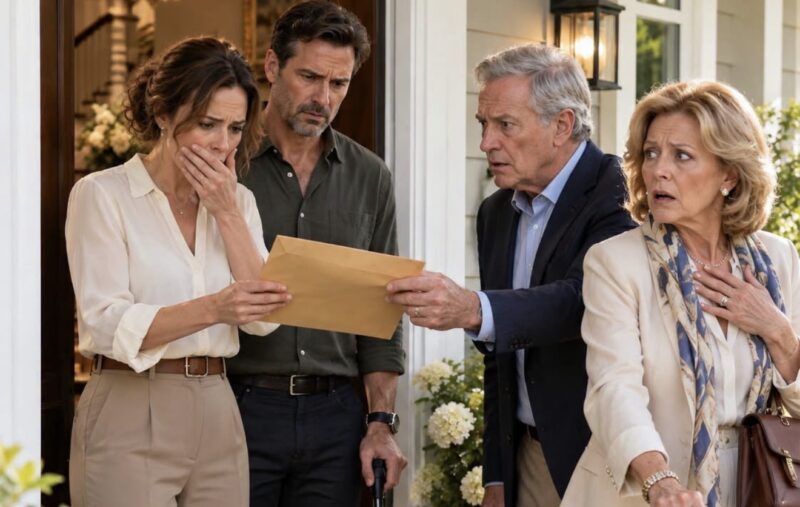
But my father stayed on the porch, clutching an envelope he kept lowering whenever she looked at him.
My parents refused to attend my wedding because my husband was a disabled Army veteran who walked with a cane.
For fourteen years, they treated me as though I no longer existed.
But when they discovered that the business my husband and I had built was worth millions, they appeared at our doorstep with three suitcases.
My mother demanded a bedroom and a share of our success, while my father stood behind her holding an envelope he seemed terrified to give me.
“Five bedrooms, a beautiful house, and a company worth millions,” my mother announced, looking past me into our foyer.
“We’re your parents, Gabriella. It’s only fair that we share in what you’ve accomplished.”
I stared at Patricia Hayes, the woman who hadn’t called me on my birthday or Christmas in fourteen years.
She was standing on my front porch in Raleigh, North Carolina, smiling as though she’d simply returned from a weekend vacation.
“Mom, you can’t just show up and announce you’re moving into our house.”
“Don’t be ridiculous, sweetheart. You have more than enough room.”
Behind her, my father, Arthur, avoided my eyes.
He was holding a large brown envelope against his chest, but whenever my mother glanced at him, he quickly lowered it.
Then I heard the familiar sound of a cane against the hardwood floor.
My husband, Daniel, appeared beside me.
He was forty-five, with a few strands of gray beginning to show at his temples.
An injury sustained during an Army disaster-relief operation had permanently affected his left leg, and although he’d undergone years of rehabilitation, he still needed a cane on difficult days.
My mother’s smile faded.
“Oh,” she said, examining him. “I see you’re still having trouble walking.”
Daniel greeted her politely, but I recognized the hurt behind his expression.
Fourteen years earlier, she’d used that same disability to humiliate him in front of our family.
My name is Gabriella Hayes Bennett.
I’m forty-two years old, a former U.S. Army captain, and the co-owner of a logistics consulting company that my husband and I built from almost nothing.
I grew up in Charlotte, where my father worked as a senior banking executive and my mother devoted herself to charity events, country-club dinners, and maintaining our family’s reputation.
My parents had always been proud of my military career.
They displayed photographs of me in uniform throughout their house and introduced me to friends as their accomplished daughter.
Everything changed when I introduced them to Daniel.
He had served as an Army staff sergeant before an accident during a hurricane-relief mission ended his active-duty career.
By the time we met, he was studying supply-chain management and hoping to use his military experience in civilian logistics.
I fell in love with his patience, humor, and determination.
Six months later, he proposed with a modest diamond ring.
“I can’t promise life will always be easy,” he told me. “But I promise you’ll never have to face the difficult parts alone.”
I accepted without hesitation.
My parents reacted very differently.
During our engagement dinner, my mother questioned Daniel about his disability benefits, employment prospects, and whether he expected me to support him financially.
Daniel answered every question respectfully.
Finally, she put down her wineglass.
“Gabriella, you’re throwing away your future. You could marry a successful man instead of spending your life taking care of someone who can barely walk.”
“Mom, that’s enough.”
She ignored me.
Then she looked directly at Daniel.
“You’re going to become a burden to my daughter. She deserves a husband, not another responsibility.”
Daniel lowered his eyes.
I turned toward my father, waiting for him to defend us.
He said nothing.
My mother leaned forward.
“If you marry this man, don’t expect us to attend the wedding. You’ll have to choose between him and your family.”
I took Daniel’s hand.
“Then I’ve already made my choice.”
We married four months later in a small ceremony attended by twenty-eight friends and relatives.
My parents never came.
For fourteen years, they remained absent from our lives, even when we struggled financially, built our first business, and eventually achieved the success they’d once insisted Daniel could never provide.
Now they were standing at our front door, expecting to enjoy everything we’d earned without them.
My mother reached for the handle of her largest suitcase.
“Well, Gabriella, are you going to invite us inside?”
Before I could answer, my father finally spoke.
“Patricia, we need to tell her the truth.”
My mother turned sharply.
“Arthur, not now.”
But he stepped forward and held out the brown envelope.
“Gabriella, your mother hasn’t told you why we’re really here.”
I looked from his trembling hands to my mother’s suddenly frightened expression.
Then he said something I hadn’t expected.
“We gave up our apartment yesterday. And there’s something about our finances that your mother has been hiding from you.”
CLICK NEXT FOR THE NEXT PART.
Next
PART 2 — WHAT WAS IN THE ENVELOPE
I stood on my own front porch, staring at the brown envelope in my father’s trembling hands, feeling the ground shift beneath a reunion that had already felt unsteady from the moment I’d opened the door.
“Arthur, don’t,” my mother said again, her voice sharper now, edged with something that sounded almost like panic beneath its usual commanding tone.
Track Pregnancy
“I’m not doing this anymore, Patricia,” my father said quietly, not looking at her.
“Fourteen years of doing this your way.
I’m done.”
Daniel’s hand found the small of my back, steady and warm, the way it always was whenever the ground beneath me felt uncertain.
“Why don’t we all come inside,” Daniel said, his voice calm despite everything.
“Whatever this is, I don’t think it needs to happen on the porch.”
I hesitated only a moment before nodding, leading them into our living room, my mother trailing behind with visible reluctance, my father clutching that envelope as though it might somehow protect him from whatever reaction was about to follow.
Track Pregnancy
Once we were seated — my mother perched stiffly on the edge of the sofa, my father beside her, Daniel and I across from them in the armchairs we’d bought together during our third year of marriage, back when every purchase still felt like a small, hard-won victory — my father finally set the envelope on the coffee table between us.
“Open it,” he said.
“Please, Gabriella.
You deserve to know everything before we ask you for anything.”
I picked up the envelope, my hands not entirely steady, and slid out a thick stack of papers.
Foreclosure notices. Three of them, spanning the past eight months, each one more urgent in tone than the last. Credit card statements showing balances deep into six figures. A letter from a bank informing my parents that their retirement accounts had been liquidated to cover outstanding debts, the remaining balance insufficient to cover what was still owed.
“I don’t understand,” I said slowly, looking up at my father.
“Dad, you were a senior banking executive.
You retired with a full pension.
How is any of this possible?”
My father’s eyes were wet, his composure finally cracking after what I suspected had been months, maybe years, of carefully maintained appearances.
“Your mother,” he said quietly, “has had a gambling problem for almost a decade.
I didn’t know how bad it had gotten until it was already too late to fix quietly.”
My mother’s face went white.
“Arthur, that’s not—”
“It’s exactly that, Patricia,” my father said, his voice gaining strength even as it trembled.
“The country club trips that weren’t actually golf retreats.
The ‘investment opportunities’ you kept insisting on pursuing without ever showing me the paperwork.
I found the casino statements eighteen months ago, hidden in a drawer I wasn’t supposed to look through.
By then, you’d already taken out three second mortgages on properties we no longer even owned.”
I sat frozen, trying to absorb the scope of what I was hearing — not simply that my parents had fallen on hard times, but that an entire decade of carefully maintained wealth and status had been secretly, systematically destroyed by exactly the kind of reckless behavior my mother had once accused Daniel of representing.
“You lectured me,” I said slowly, the realization settling over me like cold water, “about marrying someone who might become a financial burden.
While you were secretly bankrupting our entire family.”
My mother’s composure finally broke.
“It’s not the same thing, Gabriella.
I didn’t choose to have a problem.
Your husband chose to be disabled—”
“Mom,” I said sharply, cutting her off before Daniel had to absorb another blow.
“Daniel didn’t choose to get injured saving people during a hurricane.
You chose to gamble away your family’s financial security and then chose to lie about it for a decade.
Those are not remotely comparable.”
Silence fell over the room, heavy and complete.
Daniel, who had remained quiet throughout, finally spoke, his voice gentle but firm.
“Mrs. Hayes, I understand you’re frightened right now.
Losing your home, your security — that’s genuinely terrifying, and I don’t want to minimize that fear.
But I need you to understand something clearly, right now, before this conversation goes any further.
Gabriella doesn’t owe you anything.
Not after fourteen years of silence.
Whatever happens from here forward happens because she chooses it, not because you’re entitled to it.”
My mother’s eyes flashed with old, familiar anger.
“We are her parents.”
“You were her parents,” Daniel said quietly.
“Being someone’s parent isn’t just a biological fact that entitles you to their resources forever, regardless of how you treated them.
It’s something you earn, every single day, through how you actually show up for that person.
You stopped showing up fourteen years ago, the day you told your own daughter to choose between her husband and her family.”
My mother opened her mouth to respond, but my father spoke first, his voice quiet but resolute.
“He’s right, Patricia.
He’s completely right, and it’s taken me entirely too long to find the courage to say so.”
My mother sat in stunned silence, staring at my father as though she were seeing him clearly for the first time in years.
“So that’s it?” she said finally, her voice cracking.
“After thirty-six years of marriage, you’re simply going to side against me, in front of her, after everything I’ve—”
“After everything you’ve what, Patricia?” my father interrupted, his voice steadier now than I’d heard it in years.
“After everything you’ve done to protect this family’s reputation, while secretly destroying its financial foundation?
After everything you’ve sacrificed, while I quietly watched our daughter’s wedding photographs circulate among mutual friends, knowing I’d chosen silence over my own child?”
My mother’s face crumpled, the carefully maintained composure she’d worn since arriving finally giving way entirely.
“I don’t know how to do this,” she said, her voice small.
“I don’t know how to simply admit I was wrong about everything, all at once, in front of everyone.”
“You don’t have to do it all at once,” I said, surprising myself with the gentleness in my own voice, despite everything.
“But you do have to start somewhere, Mom.
Right now, today, would be a reasonable place to begin.”
My mother looked at the papers still spread across our coffee table, at my father beside her, finally honest after fourteen years, at Daniel’s steady presence beside me, at me, sitting across from her, waiting.
“I don’t know where to start,” she admitted.
“Start with why you’re really here,” I said.
“Not the version about sharing in our success.
The actual truth.”
My mother took a long, shuddering breath.
“We have nowhere else to go,” she said finally.
“The apartment is gone.
My sister won’t take us in, not after everything that’s happened with the money I borrowed from her and never repaid.
Your father’s pension is garnished to cover what remains of the debt.
We came here because we were desperate, Gabriella, and because despite everything, despite how badly we’ve treated you, you were still the only people we could think to turn to.”
It was, I realized, the most honest thing my mother had said since arriving on our porch.
“Thank you,” I said quietly.
“For finally telling me the truth.”
Daniel rose and crossed to the window, looking out at the three suitcases still sitting abandoned on our front porch where my parents had left them, forgotten entirely once the real conversation had begun.
“I think we should bring those inside,” he said quietly.
“Whatever else gets decided tonight, it’s getting cold out there, and your parents shouldn’t have to sit here worrying about their belongings on top of everything.”
I nodded, grateful for his steady practicality amid the emotional wreckage of the afternoon, and together we carried the suitcases in from the porch, setting them carefully in our entryway.
“Thank you,” my father said quietly, watching us.
“For that, and for everything else today.
I know none of this is what you expected when we showed up unannounced.”
“No,” I agreed.
“It wasn’t.”
“What happens now?” my mother asked, her voice carrying none of its earlier demanding confidence, replaced instead by genuine uncertainty.
I considered the question for a long moment, looking between my parents — my father, finally honest after fourteen years of cowardly silence, my mother, finally stripped of the careful composure she’d always used to avoid genuine vulnerability.
“Tonight, you’ll stay at a hotel,” I said finally.
“I’ll cover that, for now.
Tomorrow, we’ll talk again, once I’ve had time to actually process everything you’ve told me.
I’m not making any promises beyond that, not yet.
But I’m not closing the door either.
Not completely.”
My mother’s eyes filled with tears, something that looked almost like relief crossing her face.
“Thank you,” she said.
“That’s more than we deserve, honestly, after everything.”
“Probably,” I agreed.
“But I’d rather extend more grace than you’ve earned than less grace than you need.
We’ll figure out the rest together, slowly.”
CLICK NEXT FOR THE NEXT PART.